

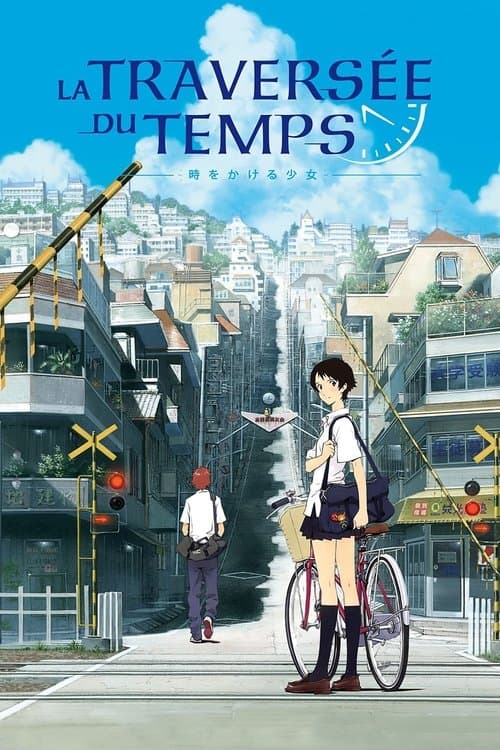
The Girl Who Leapt Through Time
時をかける少女
The Girl Who Leapt Through Time
時をかける少女
Your feedback improves this guide
Your feedback highlights guides that need a second look and keeps the rating trustworthy.
Does this age rating seem accurate to you?
Sign in to vote
Watch-outs
What this film brings
Content barometer
Violence
2/5
Moderate
Fear
2/5
A few scenes
Sexuality
1/5
Allusions
Language
0/5
None
Narrative complexity
3/5
Complex
Adult themes
0/5
None
Expert review
This animated Japanese film follows a high school girl who discovers she can briefly jump back in time, with a lively, emotional atmosphere that gradually becomes more wistful and reflective than action driven. The main sensitive elements involve credible danger, especially around a railroad crossing and a train accident, along with emotional tension caused by unintended consequences and a gentle teenage romance. The intensity is moderate overall, with no graphic violence, no explicit sexual content, and very mild language, yet some scenes may unsettle younger viewers because the threat appears suddenly and the possibility of death feels real. The story also asks for some emotional and narrative maturity, since it deals with regret, responsibility, and complicated time travel choices. For children around age 10, watching with a parent can help them process the suspenseful moments and talk about the film's ideas about growing up, consequences, and feelings.
Synopsis
When 17-year-old Makoto Konno gains the ability to 'leap' backwards through time, she immediately sets about improving her grades and preventing personal mishaps. However, she soon realises that changing the past isn't as simple as it seems, and eventually, will have to rely on her new powers to shape the future of herself and her friends.
Difficult scenes
The most striking moment comes when Makoto is placed in serious danger at a railroad crossing after losing control of her bicycle as a train approaches. The scene is brief and not graphic, but the staging makes the impact feel very real, which may be upsetting for sensitive children, especially because the danger appears suddenly. Later, the same accident risk affects other teenagers using the same faulty bicycle near the train crossing. The tension is stronger because Makoto understands what is about to happen and tries to stop it, which can create a real sense of urgency and helplessness for younger viewers. Another sensitive element comes from the emotional consequences of time leaping. Makoto changes ordinary moments to avoid embarrassment or fix problems, then realizes that her choices can shift hardship onto other people, creating a gentle but noticeable feeling of sadness and regret. The film also includes an awkward romantic confession and several scenes of teenage emotional confusion. Nothing is explicit, but these moments may require some maturity because they involve rejection, embarrassment, and feelings that are difficult for the characters to express.
Where to watch
No verified platform for the US market yet. We keep this section updated as availability changes.
Availability checked on Apr 01, 2026
About this title
- Format
- Feature film
- Year
- 2006
- Runtime
- 1h 44m
- Countries
- Japan
- Original language
- JA
- Directed by
- Mamoru Hosoda
- Main cast
- Riisa Naka, Takuya Ishida, Mitsutaka Itakura, Ayami Kakiuchi, Mitsuki Tanimura, Yuki Sekido, Utawaka Katsura, Midori Ando, Fumihiko Tachiki, Keiko Yamamoto
- Studios
- Madhouse, Happinet Pictures, KADOKAWA, KADOKAWA Shoten, Q-TEC, Memory-Tech, Studio Chizu
Content barometer
Violence
2/5
Moderate
Fear
2/5
A few scenes
Sexuality
1/5
Allusions
Language
0/5
None
Narrative complexity
3/5
Complex
Adult themes
0/5
None
Expert review
This animated Japanese film follows a high school girl who discovers she can briefly jump back in time, with a lively, emotional atmosphere that gradually becomes more wistful and reflective than action driven. The main sensitive elements involve credible danger, especially around a railroad crossing and a train accident, along with emotional tension caused by unintended consequences and a gentle teenage romance. The intensity is moderate overall, with no graphic violence, no explicit sexual content, and very mild language, yet some scenes may unsettle younger viewers because the threat appears suddenly and the possibility of death feels real. The story also asks for some emotional and narrative maturity, since it deals with regret, responsibility, and complicated time travel choices. For children around age 10, watching with a parent can help them process the suspenseful moments and talk about the film's ideas about growing up, consequences, and feelings.
Synopsis
When 17-year-old Makoto Konno gains the ability to 'leap' backwards through time, she immediately sets about improving her grades and preventing personal mishaps. However, she soon realises that changing the past isn't as simple as it seems, and eventually, will have to rely on her new powers to shape the future of herself and her friends.
Difficult scenes
The most striking moment comes when Makoto is placed in serious danger at a railroad crossing after losing control of her bicycle as a train approaches. The scene is brief and not graphic, but the staging makes the impact feel very real, which may be upsetting for sensitive children, especially because the danger appears suddenly. Later, the same accident risk affects other teenagers using the same faulty bicycle near the train crossing. The tension is stronger because Makoto understands what is about to happen and tries to stop it, which can create a real sense of urgency and helplessness for younger viewers. Another sensitive element comes from the emotional consequences of time leaping. Makoto changes ordinary moments to avoid embarrassment or fix problems, then realizes that her choices can shift hardship onto other people, creating a gentle but noticeable feeling of sadness and regret. The film also includes an awkward romantic confession and several scenes of teenage emotional confusion. Nothing is explicit, but these moments may require some maturity because they involve rejection, embarrassment, and feelings that are difficult for the characters to express.