

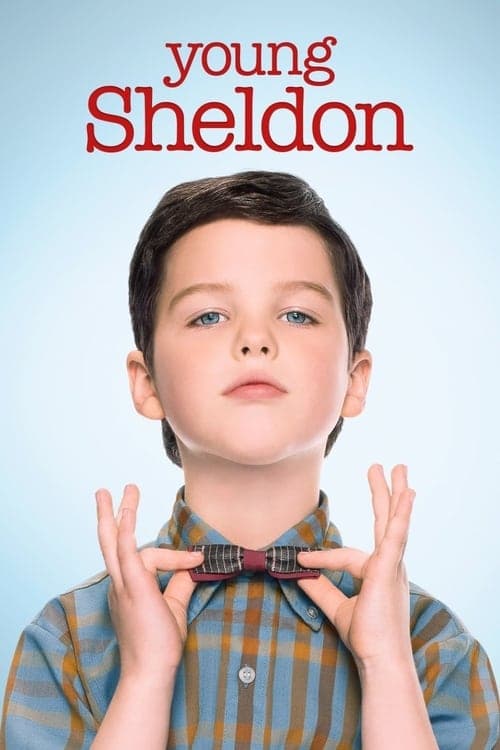
Young Sheldon
Does this age rating seem accurate to you?
Detailed parental analysis
Young Sheldon is a warm family comedy that is far from naive, telling the story of Sheldon Cooper's childhood in 1980s Texas as a 9-year-old child prodigy who enters high school and attempts to find his place in a family and community that bear no resemblance to him. The overall atmosphere is light and nostalgic, carried by subtle humour and well-drawn characters, but as the seasons progress the series ventures into distinctly more adult territory. The show targets a broad family audience from adolescence onwards, even though its main character is a child.
Underlying Values
The series builds its narrative on solid values: the courage to be different, the worth of intellectual endeavour, and the ability to adapt without betraying oneself. Sheldon embodies an avowed non-conformism that ultimately earns the respect of those around him. Family dynamics emphasise mutual support despite friction, and the mother-son relationship is presented as fundamental emotional anchorage. Conversely, the series carries a less obvious tension: intelligence is sometimes treated as a natural hierarchy, with Sheldon looking down on those he judges less brilliant, including his loved ones. This arrogance is often played for laughs without ever truly being questioned, which is worth flagging to the child viewer. Religion is addressed recurrently and fairly even-handedly, between the mother's sincere belief and Sheldon's avowed scepticism, without either camp being clearly ridiculed.
Substances
Alcohol consumption is present throughout the series and normalised in adult everyday life: the father drinks beer regularly, the grandmother drinks rosé as a background habit, and bar scenes recur frequently. This receives no explicit narrative critique. Smoking, by contrast, is treated differently: the grandmother smokes constantly but the series visually associates this habit with coughing fits, indirectly signalling its negative effects. Two adolescents smoke briefly in one episode, without particular glorification. An allusion to the grandmother buying marijuana is slipped in humorously without development. The overall substance picture is that of a series for adults, even though the main characters are children.
Parental and Family Portrayals
The Cooper family is the true centre of gravity of the series. Father George is a nuanced character, loving but flawed, whose marital tensions and professional difficulties worsen as the seasons progress. His death, evoked in later seasons, is handled with genuine emotional depth and gives rise to episodes that can touch children who have experienced parental bereavement. The mother is presented as a sincere emotional anchor, sometimes suffocating, but never ridiculous. The adolescent pregnancy of older brother Georgie constitutes a central narrative arc in later seasons, treated with an unexpectedly serious tone for a comedy. These dimensions make the series fertile ground for concrete family discussions, provided the parent anticipates these subjects.
Discrimination
Two representations raise questions. Vietnamese-American friend Tam is defined almost exclusively by his identity as a refugee: his family's history of clandestine passage and his Catholic customs are treated as exotic traits, and Sheldon comments on them with a condescension presented as ingenuousness. The character never truly escapes this function as cultural foil. Moreover, an overweight child character is cast as a brute without intelligence or personality nuance, which amounts to an unquestioned stereotype in the narrative. Both cases are worth naming explicitly with the child viewer.
Sex and Nudity
Sexual content remains implicit and never explicit, but it is present recurrently. Parents are seen in bed, without visible nudity but with dialogue that makes the context clear. Later seasons introduce themes of adult romantic relationship with a more mature tone, notably around Georgie's adolescent pregnancy. Nothing shocking in itself, but the series is not designed for children under 10 years old on this aspect.
Language
Language is regularly crude for a family comedy broadcast in access prime time. Phrases such as 'damn', 'ass', 'hell', 'bitch' or 'son of a bitch' recur frequently in the mouths of adults, without being exceptional or particularly developed narratively. It is a soundscape worth flagging for families sensitive to register of language, but nothing that constructs an aggressive norm.
Strengths
The series sustains itself over time through writing that avoids the easy trap of pure nostalgia: it builds credible secondary characters, notably grandmother Meemaw, whose comedic register masks genuine complexity. Sheldon's intelligence is staged with a precision rare for a sitcom: references to physics, mathematics and the history of science are accurate and accessible, making it a concrete vehicle for intellectual awakening for a curious child. The voiceover of adult Sheldon establishes emotional distance that allows heavy subjects (bereavement, academic failure, social isolation) to be addressed with humour without distorting them. The reconstruction of 1980s Texas, the dynamic between faith and rationalism, and the portrait of provincial America seen through the eyes of a misfitting child give the series an authentic sociological texture.
Age recommendation and discussion points
The series is accessible from age 10 for the early seasons, with parental accompaniment recommended to address language, alcohol and early sexual allusions. Seasons 4 to 7, darker and more adult, are better suited from ages 12 to 13 onwards. Two discussion angles deserve preparation: first, the question of intelligence as a relationship to others, with Sheldon believing himself superior to those who do not resemble him, which is worth interrogating; secondly, the stereotypes attached to Tam and the overweight character, which the series never questions of its own accord and which the parent can invite the child to spot and name.
Synopsis
The early life of child genius Sheldon Cooper, later seen in The Big Bang Theory.
Where to watch
Availability checked on Apr 16, 2026
About this title
- Format
- TV series
- Year
- 2017
- Countries
- United States of America
- Original language
- EN
- Directed by
- Steven Molaro, Chuck Lorre
- Main cast
- Iain Armitage, Zoe Perry, Lance Barber, Montana Jordan, Raegan Revord, Annie Potts, Emily Osment, Jim Parsons
- Studios
- Warner Bros. Television, Chuck Lorre Productions
Content barometer
- Violence1/5Mild
- Fear1/5Mild
- Sexuality2/5Mild
- Language2/5Moderate
- Narrative complexity2/5Moderate
- Adult themes3/5Marked
Watch-outs
- Grief
- Alcohol
- Strong language
- Ethnic or racial stereotypes
- Death / grief
Values conveyed
- Courage
- Acceptance of difference
- difference and uniqueness
- intelligence and curiosity
- family bonds
- perseverance
- tolerance
- gentle humor