
X-Men '97
Does this age rating seem accurate to you?
Detailed parental analysis
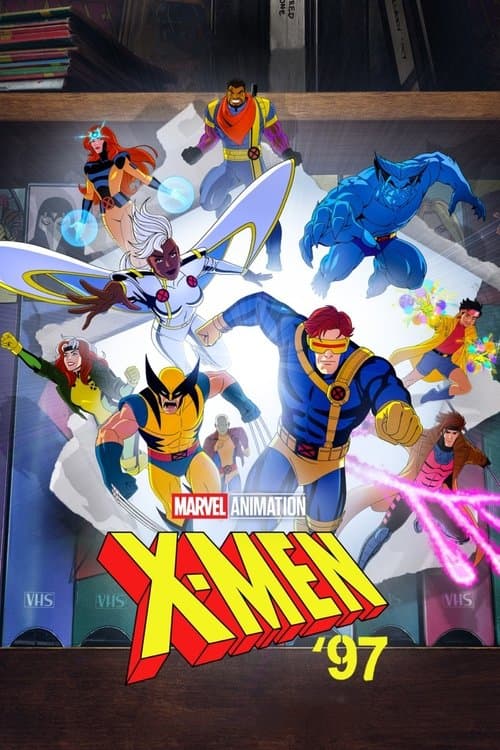
X-Men '97 is a superheroic animated series with a dark and emotionally dense tone, a direct revival of the 1990s animated series. It follows the X-Men team as they attempt to uphold Charles Xavier's vision of peace in a world increasingly hostile to mutants. The series primarily targets teenagers and adults, particularly those who grew up with the original version, but it can reach children from 10-11 years old with parental guidance.
Violence
Violence is the series' primary point of concern. Episode 5 represents a traumatic peak: the Genosha massacre is depicted with rare intensity for superheroic animation, including deaths of major characters, visible blood and large-scale graphic destruction. This is not background or stylised violence at a distance: it is direct, emotionally charged and designed to provoke genuine narrative shock. The rest of the series maintains a sustained level of action with regular confrontations, but without reaching this intensity. The violence is not gratuitous: it serves to illustrate the concrete consequences of hatred and fanaticism, which gives it solid narrative purpose, but does not lighten it for younger viewers nonetheless.
Social Themes
Systemic discrimination, the persecution of a minority and political responses to difference form the thematic heart of the series. The Genosha genocide functions explicitly as a metaphor for real historical violence against marginalised groups. The series poses concrete political questions: should one seek integration or autonomy? Is armed resistance legitimate in the face of oppression? These questions run through the arcs of Magneto and the X-Men without univocal answers, making them particularly rich material for discussion with teenagers.
Underlying Values
The series puts two worldviews in tension: Xavier's, founded on dialogue and coexistence, and Magneto's, founded on survival and resistance. Neither is presented as absolutely right, which avoids the usual manichaeism of the genre. Collective solidarity, sacrifice and loyalty to the group are consistently valued. Revenge appears as a genuine narrative temptation for several characters, but it is systematically put into perspective by its consequences, without being glorified.
Discrimination
Discrimination is the explicit engine of the narrative: mutants are persecuted, registered, massacred and treated as a threat to be eradicated. The series does not merely evoke this treatment in the background: it shows its psychological effects on characters and the institutional mechanisms that make it possible. The representation of Morph as a non-binary character has provoked contrasting reactions among fans, but the series integrates it without making it a spectacular issue: it is a discreet writing choice, which can nonetheless open a natural conversation with a child or teenager.
Parental and Family Portrayals
The parental figure is central to several arcs: Xavier is an absent paternal figure whose legacy structures the entire group dynamic, and the series questions what it means to perpetuate the vision of a departed mentor. Cyclops and Jean Grey navigate direct family issues that touch on parenthood and loss. These representations are nuanced and far removed from the usual archetypes of the superheroic genre.
Language
Language remains moderate for a series aimed at a teenage audience. A few colloquial or mildly vulgar terms punctuate the dialogue without constituting a dominant register. Nothing that warrants particular concern beyond the recommended age.
Strengths
X-Men '97 is a remarkably well-written animated series for the superheroic genre. It treats its characters with unusual psychological depth, grants them lasting contradictions and does not resolve its moral tensions through shortcuts. Episode 5 in particular achieves a dramatic intensity that far exceeds the usual standards of animation for young audiences, and has left a lasting mark on adult viewers. The series succeeds in being both a faithful nostalgic object true to its source material and an autonomous work capable of surprising. It offers teenagers concrete access to complex political and ethical questions, without simplifying or moralising them.
Age recommendation and discussion points
The series is not recommended before age 10 due to the violence in certain episodes, particularly the Genosha massacre, which can be traumatic for younger children. From age 12 onwards, viewing is straightforward for an accompanied teenager, and fully suitable from age 14 onwards in autonomy. Two angles of discussion are worth opening after viewing: why certain characters choose violent resistance in the face of oppression, and what this says about the legitimacy of force as a response to injustice; and how the series represents difference not as a problem to be solved, but as a reality that society chooses to treat as an enemy.
Synopsis
The X-Men, a band of mutants who use their uncanny gifts to protect a world that hates and fears them, are challenged like never before, forced to face a dangerous and unexpected new future.
Where to watch
Availability checked on Jul 02, 2026
About this title
- Format
- TV series
- Year
- 2024
- Countries
- United States of America
- Original language
- EN
- Studios
- Marvel Studios
Content barometer
- Violence4/5Strong
- Fear4/5Intense
- Sexuality1/5Allusions
- Language1/5Mild
- Narrative complexity1/5Accessible
- Adult themes0/5None
Watch-outs
- Death
- Violence