
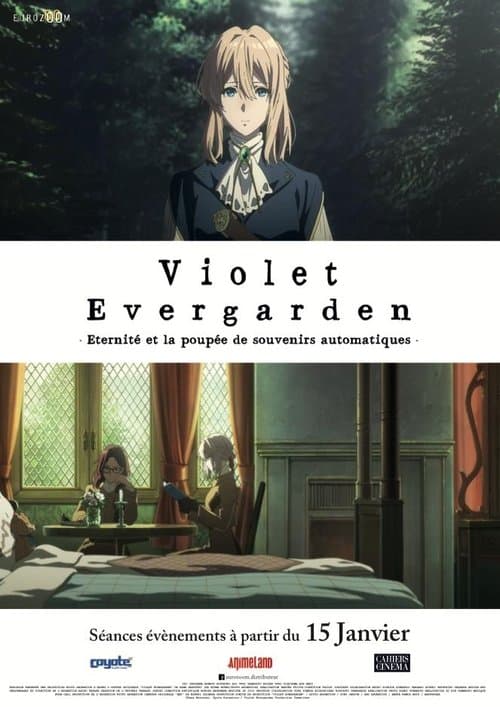
Violet Evergarden: Eternity and the Auto Memory Doll
ヴァイオレット・エヴァーガーデン 外伝 - 永遠と自動手記人形 -
Does this age rating seem accurate to you?
Detailed parental analysis
Violet Evergarden: Eternity and the Auto Memory Doll is a Japanese animated film with a contemplative and melancholic tone, driven by rare emotional sensitivity. The plot follows Violet, a young woman with a past as a soldier turned professional scribe, tasked with teaching her craft to a well-born teenager whose deeply intertwined relationship with her sister will gradually be revealed. The film is aimed primarily at teenagers and adults, particularly fans of the animated television series of the same name, although it can work as a self-contained entry point into this universe.
Underlying Values
The film builds its entire premise around the capacity to put words to what one feels and to express what one dare not say to those one loves. The profession of Auto Memory Doll, scribes who write letters on behalf of those who cannot write their hearts, becomes a powerful narrative device to explore emotional communication, emotional restraint and the value of family bonds. Loyalty, quiet sacrifice and care for another are presented as concrete virtues, embodied in actions rather than declared. The film does not moralise: it shows, soberly, what it means to care for someone.
Parental and Family Portrayals
The central relationship between the two sisters Taylor and Amy is the true emotional engine of the narrative. The film explores with subtlety the dynamics of a sibling bond made of unspoken sacrifices, painful separations and love that struggles to express itself directly. The adoptive family figure is also present through the bonds Violet maintains with those around her, quietly reminding us that family is built also through choice and loyalty rather than blood alone. These representations offer genuine material for conversation with a child or teenager about what it means to be family.
Social Themes
Violet's past as a child soldier is not depicted in this film but constitutes a background that fans of the series will know. This subtle presence poses, without illustrating it visually, the question of what war does to the most vulnerable individuals, and the possible reconstruction after a violent past. The film treats grief and loss not as taboos but as realities to be navigated, making it a potentially useful conversation tool with a teenager facing these questions.
Violence
Violence is virtually absent from the film itself. Violet's military past is evoked contextually but never shown in an explicit or graphic manner. The narrative tensions are emotional, not physical. For younger viewers, the intensity comes from the register of grief and separation, not from violent imagery.
Strengths
The film achieves remarkable emotional quality by grounding its intensity not in emphatic stylistic flourishes but in the writing of its characters and the precision of their relationships. The progression of the two narrative arcs, that of Violet and that of the two sisters, is constructed with genuine mastery of pacing and restraint. The animation offers settings of great visual beauty that serve the contemplative purpose without overwhelming it. For a teenager at an age to question emotional communication and the complexity of family bonds, this film constitutes a substantial narrative experience, far beyond mere entertainment.
Age recommendation and discussion points
The film is accessible from age 10 for sensitive children accustomed to works with sustained emotional register, but reaches its full meaning and depth from ages 12-13 onwards. After viewing, two discussion angles naturally present themselves: why is it so difficult to tell those we love what we truly feel, and what are we willing to sacrifice to protect someone in our family?
Synopsis
Violet Evergarden comes to a private women's academy to tutor Isabella in the ways of being a lady. Heir to the York family, Isabella feels trapped in this new and uncomfortable world. She still grieves for the only person to ever bring her happiness – now lost to her. Violet's lessons do give her a brief respite from the melancholy but with the absence of joy, how long does it take to truly heal?
About this title
- Format
- Feature film
- Year
- 2019
- Runtime
- 1h 30m
- Countries
- Japan
- Original language
- JA
- Directed by
- Haruka Fujita
- Main cast
- Yui Ishikawa, Minako Kotobuki, Aoi Yuuki, Koki Uchiyama, Takehito Koyasu, Aya Endo, Minori Chihara, Haruka Tomatsu, Azusa Tadokoro, Hana Takeda
- Studios
- Kyoto Animation, Pony Canyon, ABC Animation, Bandai Namco Arts
Content barometer
- Violence1/5Mild
- Fear1/5Mild
- Sexuality0/5None
- Language0/5None
- Narrative complexity2/5Moderate
- Adult themes0/5None
Watch-outs
- Grief
- Death / grief
Values conveyed
- Compassion
- Loyalty
- Forgiveness
- sisterly love
- separation and reunion
- learning and perseverance
- sacrifice out of love
- emotional healing
- female solidarity