

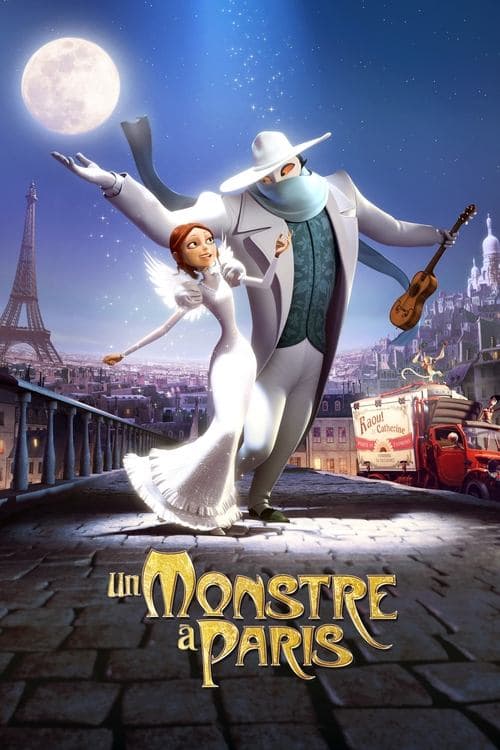
A Monster in Paris
A Monster in Paris
Your feedback improves this guide
Your feedback highlights guides that need a second look and keeps the rating trustworthy.
Does this age rating seem accurate to you?
Sign in to vote
Watch-outs
What this film brings
Content barometer
Violence
2/5
Moderate
Fear
2/5
A few scenes
Sexuality
1/5
Allusions
Language
1/5
Mild
Narrative complexity
1/5
Accessible
Adult themes
1/5
Mild
Expert review
A Monster in Paris is a family animated adventure with a whimsical tone, an old Paris setting, musical performances, and a chase story built around a creature first seen as frightening. The main sensitive elements are several mild scare scenes, a laboratory explosion, chase sequences with moments of peril, a threatening authority figure, and a slightly dark mood created by public panic. Everything remains highly stylized, with no graphic violence and no significant adult content, and the tense moments are softened by humor, songs, and the gradual discovery that the monster is not truly dangerous. For most children, this works better from around age 7, because very young viewers may still be unsettled by the creature's design, the hunt scenes, and some darker nighttime sequences. Parents can help by explaining in advance that the story is partly about learning not to judge someone only by how they look.
Synopsis
Paris, 1910. Emile, a shy movie projectionist, and Raoul, a colourful inventor, find themselves embarked on the hunt for a monster terrorizing citizens. They join forces with Lucille, the big-hearted star of the Bird of Paradise cabaret, an eccentric scientist and his irascible monkey to save the monster, who turns out to be an oversized but harmless flea, from the city's ruthlessly ambitious police chief.
Difficult scenes
Early in the story, a visit to the laboratory goes wrong when odd experiments trigger strange effects and then a sudden explosion. The sequence stays cartoonish and shows no realistic injury, but the noise, confusion, and abrupt appearance of an unknown creature may startle younger children. Several scenes show the people of Paris frightened by the supposed monster, with alarming newspaper reports, panicked reactions, and a general atmosphere of pursuit. This collective fear can be unsettling, especially because the creature is first presented as a shadowy and mysterious presence before the audience learns more about it. Commissioner Maynott serves as an authoritarian and manipulative antagonist, and he pushes the hunt for the monster to support his own ambitions. His threatening behavior, forceful orders, and the way he pressures other characters may be more disturbing than the creature itself for sensitive viewers. In the later part of the film, there is a fast paced chase through Paris with a stronger sense of danger, including scenes at great height and the use of a firearm. The presentation still fits family viewing, but the tension rises clearly and younger children may need reassurance from an adult.
Where to watch
No verified platform for the US market yet. We keep this section updated as availability changes.
About this title
- Format
- Feature film
- Year
- 2011
- Runtime
- 1h 22m
- Countries
- France, Belgium
- Original language
- FR
- Directed by
- Bibo Bergeron
- Main cast
- Vanessa Paradis, Matthieu Chedid, Gad Elmaleh, François Cluzet, Ludivine Sagnier, Julie Ferrier, Bruno Salomone, Sébastien Desjours, Philippe Peythieu, Allan Wenger
- Studios
- EuropaCorp, Bibo Films, France 3 Cinéma, Walking The Dog, uFilm, uFund
Content barometer
Violence
2/5
Moderate
Fear
2/5
A few scenes
Sexuality
1/5
Allusions
Language
1/5
Mild
Narrative complexity
1/5
Accessible
Adult themes
1/5
Mild
Expert review
A Monster in Paris is a family animated adventure with a whimsical tone, an old Paris setting, musical performances, and a chase story built around a creature first seen as frightening. The main sensitive elements are several mild scare scenes, a laboratory explosion, chase sequences with moments of peril, a threatening authority figure, and a slightly dark mood created by public panic. Everything remains highly stylized, with no graphic violence and no significant adult content, and the tense moments are softened by humor, songs, and the gradual discovery that the monster is not truly dangerous. For most children, this works better from around age 7, because very young viewers may still be unsettled by the creature's design, the hunt scenes, and some darker nighttime sequences. Parents can help by explaining in advance that the story is partly about learning not to judge someone only by how they look.
Synopsis
Paris, 1910. Emile, a shy movie projectionist, and Raoul, a colourful inventor, find themselves embarked on the hunt for a monster terrorizing citizens. They join forces with Lucille, the big-hearted star of the Bird of Paradise cabaret, an eccentric scientist and his irascible monkey to save the monster, who turns out to be an oversized but harmless flea, from the city's ruthlessly ambitious police chief.
Difficult scenes
Early in the story, a visit to the laboratory goes wrong when odd experiments trigger strange effects and then a sudden explosion. The sequence stays cartoonish and shows no realistic injury, but the noise, confusion, and abrupt appearance of an unknown creature may startle younger children. Several scenes show the people of Paris frightened by the supposed monster, with alarming newspaper reports, panicked reactions, and a general atmosphere of pursuit. This collective fear can be unsettling, especially because the creature is first presented as a shadowy and mysterious presence before the audience learns more about it. Commissioner Maynott serves as an authoritarian and manipulative antagonist, and he pushes the hunt for the monster to support his own ambitions. His threatening behavior, forceful orders, and the way he pressures other characters may be more disturbing than the creature itself for sensitive viewers. In the later part of the film, there is a fast paced chase through Paris with a stronger sense of danger, including scenes at great height and the use of a firearm. The presentation still fits family viewing, but the tension rises clearly and younger children may need reassurance from an adult.