Truant Officer Donald
Does this age rating seem accurate to you?
Detailed parental analysis
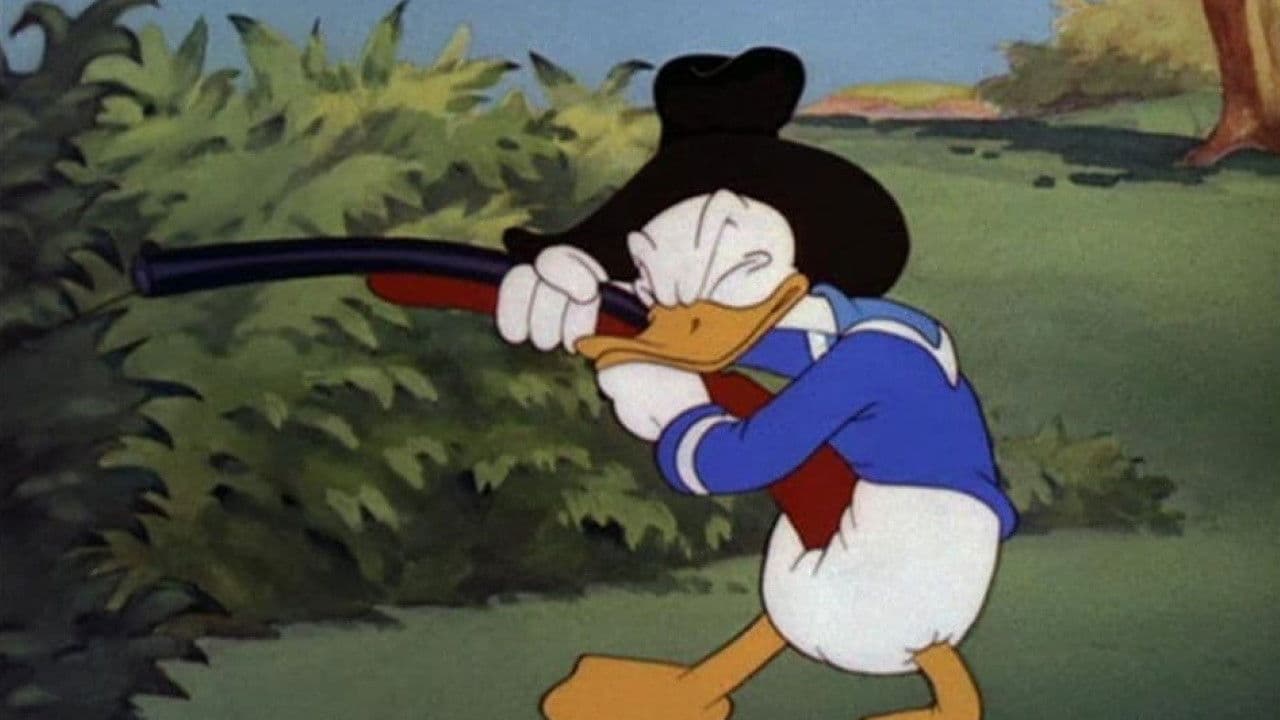
Donald's Park Ranger is a Disney animated short with a brisk pace and the atmosphere of an unbridled chase comedy. The story follows Donald, tasked with bringing his recalcitrant nephews to school, who finds himself confronted by their ingenuity and their sense of resistance. The film aims at a broad family audience, but its content proves more striking than it appears at first glance.
Violence
Violence is the central comedic engine of the film and is markedly more intense than the average Disney short of the era. Donald uses a suction cup gun against his nephews, attempts to smoke them out by setting fire to the entrance of their cabin, and beats them violently when he discovers their latest trick. The nephews, for their part, use penknives to escape from a locked van and fire a cannon at Donald. One scene involves an object inserted from behind in a deliberately humiliating manner. The whole thing is treated in a burlesque style and without realistic consequences, but the frequency and variety of the assaults far exceed the threshold of simple cartoon scrapping. For younger children, the succession of these gags can normalise aggressive acts under the guise of comedy, without the narrative ever questioning their legitimacy.
Underlying Values
The film maintains a structural ambiguity on the question of authority. Donald officially embodies the camp of compulsory schooling and education, a value he proclaims loudly and clearly, but his methods are coercive, disproportionate and frankly violent. The nephews, meanwhile, are presented as ingenious, supportive and skilled, and their victory over the adult is clearly staged as satisfying for the viewer. The narrative thus implicitly values resistance to authority when that authority is exercised by force, which is not in itself a problematic message, but deserves to be named. The question of whether school is worth defending, and how, remains entirely out of frame.
Parental and Family Portrayals
Donald plays here the role of a substitute parental authority figure, and he offers a frankly poor portrait of it: impulsive, brutal, unable to keep his composure, and quick to resort to force long before any attempt at dialogue. The scene in which he believes he has caused his nephews' death by fire and collapses in guilt is the film's only moment of genuine emotion, but it is immediately erased by a return to violence as soon as the deception is revealed. This portrait of an adult incapable of regulating his emotions and actions can be discussed with a child as a counter-example.
Strengths
The film bears witness to a genuine sense of pacing and a well-mastered escalating construction, each gag building on the previous one with coherent internal logic. The animation work on Donald's expressions remains a model of the genre, rendering every burst of rage or emotional collapse immediately legible. For an older child or adolescent, the short also functions as a document of humour from the era and its limits: it allows one to question what made audiences laugh in 1941 and why certain gags seem frankly excessive today.
Age recommendation and discussion points
The film is to be reserved from age 7 onwards, ideally accompanied by an adult for the younger end of this age group. Two angles of discussion are worth pursuing after viewing: why are the nephews presented as the heroes when they refuse to go to school, and does an authority that uses force deserve to be respected or circumvented?
Synopsis
Donald catches his nephews swimming on a school day. He thinks he's made an easy catch, but the boys are much more resourceful than that. When he tries to smoke them out of their clubhouse, they put three roast turkeys in their bed and dress one boy as an angel.
About this title
- Format
- Short film
- Year
- 1941
- Runtime
- 7m
- Countries
- United States of America
- Original language
- EN
- Directed by
- Jack King
- Main cast
- Clarence Nash
- Studios
- Walt Disney Productions
Content barometer
- Violence3/5Notable
- Fear2/5A few scenes
- Sexuality0/5None
- Language0/5None
- Narrative complexity0/5Simple
- Adult themes0/5None
Watch-outs
- Violence
- Abuse
Values conveyed
- Courage
- family
- resourcefulness
- humor