
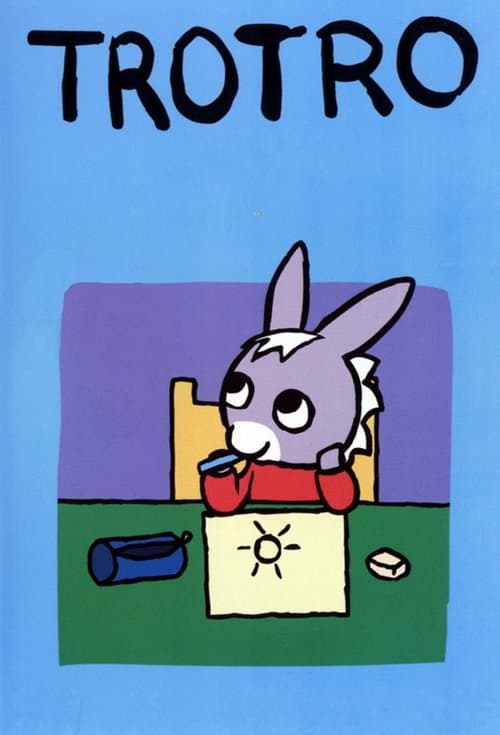
Trotro
Does this age rating seem accurate to you?
Detailed parental analysis
Trotro is a short, light animated series with a warm and colourful atmosphere, intended for very young children. Each episode, lasting just a few minutes, follows a mischievous little donkey who explores the world in his own way, gets into mischief and learns from his everyday experiences. The target audience is clearly young children, from early childhood onwards.
Underlying Values
The narrative structure of each episode rests on a simple pedagogical pattern: Trotro misbehaves, the consequences follow naturally, and the lesson emerges of its own accord without heavy-handed moralising. Autonomy and experimentation are presented as normal drivers of a child's development. Friendship and sharing appear regularly as underlying values, without being hammered home. This model of learning through experience is consistent with the development of young children and offers a good starting point for simple conversations after viewing.
Parental and Family Portrayals
Trotro's mother is present and caring, but her role is limited to domestic spaces, with cooking and laundry at the forefront. She never scolds Trotro despite his repeated mischief, which raises questions about the place of boundaries and authority in education as the series represents it. This narrative choice, probably deliberate to avoid any anxiety in the very young viewer, has the side effect of erasing the parental figure as an agent of regulation. This is a useful point to address with the child: in real life, adults set rules, and that is normal.
Discrimination
The series reproduces fairly conventional gendered representations: the mother confined to household tasks, boys roughhousing, girls playing with dolls. These stereotypes are not questioned or challenged by the narrative; they are simply present as a natural backdrop. For a very young child, these images contribute to the construction of representations of the world. An attentive parent can simply name what they see and broaden the conversation.
Strengths
The series has the merit of its form: very short episodes, perfectly calibrated for the concentration span of a child aged two to four, with a gentle pace and situations immediately recognisable from everyday life. Identification with Trotro is easy and healthy, the character being neither perfect nor punished, simply alive. The absence of violence, fear and disturbing content makes it a serene viewing space for very young children. The graphic and narrative simplicity is not a flaw at this age: it leaves room for imagination and projection.
Age recommendation and discussion points
The series is suitable from age 2 and provides a gentle and risk-free introduction to viewing for very young children. Two angles of discussion are worth exploring with the child: asking him what he would have done in Trotro's place, to anchor the notion of consequence, and pointing out to him that in real life, mums and dads do lots of different things, not just cooking or housework.
Synopsis
Trotro the donkey's adventures.
About this title
- Format
- TV series
- Year
- 2004
- Countries
- France, United States of America
- Original language
- FR
- Directed by
- Bénédicte Guettier
- Main cast
- Florine Orphelin, Caroline Combes
- Studios
- 2 Minutes, Storimages, TPS Jeunesse
Content barometer
- Violence0/5None
- Fear0/5None
- Sexuality0/5None
- Language0/5None
- Narrative complexity1/5Accessible
- Adult themes0/5None
Watch-outs
- Gender stereotypes