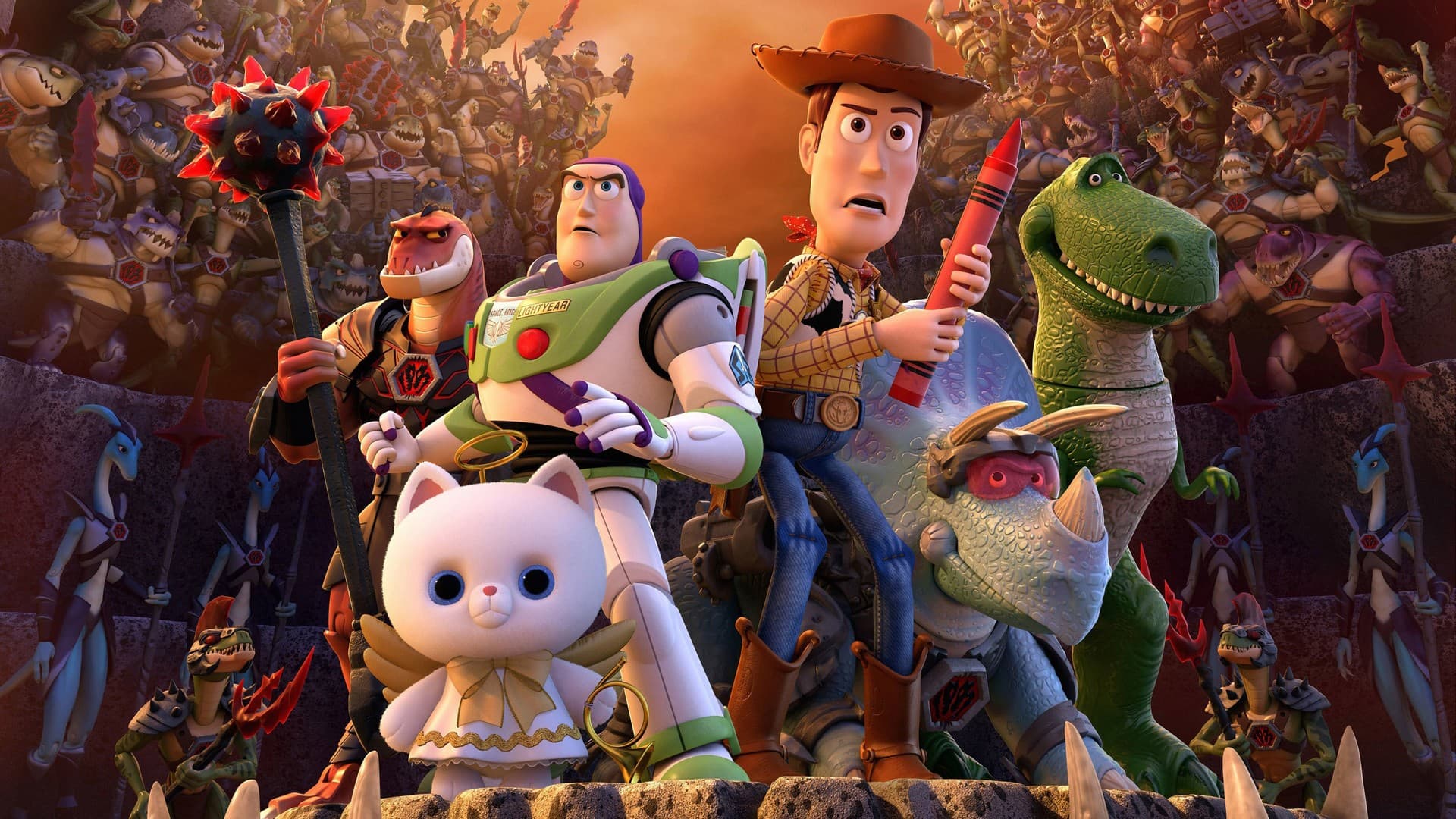

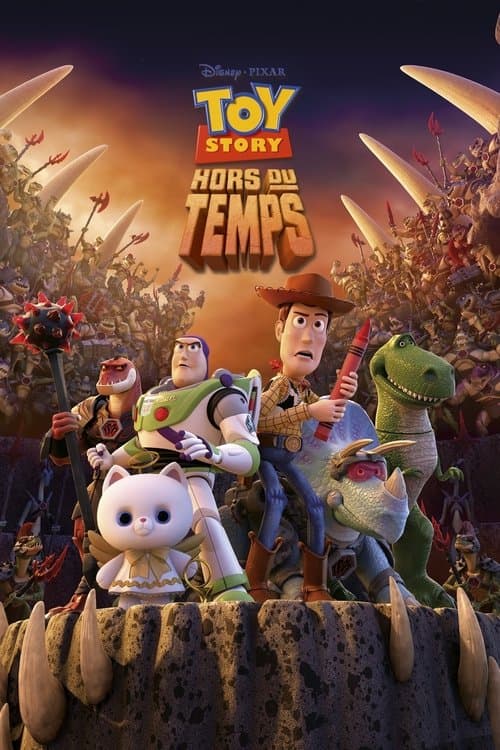
Toy Story That Time Forgot
Does this age rating seem accurate to you?
Detailed parental analysis
Toy Story: Out of Time is a special television short from the Pixar universe with an adventurous and slightly tense tone, primarily aimed at young children already familiar with the characters. The plot follows Buzz and Woody who, alongside Bonnie, discover a collection of dinosaur toys unaware they are toys at all, and who draw them into a miniature gladiator tournament. Despite its short runtime of around twenty minutes, it carries a sincere message about identity and childhood imagination.
Violence
Violence is the first element parents of very young children should examine. The narrative largely unfolds in an arena where dinosaur toys face off against other toys with blades and sticks, featuring a decapitated toy and a sock monkey literally chewed by a swarm of small dinosaurs, its stuffing spilling across the screen. Two characters are swallowed by a toy creature and then suspended above a running fan blade. The plastic and textile nature of the protagonists substantially softens the impact: there is neither blood nor organic injury shown. Nevertheless, the register remains one of stylised and repeated peril, intense enough to unsettle children under five who would not yet have the framework to distinguish fictional threat from real threat.
Underlying Values
The special constructs its argument around two clearly articulated moral tensions. On one hand, the value of childhood imagination and physical play is set against the appeal of video games, presented as an impoverished form of experience. On the other, the character arc of Trixie valorises self-acceptance and loyalty to one's role rather than the pursuit of a more socially prestigious self-image. Manipulation through misinformation, embodied by the antagonist Le Clerc, is explicitly undone by truth, which constitutes solid material for discussion. The overall message leans towards simplicity and authenticity against prestige or performance, without ever becoming heavy-handed or didactic.
Social Themes
The implicit critique of video game dependency is the only social issue the narrative addresses, in a stylised but sufficiently clear manner to be perceived by parents and, to a lesser extent, by older children. Video games are not frontally demonised, but are presented as a form of isolation from shared imagination that deprives the child of connection with their toys. This stance is particular to the Toy Story franchise as a whole and continues the thematic thread of the series.
Strengths
In twenty-two minutes, the special succeeds in establishing a genuine internal conflict for its main female character, Trixie, without resorting to cheap emotional beats. The writing is sophisticated enough to slip in humorous references aimed at adults regarding toy commercialism without breaking narrative rhythm for children. The establishment of the gladiator arena as a tension engine works visually, and the finale avoids an overly neat resolution. For such a short format, it achieves honest narrative balance, without pretension beyond what the format allows.
Age recommendation and discussion points
The special is appropriate from five to six years old, provided parents are available for more sensitive children during the arena scenes. For four-year-olds and younger, the combat sequences and toy destruction may be unsettling. Two angles of discussion are worth exploring after viewing: why is Trixie happier accepting being a toy than trying to be something else, and what makes playing with a real toy different from playing on screen.
Synopsis
During a post-Christmas play date, the gang find themselves in uncharted territory when the coolest set of action figures ever turn out to be dangerously delusional. It's all up to Trixie, the triceratops, if the gang hopes to return to Bonnie's room in this Toy Story That Time Forgot.
About this title
- Format
- Short film
- Year
- 2014
- Runtime
- 22m
- Countries
- United States of America
- Original language
- EN
- Directed by
- Steve Purcell
- Main cast
- Kristen Schaal, Kevin McKidd, Tom Hanks, Tim Allen, Emily Hahn, Steve Purcell, R.C. Cope, Emma Hudak, Wallace Shawn, Jonathan Kydd
- Studios
- Pixar, Walt Disney Pictures
Content barometer
- Violence2/5Moderate
- Fear2/5A few scenes
- Sexuality0/5None
- Language0/5None
- Narrative complexity0/5Simple
- Adult themes0/5None
Watch-outs
- Violence
Values conveyed
- Friendship
- Acceptance of difference
- Loyalty
- Autonomy
- self-acceptance
- identity
- solidarity
- trust
- the meaning of play