

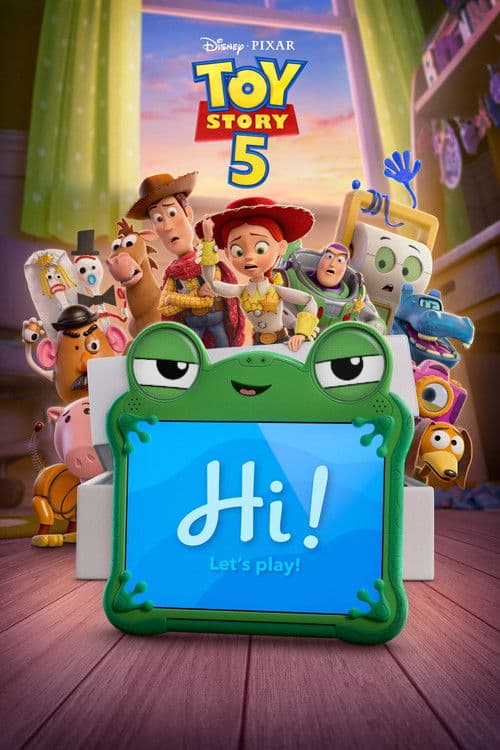
Toy Story 5
Does this age rating seem accurate to you?
Detailed parental analysis
Toy Story 5 is an animated adventure driven by joyful energy yet punctuated by emotionally intense moments, remaining faithful to the tone of the Pixar franchise. The plot follows Jessie and Bonnie's toy gang as they confront a world where screens and social media threaten to replace traditional play, whilst Bonnie herself experiences online exclusion. The film primarily targets children from 6-7 years old, but its themes of cyberbullying and digital addiction speak directly to parents as well.
Social Themes
The heart of the film is a reflection on children's digital addiction and cyberbullying. Bonnie is ridiculed and rejected by her peers on a social media platform, in scenes described as genuinely distressing for some children. The film does not demonise technology in a simplistic way: it explores the balance between imaginative play and screen use, which gives it genuine educational value. It is precisely this nuanced treatment that makes it a solid starting point for family conversation, but also what can weigh emotionally on younger viewers, especially those who have themselves experienced social exclusion.
Underlying Values
The narrative values genuine friendship and complicity as antidotes to isolation, in opposition to the superficial sociability of networks. Jessie embodies a model of courage, empathy and collective leadership, without these qualities being presented as performances to achieve but rather as natural resources to draw upon. The film also carries a message about preserving childhood imagination in the face of pressure to grow up too quickly, a recurring theme in the franchise but here anchored in a contemporary context. The fear of being forgotten or abandoned, already present in previous episodes, returns with notable emotional intensity through the character of Jessie.
Discrimination
The film deserves specific mention on this point: Jessie, a female character previously secondary, is promoted to main protagonist and takes on the role of sheriff and leader. This narrative choice explicitly reverses a previous dynamic in which she was relegated to a supporting role, and the film makes it a structural element of the story rather than a mere cosmetic adjustment. This is an angle parents can highlight with their children, particularly to discuss who has the right to be a hero and why.
Language
The language remains within very reasonable limits: no strong profanity, but a few playful insults between toys and attempts at a slightly coarser register. Scatological humour is present through a toy potty-training character that generates several toilet jokes. This type of humour is calibrated to make children aged 5 to 8 laugh and poses no particular issue, but parents sensitive to it can expect it.
Strengths
The film succeeds in anchoring a nostalgic franchise in contemporary issues without betraying its tone or universe. Jessie's promotion to main protagonist gives the story a new dynamic and a richer emotional arc than in recent episodes. The treatment of cyberbullying is concrete enough to resonate with children already familiar with digital spaces, without tipping into didacticism. The Pixar franchise maintains here its capacity to layer a child's reading and an adult reading, making it a film watchable as a family without parents becoming bored.
Age recommendation and discussion points
The film is suitable from 6-7 years old, with particular attention for younger or emotionally sensitive children, for whom scenes of bullying and exclusion can be genuinely disturbing. Two angles of discussion are worth opening after viewing: ask the child what he or she thinks about the difference between friends one has online and those with whom one actually plays, and explore with them why Jessie takes charge in this film and what that changes about the story.
Synopsis
When Bonnie receives a Lilypad tablet as a gift and becomes obsessed, Buzz, Woody, Jessie and the rest of the gang's jobs become exponentially harder when they have to go head to head with the all-new threat to playtime.
About this title
- Format
- Feature film
- Year
- 2026
- Countries
- United States of America
- Original language
- EN
- Directed by
- Andrew Stanton
- Main cast
- Tom Hanks, Tim Allen, Joan Cusack, Greta Lee, Conan O'Brien, Craig Robinson, Shelby Rabara, Tony Hale, Scarlett Spears, Jay Hernandez
- Studios
- Pixar
Content barometer
- Violence1/5Mild
- Fear2/5A few scenes
- Sexuality0/5None
- Language1/5Mild
- Narrative complexity2/5Moderate
- Adult themes0/5None
Watch-outs
- Bullying
- Mockery
- Gender stereotypes
Values conveyed
- Courage
- Friendship
- Acceptance of difference
- Loyalty
- Autonomy
- solidarity
- adapting to change
- self-confidence
- creativity
- balancing technology and play