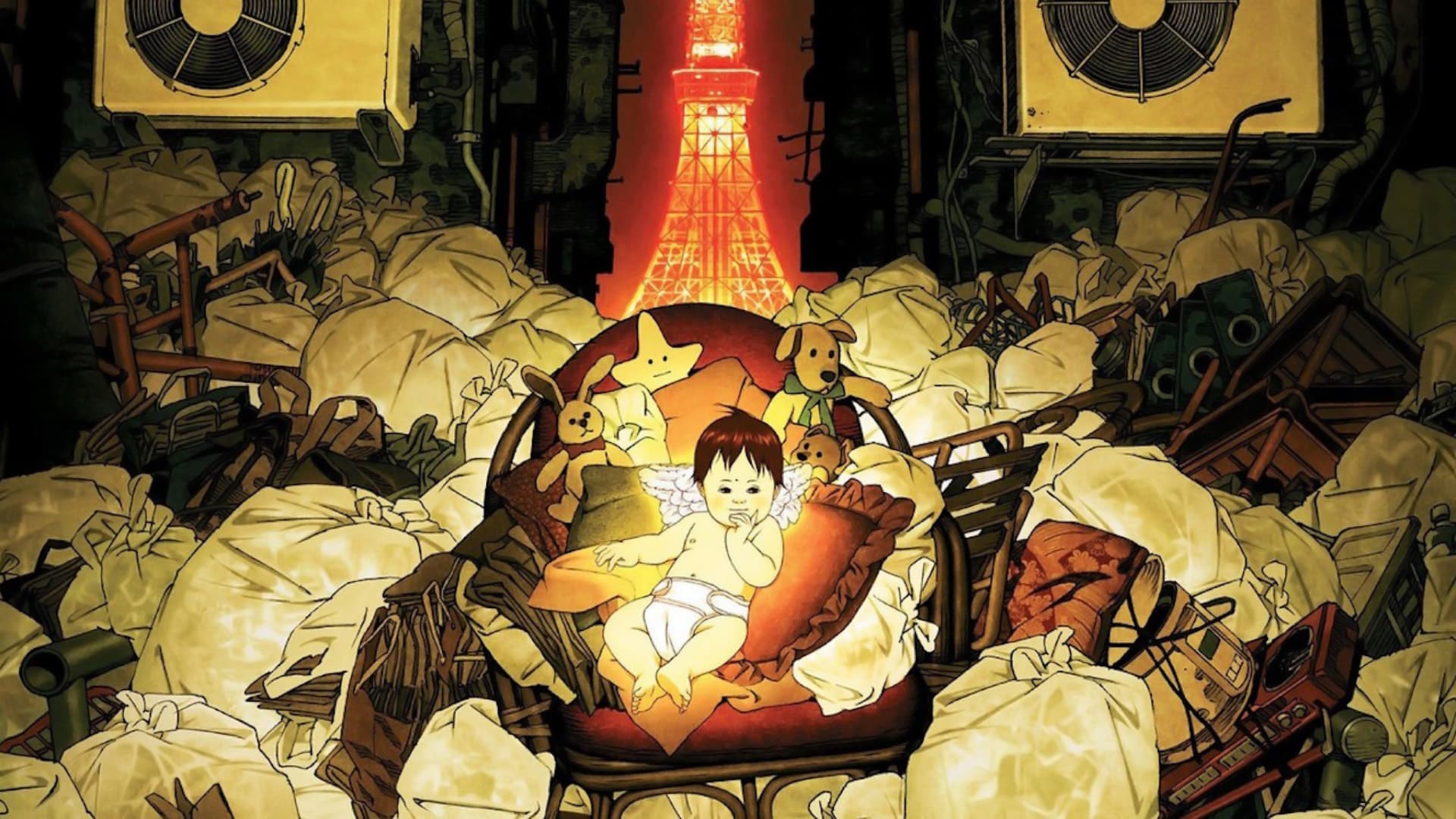


Tokyo Godfathers
東京ゴッドファーザーズ
Does this age rating seem accurate to you?
Detailed parental analysis
Tokyo Godfathers is a Japanese animated film with a singular atmosphere, blending absurd comedy, intense emotion and social realism in a wintry Tokyo. The plot follows three homeless people who discover an abandoned newborn in the rubbish on Christmas Eve and decide to track down its parents. The film is clearly aimed at a teenage and adult audience, as the themes addressed and situations depicted are too complex and too laden for a young child.
Underlying Values
This is where the film is richest and most rewarding to explore with a teenager. The narrative places at its centre the notion of chosen family: three unrelated individuals, each carrying a broken history, form a functional and loving unit of solidarity. Redemption is not treated as a moral mechanism but as something difficult, fragile and rooted in concrete actions towards others. The film refuses to rank forms of suffering or life trajectories, which gives it genuine intellectual generosity. Money, social status and respectability are systematically deconstructed as markers of human worth.
Parental and Family Portrayals
Family and parental representations lie at the heart of the film's purpose. Each of the three protagonists bears a painful family rupture: abandonment, running away, shame, loss of a fantasised fatherhood. The film portrays parents who are failing, absent or overwhelmed, without condemning them outright or absolving them easily. Parenthood is treated as a responsibility one can flee from, fail at or assume late in life, and the baby in the narrative functions as a revealer of these buried wounds. This is a very concrete angle to open up with a teenager about what they expect or hope for from a parental figure.
Violence
Violence is present on several occasions and with real visual intensity. A man is shot with visible blood spray, a homeless person is beaten by teenagers and shown bloodied, and a flashback scene shows a character committing a violent act against a loved one. These moments are not gratuitous: they anchor the film in a harsh social reality and serve character development. But they are explicit enough not to be suitable for a child or a sensitive pre-teenager.
Discrimination
The film uses homophobic terms on two occasions, one of them uttered by a main protagonist in a fit of anger. The word is discriminatory and the film does not immediately question it explicitly, which can be unsettling without proper context. In return, the character of Hana, a transgender woman, is treated with real depth for a 2003 film: she is the moral driving force of the group, her vulnerability is taken seriously and her dignity is never sacrificed. The tension between these two realities deserves to be named clearly with a teenager before or after viewing.
Substances
The alcoholism of one of the three protagonists is portrayed realistically and without glamour: drunkenness, slurred speech, dependency as an avoidance mechanism. The film does not valorise this consumption and links it directly to the character's trajectory of rupture. It is more a subject for discussion about underlying suffering than about the consumption itself.
Language
The film contains recurrent coarse language in its original subtitled version, including insults and vulgar expressions. The presence of homophobic terms, mentioned in the discrimination section, constitutes the most substantial element on this front. The overall register is that of marginalised characters, whose language reflects the roughness of their living conditions without this being aestheticised.
Social Themes
Social marginalisation and severe urban poverty are the permanent backdrop of the film and constitute a real subject in themselves. The homeless are represented as full individuals, with histories, internal hierarchies and concrete mutual support, far from usual representations that reduce them to dangerousness or passivity. The film offers a natural gateway to discussion around precarity, social invisibility and the way we regard those living on the streets.
Strengths
The film constructs with precision three main characters, none of whom is simplified: each carries an internal contradiction, a past cowardice and a form of authentic generosity. The writing weaves their individual stories together with remarkable narrative economy, without awkward exposition. The dark humour that runs through certain sequences does not lighten the stakes but makes them bearable, which testifies to a genuine balance of tone. Visually, the nocturnal and wintry Tokyo is rendered with an attention to urban detail that constantly reinforces the emotional credibility of the narrative. For a teenager, this is a film that works on the capacity to be surprised by seemingly off-putting characters and to identify humanity where one would not expect to find it.
Age recommendation and discussion points
The film is not recommended before the age of 13 due to visual violence, heavy themes and discriminatory vocabulary, and is fully suitable from the age of 15 for uncomplicated viewing. Two angles of discussion are particularly worth pursuing after viewing: what is it that makes a group of unrelated people become a family, and how does the film represent homeless people compared to what we think we know about them in everyday life.
Synopsis
On Christmas Eve, three homeless people living on the streets of Tokyo discover a newborn baby among the trash and set out to find its parents.
About this title
- Format
- Feature film
- Year
- 2003
- Runtime
- 1h 32m
- Countries
- Japan
- Original language
- JA
- Directed by
- Satoshi Kon
- Main cast
- Aya Okamoto, Yoshiaki Umegaki, Tohru Emori, Satomi Korogi, Mamiko Noto, Ryuji Saikachi, Kyoko Terase, Rikiya Koyama, Hiroya Ishimaru, Koichi Yamadera
- Studios
- Madhouse, Sony Pictures, dentsu, GENCO
Content barometer
- Violence3/5Notable
- Fear2/5A few scenes
- Sexuality1/5Allusions
- Language3/5Notable
- Narrative complexity3/5Complex
- Adult themes2/5Present
Values conveyed
- Compassion
- Forgiveness
- friendship
- solidarity
- resilience