Three Little Pigs
Does this age rating seem accurate to you?
Detailed parental analysis
Three Little Pigs is a Disney animated short film with a cheerful tone yet threaded through with genuine tension, driven by a frankly menacing antagonist. The plot follows three pig brothers who each build their own house before facing a wolf determined to devour them. The film targets young children, but its symbolic reach and certain problematic elements warrant parental attention before viewing.
Discrimination
The original 1933 version contains a sequence now wholly unacceptable: the wolf disguises himself as a peddler with a prosthetic nose, a marked Yiddish accent and music with Jewish overtones, constituting an unambiguous antisemitic caricature. This scene was altered in later versions distributed by Disney, but it remains present in period copies accessible online. If your child watches an older version, the scene warrants direct explanation: this type of representation was common in popular media of the 1930s and is now recognised as a form of racism. It offers a concrete opportunity to address the question of stereotypes and their history.
Violence
The wolf successively destroys two houses with the pigs inside, and the threat of being eaten is explicit and repeated throughout the film. The violence remains stylised and bloodless, but the dramatic pressure is real: several parents report that the wolf is genuinely frightening, even for adults. The denouement sees the wolf burn his backside in a pot of boiling water and flee dragging his rear along the ground, which defuses the tension into comic register. The narrative outcome is clear: the danger is punished, the pigs are saved. For a very young or sensitive child, the intensity of the destruction scenes may nonetheless provoke genuine fright.
Underlying Values
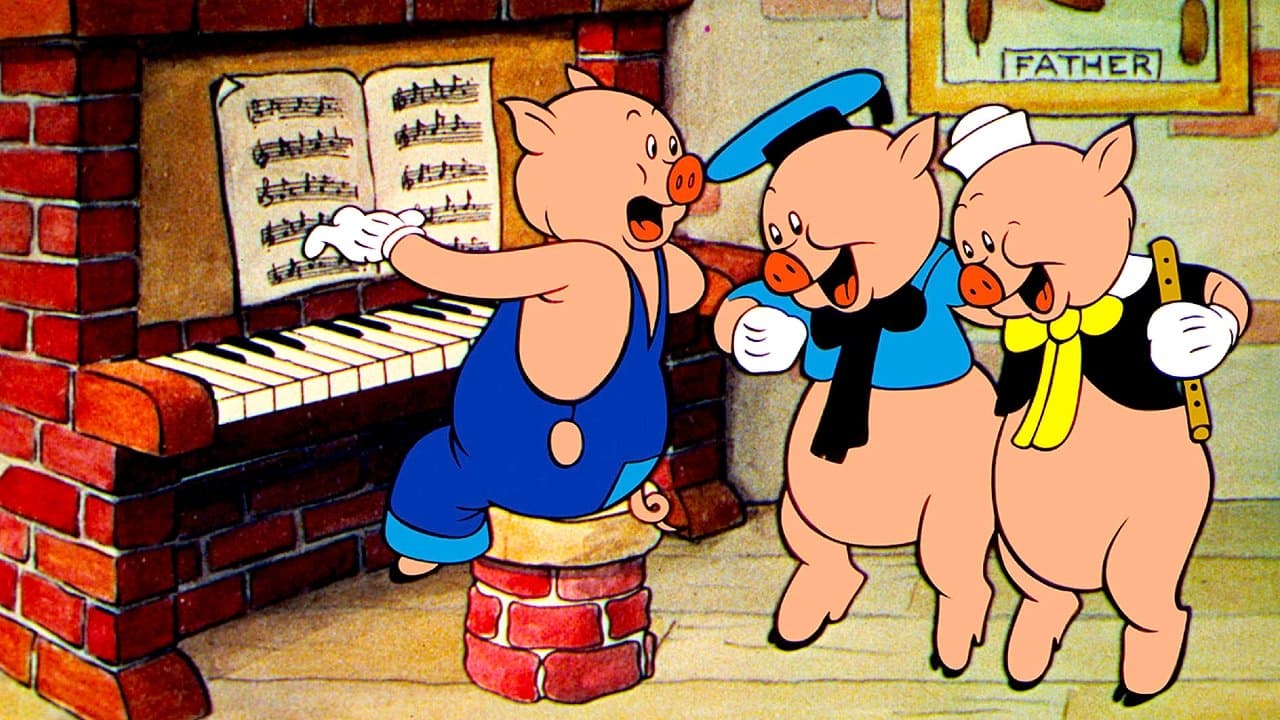
The central message is explicit and structuring: serious work and foresight protect, carelessness exposes. The third pig, who builds in brick whilst his brothers play, is the only one to resist the wolf. This pattern valorises effort and anticipation in a direct manner, without particular nuance for the two less prudent brothers, who nonetheless fare well thanks to family solidarity. The film was read at the time of its release as a metaphor for the Great Depression, the wolf embodying the economic crisis that only rigour allows one to confront. This subtext is not perceptible to a young child, but it offers an interesting angle for discussion with an older child. A detail of dark humour merits noting: the portrait of the pigs' father hanging on the wall depicts a string of sausages, a discreet reminder that in this world, pigs too end up eaten.
Parental and Family Portrayals
Parents are entirely absent from the narrative. The three pigs are left to themselves facing danger, and it is their own collective ingenuity that saves them. This forced autonomy is constitutive of the tale, but it can be noted with a young child who seeks protective figures in the story.
Strengths
The film marked animation history through its ability to give each of the three pigs a distinct personality in mere minutes, a remarkable narrative economy for a short film. The main song, catchy and effective, has endured across decades and remains a shared cultural reference point. The film also illustrates how a simple narrative can carry an adult reading without betraying its legibility for children: the economic metaphor functions in parallel with the tale without ever weighing it down. For a child, it is a solid introduction to the structure of the classical tale with its repeated trials and its resolution through intelligence rather than force.
Age recommendation and discussion points
The film is accessible from age 4 or 5 for children not sensitive to fear, but the presence of the wolf and the intensity of certain scenes call for caution with very young or anxious children. If you watch an older version, the antisemitic peddler sequence demands an immediate and direct conversation about stereotypes. With an older child, two angles are worth discussing: why the pig who works fares better, and does that mean the other two deserved to be frightened?
Synopsis
The two pigs building houses of hay and sticks scoff at their brother, building the brick house. But when the wolf comes around and blows their houses down (after trickery like dressing as a foundling sheep fails), they run to their brother's house. And throughout, they sing the classic song, "Who's Afraid of the Big Bad Wolf?".
Where to watch
Availability checked on Apr 28, 2026
About this title
- Format
- Short film
- Year
- 1933
- Runtime
- 9m
- Countries
- United States of America
- Original language
- EN
- Directed by
- Burt Gillett
- Main cast
- Billy Bletcher, Pinto Colvig, Dorothy Compton, Mary Moder
- Studios
- Walt Disney Productions
Content barometer
- Violence2/5Moderate
- Fear3/5Notable tension
- Sexuality0/5None
- Language0/5None
- Narrative complexity0/5Simple
- Adult themes0/5None
Watch-outs
- Death
- Ethnic or racial stereotypes
Values conveyed
- Courage
- Perseverance
- Autonomy
- caution
- brotherhood
- resourcefulness