
The Wild Robot
Does this age rating seem accurate to you?
Detailed parental analysis
The Wild Robot is an animated film with an emotionally rich atmosphere, oscillating between luminous tenderness and moments of sometimes striking intensity. The plot follows a robot who, shipwrecked on a wild island, finds himself raising a chick alone against its own species, gradually learning what it means to love and protect. The film is aimed primarily at school-age children and their parents, but its emotional depth and themes extend beyond simple family entertainment.
Parental and Family Portrayals
Parenthood is the beating heart of the film. The robot is not a biological parent, was not programmed to be one, and yet it is precisely this gap between its nature and what it becomes that gives the narrative all its power. The film thoughtfully explores what it means to raise a child different from yourself, to accompany their development, and ultimately to accept letting them go. Adoption, blended families and parental sacrifice are treated without sentimentality, which explains the emotional impact reported by many adults during screenings. It is particularly fertile ground for discussion in blended or adoptive families.
Violence
Violence is not gratuitous, but it is real, and several sequences are designed to carry weight. The opening in the night storm establishes an oppressive atmosphere. Scenes of animal predation, whilst brief and without gore, clearly show the laws of nature in their ruthless form. An incident results in the accidental death of parents and the destruction of eggs, a scene liable to upset younger viewers. The final attack by laser-armed robots, set against a dark, red-tinged atmosphere, marks the film's peak of intensity. The forest fire, visually striking, reinforces this sense of looming threat. Overall, the film carries genuine dramatic weight rather than spectacle violence, but young children may genuinely be frightened.
Underlying Values
The film constructs an interesting tension between programming and free will: its robot evolves beyond what it was designed for, which raises the implicit question of what defines identity and vocation. The central value is not performance or conformity, but the capacity to transform experience into love. The narrative also takes a stance on community as a safety net and mutual aid as a condition for survival, without ever turning it into a slogan. The institutional violence of the antagonistic robots, sent to retrieve an economic asset, subtly touches on the question of perceived utility versus felt value.
Social Themes
The film depicts a fragile ecosystem threatened by external technological forces and by amplified natural disasters. The forest fire and the brutality of industrial robots sketch out, in outline, a reflection on the relationship between nature and technology, without developing an explicitly ecological discourse. It is present enough to fuel discussion with a curious child, without being didactic.
Discrimination
Bullying and rejection of the different occupy significant narrative space. The young chick is ostracised by its own species because it does not resemble them and does not behave like them. A scene of near-collective drowning is directly linked to this rejection. The film treats this theme with seriousness and does not shy away from the cruelty a group can inflict on those who deviate from the norm, making it solid ground for discussing school bullying with a child who is affected or a witness to it.
Strengths
The film achieves a rare balance between adventure narrative, philosophical fable and emotional portrait. The writing avoids the usual moral shortcuts of the genre: the antagonists have their logic, secondary characters have depth, and the ending does not sacrifice emotional truth for a comfortable happy ending. The way the narrative handles separation and the child's growing autonomy offers parents as much as children an honest mirror on what it means to grow and to let grow. The emotional intensity reported by many adults is not a miscalibration: it is the mark of a film that takes its subject seriously.
Age recommendation and discussion points
The film is not recommended before age 7 due to several sequences of genuine intensity, notably the accidental death of animals, predation scenes and the final night-time attack. From age 8 onwards, it is accessible for most children accompanied by an adult ready to welcome the emotions the film provokes. A fully serene viewing sits rather around age 10. After the film, two conversational threads are particularly worthwhile: ask the child what makes someone a parent in his view, and ask him whether being different from others is a weakness or a strength in the film.
Synopsis
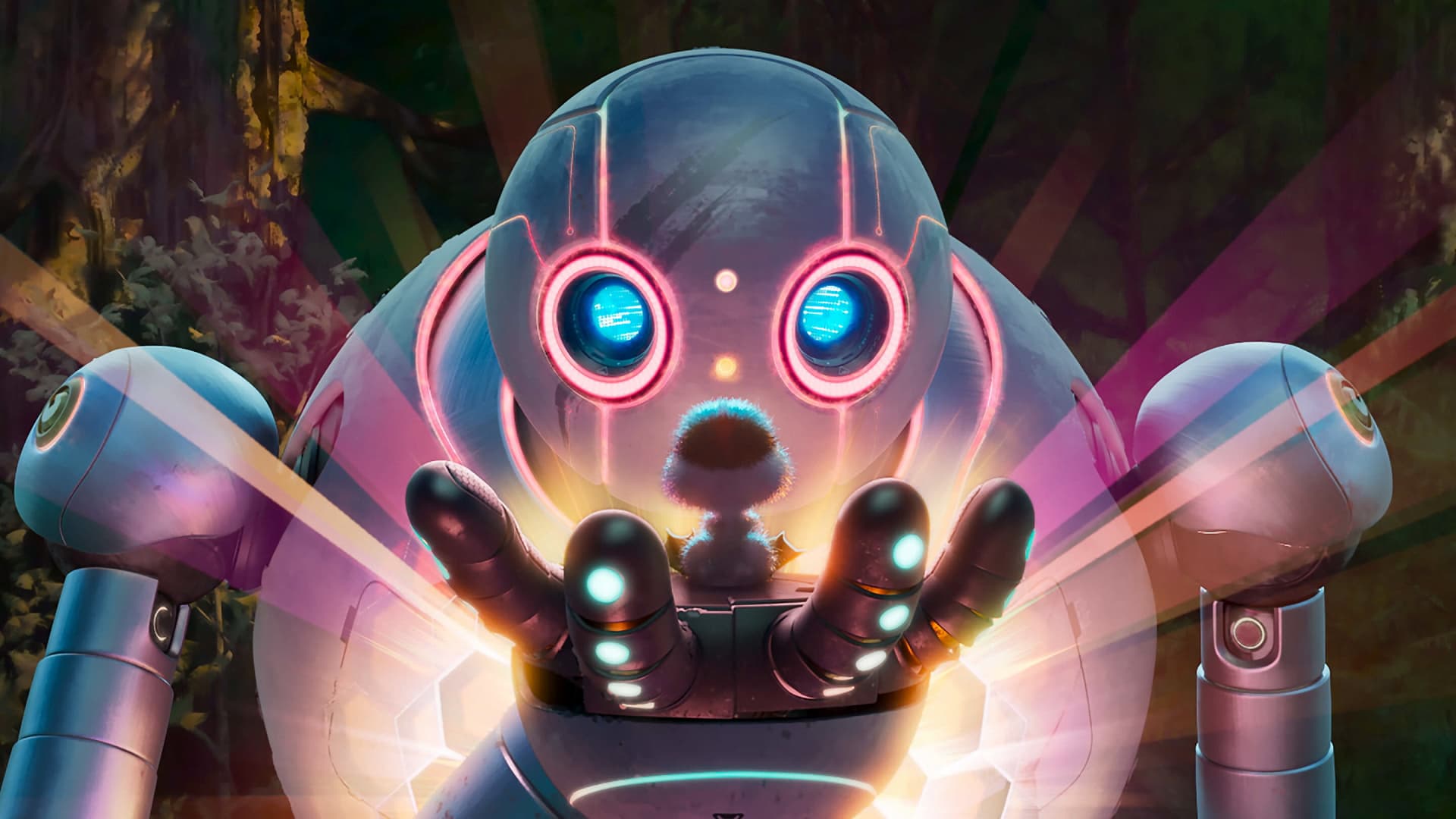
After a shipwreck, an intelligent robot called Roz is stranded on an uninhabited island. To survive the harsh environment, Roz bonds with the island's animals and cares for an orphaned baby goose.
About this title
- Format
- Feature film
- Year
- 2024
- Runtime
- 1h 42m
- Countries
- United States of America
- Original language
- EN
- Studios
- DreamWorks Animation
Content barometer
- Violence3/5Notable
- Fear3/5Notable tension
- Sexuality0/5None
- Language0/5None
- Narrative complexity2/5Moderate
- Adult themes0/5None
Values conveyed
- Acceptance of difference
- Perseverance
- Compassion
- Autonomy
- friendship
- empathy
- adoption
- resilience