
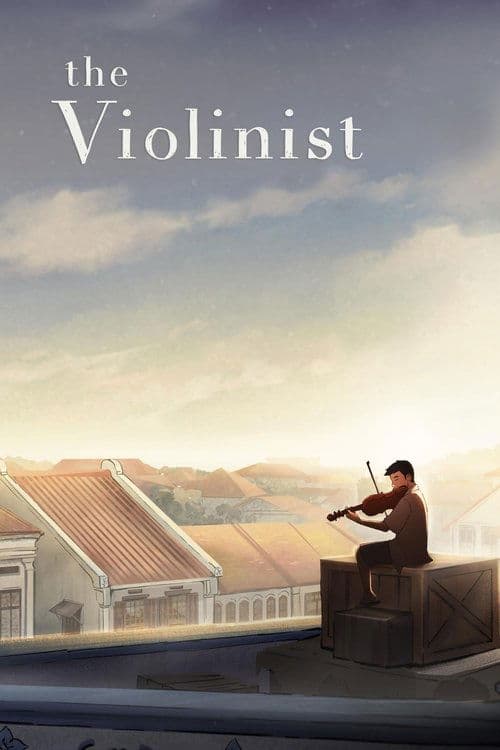
The Violinist
The Violinist
Your feedback improves this guide
Your feedback highlights guides that need a second look and keeps the rating trustworthy.
Does this age rating seem accurate to you?
Sign in to vote
Watch-outs
What this film brings
Content barometer
Violence
2/5
Moderate
Fear
2/5
A few scenes
Sexuality
0/5
None
Language
0/5
None
Narrative complexity
3/5
Complex
Adult themes
0/5
None
Expert review
The available plot summary points to a historical drama built around music, friendship, separation, and the impact of war, with a serious and melancholy tone rather than a light family adventure for very young children. The main sensitive material seems to come from the Japanese invasion, a character joining resistance forces, a long disappearance, and the sadness linked to uncertainty and possible loss. The violence does not appear highly graphic in the synopsis, but the wartime setting is central to the story and can feel emotionally heavy for younger viewers, especially because the narrative is driven by absence, waiting, and unresolved fear. For sensitive children, the challenge is likely to be the emotional weight more than any single frightening image. Parents may want to watch with older children and talk beforehand about wartime history, then discuss grief, resilience, and how music can help people cope with separation.
Synopsis
It is Singapore in the late 1930s. Kai and Fei are childhood friends and aspiring violinists. When Japan invades Malaya in 1941, Kai chooses to forgo his music career to join the anti-Japanese forces. After the war Kai goes missing. Determined to find him, Fei performs all over Southeast Asia, all the while seeking any news of Kai. Yet, as time fades, Fei has to decide if she must find her own music to define the remaining years of her life.
Difficult scenes
The moment when Japan invades the region may be unsettling for young viewers, even if the film does not seem built around highly graphic battle scenes. The shift from a childhood world of music into wartime danger creates a clear sense of threat that some children may find distressing. Kai gives up his musical future to join anti-Japanese forces, introducing the idea of leaving for danger and making a personal sacrifice. For children, this can feel sad and worrying because the story moves from friendship and artistic dreams toward separation and uncertainty. After the war, Kai's disappearance becomes a major emotional thread, and Fei keeps searching for him over many years. That prolonged uncertainty may strongly affect sensitive viewers, because the story appears to dwell on absence, hope, and the fear of never seeing a loved one again. As time passes, the film seems to focus on difficult life choices and the emotional cost of moving forward. Even without harsh imagery, the combination of separation, childhood memories, and quiet resignation gives the story a mature sadness that may be heavy for younger children.
Where to watch
No verified platform for the US market yet. We keep this section updated as availability changes.
Availability checked on Apr 01, 2026
About this title
- Format
- Feature film
- Year
- 2026
- Runtime
- 1h 40m
- Countries
- Singapore, Spain, Italy, Taiwan
- Original language
- ES
- Directed by
- Ervin Han, Raúl García
- Main cast
- Tan Kheng Hua, Kazuya Tanabe, Adrian Pang, Ayden Sng, Fang Rong
- Studios
- Robot Playground Media, TV ON Producciones, Altri occhi, Bombillo Amarillo, Mystic House Animation, Throne Inc., Select Entertainment, Little Green White, 108 Media, Infocomm Media Development Authorithy of Singapore, Inspidea Sdn Bhd, Valencian Institute of Culture
Content barometer
Violence
2/5
Moderate
Fear
2/5
A few scenes
Sexuality
0/5
None
Language
0/5
None
Narrative complexity
3/5
Complex
Adult themes
0/5
None
Expert review
The available plot summary points to a historical drama built around music, friendship, separation, and the impact of war, with a serious and melancholy tone rather than a light family adventure for very young children. The main sensitive material seems to come from the Japanese invasion, a character joining resistance forces, a long disappearance, and the sadness linked to uncertainty and possible loss. The violence does not appear highly graphic in the synopsis, but the wartime setting is central to the story and can feel emotionally heavy for younger viewers, especially because the narrative is driven by absence, waiting, and unresolved fear. For sensitive children, the challenge is likely to be the emotional weight more than any single frightening image. Parents may want to watch with older children and talk beforehand about wartime history, then discuss grief, resilience, and how music can help people cope with separation.
Synopsis
It is Singapore in the late 1930s. Kai and Fei are childhood friends and aspiring violinists. When Japan invades Malaya in 1941, Kai chooses to forgo his music career to join the anti-Japanese forces. After the war Kai goes missing. Determined to find him, Fei performs all over Southeast Asia, all the while seeking any news of Kai. Yet, as time fades, Fei has to decide if she must find her own music to define the remaining years of her life.
Difficult scenes
The moment when Japan invades the region may be unsettling for young viewers, even if the film does not seem built around highly graphic battle scenes. The shift from a childhood world of music into wartime danger creates a clear sense of threat that some children may find distressing. Kai gives up his musical future to join anti-Japanese forces, introducing the idea of leaving for danger and making a personal sacrifice. For children, this can feel sad and worrying because the story moves from friendship and artistic dreams toward separation and uncertainty. After the war, Kai's disappearance becomes a major emotional thread, and Fei keeps searching for him over many years. That prolonged uncertainty may strongly affect sensitive viewers, because the story appears to dwell on absence, hope, and the fear of never seeing a loved one again. As time passes, the film seems to focus on difficult life choices and the emotional cost of moving forward. Even without harsh imagery, the combination of separation, childhood memories, and quiet resignation gives the story a mature sadness that may be heavy for younger children.