The Tale of Despereaux
Does this age rating seem accurate to you?
Detailed parental analysis
The Legend of Despereaux is an animated film with a contrasting atmosphere, oscillating between luminous fantasy and sequences that are frankly dark, surprising for a cartoon intended for children. The story follows a small, courageous and idealistic mouse who, banished from his community, attempts to save a princess and restore light to a kingdom plunged into sadness. The film is theoretically aimed at young children, but its tone, narrative complexity and certain images make it more suited to children aged 7 and above.
Violence
The film contains several sequences with notable visual intensity for family animation. The castle dungeons constitute an oppressive environment, populated by threatening rats in an atmosphere close to horror film. A circus arena scene features a scarred and ferocious cat pursuing victims, with sustained tension. Characters are bound, imprisoned, and a group of rats explicitly threatens to kill a mouse. A rat is killed by a cat, off-screen but clearly signified. The death of the queen, caused by an accident involving a rat, occurs suddenly and may unsettle younger viewers. This violence remains implicit or off-screen, and it always serves the narrative rather than being gratuitous, but its accumulation gives the film a genuine darkness.
Underlying Values
The film carries solid and coherent structural values. Courage is presented as an inner disposition independent of size or status, which constitutes a strong message well embodied by the main character. Love of reading and imagination is valued concretely: Despereaux reads books rather than devouring them, and it is precisely this singularity that makes his strength. Forgiveness occupies a central place in the resolution of the narrative, notably through the arc of the rat Roscuro, whose quest for redemption is treated with genuine emotional depth. The film also implicitly questions communal conformism, showing that the exclusion of the different impoverishes the group as much as the individual.
Parental and Family Portrayals
The most striking parental figure is that of the king, plunged into paralyzing grief after his wife's death. His emotional collapse renders him absent to his daughter and leads to absurd decisions for the entire kingdom. This portrayal of a loving but failing father through excess of sorrow is treated with a certain accuracy, but it may prompt children to question the fragility of adults supposed to protect them. The death of the mother, occurring abruptly at the very beginning of the film, establishes from the outset a context of unresolved grief that runs through the entire narrative.
Social Themes
The film depicts a kingdom struck by a form of collective depression after the disappearance of joy, symbolised by the end of soup and light. This metaphor of communal grief and social paralysis is readable for older children, but may seem abstract for younger ones. The structure of parallel narratives, with characters from very different backgrounds (nobility, underground world, servitude), sketches a reflection on inequalities of condition without ever developing it explicitly.
Strengths
The film distinguishes itself through ambitious narrative construction, articulating several plot threads in parallel with an omniscient narrator whose voice gives the story the texture of a literary tale. This form, rare in family animation, introduces children to non-linear narration and the notion of multiple points of view. The character of Roscuro is particularly well written: his moral ambivalence, his suffering and his trajectory towards redemption make him one of the film's most complex characters, far beyond the simple antagonist. The artistic direction skilfully plays on contrasts between the luminous world of the castle and the darkness of the dungeons, giving visual coherence to the emotional stakes of the narrative.
Age recommendation and discussion points
The film is not recommended before age 7 due to its dark sequences and the death of an adult character occurring without preparation. From age 7-8 onwards, it can be watched calmly by a child without particular sensitivity to oppressive atmospheres, with parental accompaniment advised for the youngest in this age group. Two angles of discussion are worth pursuing after viewing: why is Despereaux set apart by his own simply because he is different, and what does this say about the way we treat those who do not conform? And regarding Roscuro: can one truly forgive someone who has hurt us, and what does it change for oneself?
Synopsis
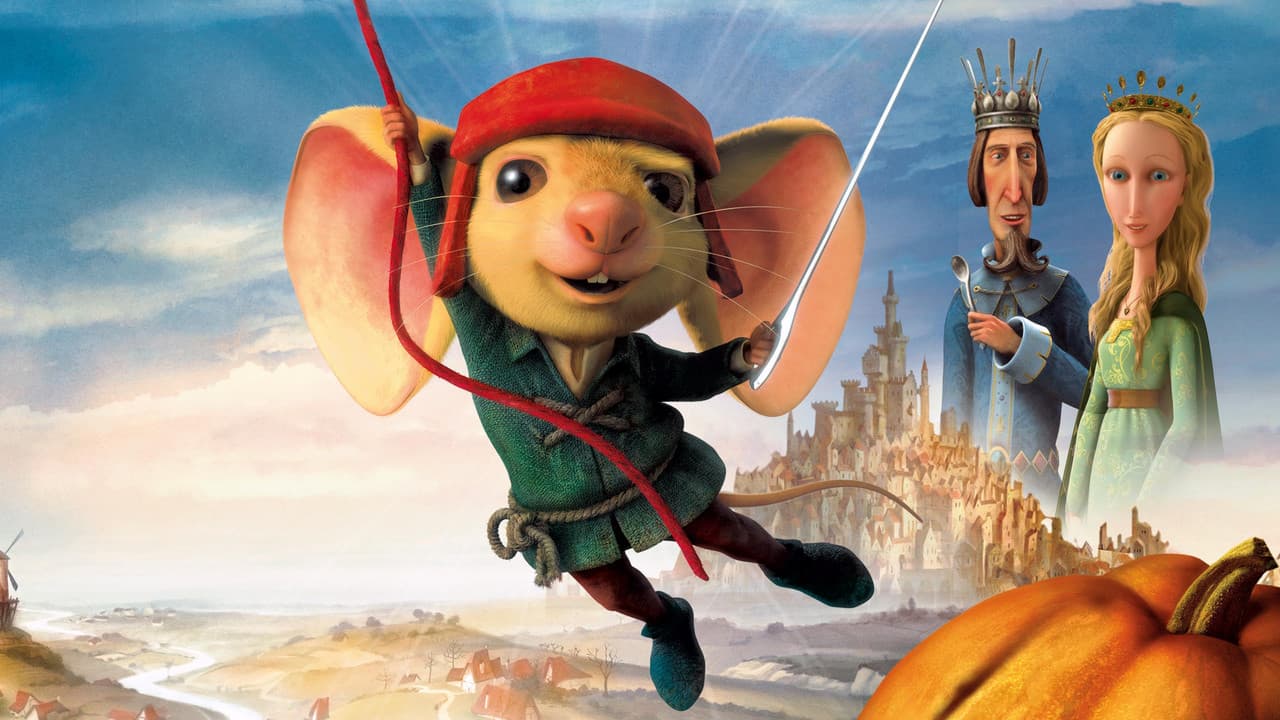
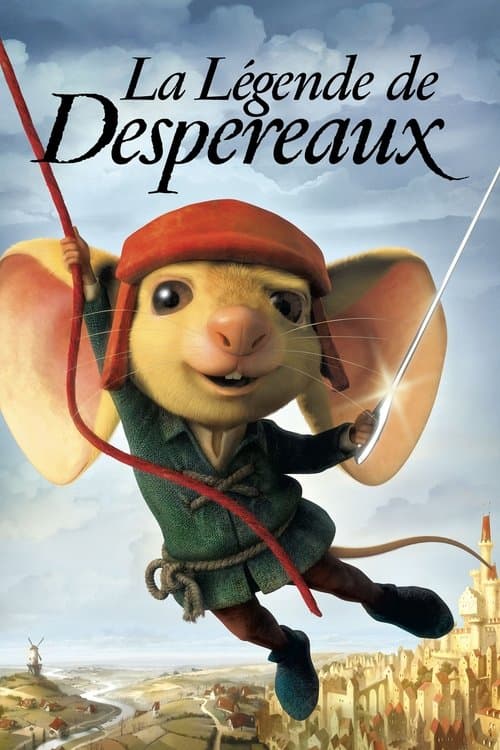
Once upon a time... in the far away kingdom of Dor... lived a brave and virtuous mouse with comically oversized ears who dreamt of becoming a knight. Banished from his home for having such lofty ambitions, Despereaux sets off on an amazing adventure with his good-hearted rat friend Roscuro, who leads him, at long last, on a very noble quest to rescue an endangered princess and save an entire kingdom from darkness.
Where to watch
Availability checked on Apr 29, 2026
About this title
- Format
- Feature film
- Year
- 2008
- Runtime
- 1h 30m
- Countries
- United Kingdom, United States of America
- Original language
- EN
- Directed by
- Sam Fell, Robert Stevenhagen
- Main cast
- Matthew Broderick, Dustin Hoffman, Emma Watson, Tracey Ullman, Kevin Kline, Sigourney Weaver, William H. Macy, Stanley Tucci, Ciarán Hinds, Robbie Coltrane
- Studios
- Larger Than Life Productions
Content barometer
- Violence2/5Moderate
- Fear3/5Notable tension
- Sexuality0/5None
- Language0/5None
- Narrative complexity1/5Accessible
- Adult themes0/5None
Values conveyed
- Courage
- Acceptance of difference
- Perseverance
- Forgiveness
- redemption
- friendship
- embracing difference
- hope