The SpongeBob SquarePants Movie
Does this age rating seem accurate to you?
Detailed parental analysis
The SpongeBob Movie is an absurd and colourful animated comedy, driven by unbridled energy and multi-layered humour that oscillates between the naive and the offbeat. The plot follows SpongeBob and his best friend Patrick on a perilous road trip to save their city and prove that one can be an adult without having lost one's childlike soul. Although derived from a children's series, the film contains elements clearly aimed at parents and teenagers, which places it in an intermediate zone requiring some caution for younger viewers.
Substances
Substances occupy a genuine and repeated narrative place. From the earliest part of the film, SpongeBob and Patrick become massively intoxicated on ice cream and demonstrate the effects in a mimetic fashion with alcoholic intoxication: unsteady gait, incoherent speech, euphoric behaviour followed by a visual hangover. Later, the Thug Tug bar is a place where fish drink beer, smoke and consume alcohol ostentatiously, without the film maintaining the slightest critical distance. These scenes are played for laughs, but they implicitly normalise intoxication as a source of good humour. This is probably the most useful point to raise with a child: the film treats a state of drunkenness as a farce, which it is not in reality.
Violence
Violence is present regularly, treated in the mode of physical comedy and burlesque exaggeration. The sequence at the Thug Tug bar accumulates intimidations, brawls and physical threats. King Neptune makes several explicit death threats. A character is stabbed, without bloodshed, in a clearly absurd gag. These elements are not intended to frighten or traumatise, and violence is never presented as a serious model for conflict resolution, but it remains present with notable frequency for a film stamped as children's entertainment. For younger viewers, the repeated threats and intimidation scenes may linger in memory.
Sex and Nudity
The film incorporates several sexual innuendos that fly over children's heads but are perfectly legible to teenagers and adults. Patrick appears dressed in fishnet stockings and leather boots in a deliberately double-reading staging. A shirt opens in the manner of an adult magazine. The name 'SpongeBoob' is pronounced with emphasis. These elements fall into the category of adult humour slipped into a children's film, a common practice in animation aimed at holding parents' attention, but which merits anticipation. Nudity is limited to exposed buttocks and characters without trousers, clearly in a comedic register.
Underlying Values
The film builds a structuring message around the refusal of forced maturity: being regarded as a child or a 'kid' is not a weakness, and sincere naivety is worth more than the surface cynicism of adults. This is a fairly solid arc of emotional validation, which resonates positively for children subjected to the pressure to 'grow up fast'. In parallel, the narrative valorises unconditional friendship, collective effort and loyalty without reciprocal obligation. The figure of authority, embodied by an impulsive and tyrannical king, is ridiculed, which can be discussed with younger viewers regarding the difference between challenging unjust authority and rejecting all rules.
Language
The linguistic register contains a few words worth flagging. The word 'jackass' is used three times in an audible way, which is unusual for a film aimed at family audiences. Terms such as 'stupid', 'twit' and 'dork' recur occasionally. These occurrences are few enough not to undermine the whole, but they are clear enough for children to retain and reuse them.
Strengths
The film operates on several levels of humour simultaneously, which is a rare feat of screenwriting in mainstream animation: children laugh at physical burlesque, teenagers at parodic references, adults at deliberately absurd subtexts. The construction of the SpongeBob-Patrick duo rests on a dynamic of sincere and touching friendship, without sentimentalisation or emotional manipulation, which is rarer than it appears. The narrative, despite its apparent lack of structure, maintains a coherent thematic line on the value of innocence in the face of adult conventions. The absurdist humour sometimes prompts children to question the logic of situations, which is no negligible intellectual exercise.
Age recommendation and discussion points
The film is not recommended before age 7 due to intimidation scenes, repeated threats and the normalisation of drunkenness as a comedic device. From age 8 onwards, viewing is possible with an available adult to provide context. Two angles are worth addressing after the film: why the film presents a state of drunkenness as something funny, and what this says about the way adults sometimes talk about alcohol; and how the film handles the question of being 'too childish', and whether growing up truly requires abandoning what one loves.
Synopsis
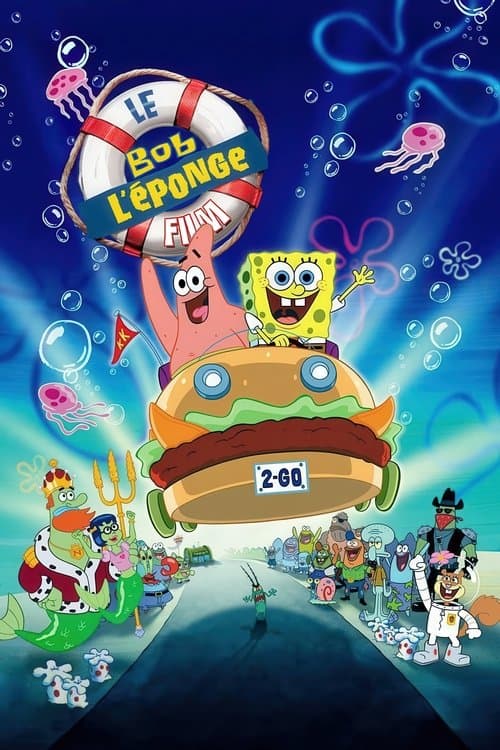
There's trouble brewing in Bikini Bottom. Someone has stolen King Neptune's crown, and it looks like Mr. Krab, SpongeBob's boss, is the culprit. Though he's just been passed over for the promotion of his dreams, SpongeBob stands by his boss, and along with his best pal Patrick, sets out on a treacherous mission to Shell City to reclaim the crown and save Mr. Krab's life.
About this title
- Format
- Feature film
- Year
- 2004
- Runtime
- 1h 27m
- Countries
- United States of America
- Original language
- EN
- Studios
- Paramount Pictures, Nickelodeon Movies, United Plankton Pictures, Rough Draft Korea, Warner Bros. Animation
Content barometer
- Violence2/5Moderate
- Fear2/5A few scenes
- Sexuality2/5Mild
- Language2/5Moderate
- Narrative complexity1/5Accessible
- Adult themes3/5Marked
Watch-outs
- Alcohol
- Strong language
- Violence
- Sexuality
Values conveyed
- Friendship
- Perseverance
- Autonomy
- courage
- self-confidence
- loyalty