


The Secret Life of Pets 2


The Secret Life of Pets 2
Your feedback improves this guide
Your feedback highlights guides that need a second look and keeps the rating trustworthy.
Does this age rating seem accurate to you?
Sign in to vote
Watch-outs
What this film brings
Content barometer
Violence
2/5
Moderate
Fear
3/5
Notable tension
Sexuality
0/5
None
Language
1/5
Mild
Narrative complexity
1/5
Accessible
Adult themes
2/5
Present
Detailed parental analysis
ⓘ- Violence
- Underlying Values
- Substances
- Language
Like Pets 2 is a family animated comedy with a light and colourful tone, driven by brisk pacing and a barrage of visual gags. The film follows several New York pet animals, each facing a trial that pushes them to overcome their fears and limitations. It explicitly targets young children from five or six years old, and functions as unpretentious family entertainment without any particular narrative ambition.
Violence
The film carries two structural messages: children must be exposed to risk in order to grow, and fear is overcome through physical courage. These messages are sound in intention but their narrative translation is sometimes awkward. The rabbit who becomes a formidable fighter is clearly glorified, without the film offering a critical perspective on this evolution. Solidarity between animals is present and functions well as a secondary value, notably around the protection of the mistreated tiger. The narrative remains broadly constructed on positive moral ground, even though the promotion of combat as a vector of self-overcoming merits discussion with a child.
Underlying Values
The film carries two structural messages: children must be exposed to risk in order to grow, and fear is overcome through physical courage. These messages are sound in intention but their narrative translation is sometimes awkward. The rabbit who becomes a formidable fighter is clearly glorified, without the film offering a critical perspective on this evolution. Solidarity between animals is present and functions well as a secondary value, notably around the protection of the mistreated tiger. The narrative remains broadly constructed on positive moral ground, even though the promotion of combat as a vector of self-overcoming merits discussion with a child.
Substances
One scene shows a female cat under the influence of catnip, displaying ecstatic and uninhibited behaviour presented in a humorous and cool manner. For a child of six or seven years old, the distinction between this fictional substance and the reality of drugs is not obvious, and the tone of the scene leaves no room for reservation. It is not the heart of the film, but it is a point sufficiently explicit to warrant a brief exchange with the child after viewing.
Language
The film contains a few mild terms in the original English version such as 'pissed', 'idiot' or 'turd'. In the French version, the equivalent remains in a low colloquial register but without marked coarseness. It is not a salient point for the target children, but parents sensitive to language will note it.
Strengths
The film fully embraces its lightness and offers brisk pacing, well-executed visual gags and a roster of animal characters sufficiently distinct to hold the attention of young children. The structure of parallel arcs, though narratively unambitious, allows each character to carry an autonomous mini-adventure, which suits the concentration span of five to eight year olds. The arc around animal mistreatment in the circus introduces genuine emotional tension and can serve as a first entry point into the question of respect for animals. On the artistic and scriptwriting level, the film falls short of Pixar or Disney animation standards: it entertains without leaving a mark, and that is an acknowledged ceiling.
Age recommendation and discussion points
The film is suitable from age six, with supervision recommended for children closer to five years old due to a few chase scenes and animal mistreatment that may cause concern. Two angles of discussion are worth pursuing after viewing: ask the child what he or she thinks about the fact that the rabbit learns to fight to solve his problems, and discuss the scene of the tiger in the circus to simply address the question of animal treatment.
Synopsis
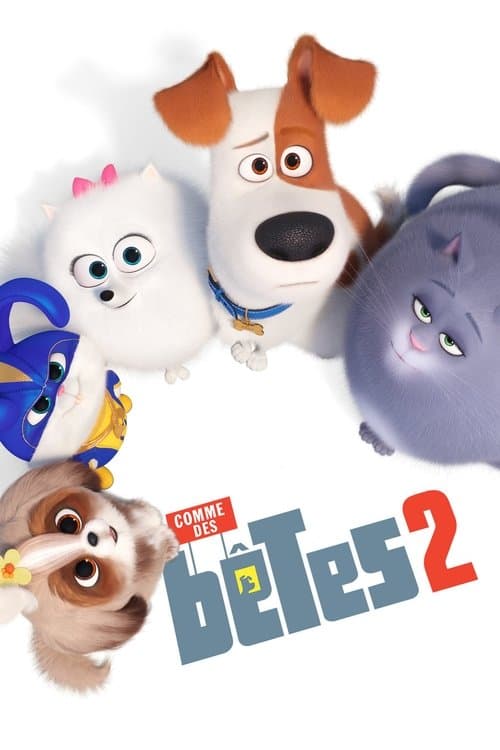
Max the terrier must cope with some major life changes when his owner gets married and has a baby. When the family takes a trip to the countryside, nervous Max has numerous run-ins with canine-intolerant cows, hostile foxes and a scary turkey. Luckily for Max, he soon catches a break when he meets Rooster, a gruff farm dog who tries to cure the lovable pooch of his neuroses.
Where to watch
No verified platform for the US market yet. We keep this section updated as availability changes.
Availability checked on Apr 01, 2026
About this title
- Format
- Feature film
- Year
- 2019
- Runtime
- 1h 26m
- Countries
- United States of America
- Original language
- EN
- Studios
- Universal Pictures, Illumination
Content barometer
Violence
2/5
Moderate
Fear
3/5
Notable tension
Sexuality
0/5
None
Language
1/5
Mild
Narrative complexity
1/5
Accessible
Adult themes
2/5
Present
Detailed parental analysis
ⓘ- Violence
- Underlying Values
- Substances
- Language
Like Pets 2 is a family animated comedy with a light and colourful tone, driven by brisk pacing and a barrage of visual gags. The film follows several New York pet animals, each facing a trial that pushes them to overcome their fears and limitations. It explicitly targets young children from five or six years old, and functions as unpretentious family entertainment without any particular narrative ambition.
Violence
The film carries two structural messages: children must be exposed to risk in order to grow, and fear is overcome through physical courage. These messages are sound in intention but their narrative translation is sometimes awkward. The rabbit who becomes a formidable fighter is clearly glorified, without the film offering a critical perspective on this evolution. Solidarity between animals is present and functions well as a secondary value, notably around the protection of the mistreated tiger. The narrative remains broadly constructed on positive moral ground, even though the promotion of combat as a vector of self-overcoming merits discussion with a child.
Underlying Values
The film carries two structural messages: children must be exposed to risk in order to grow, and fear is overcome through physical courage. These messages are sound in intention but their narrative translation is sometimes awkward. The rabbit who becomes a formidable fighter is clearly glorified, without the film offering a critical perspective on this evolution. Solidarity between animals is present and functions well as a secondary value, notably around the protection of the mistreated tiger. The narrative remains broadly constructed on positive moral ground, even though the promotion of combat as a vector of self-overcoming merits discussion with a child.
Substances
One scene shows a female cat under the influence of catnip, displaying ecstatic and uninhibited behaviour presented in a humorous and cool manner. For a child of six or seven years old, the distinction between this fictional substance and the reality of drugs is not obvious, and the tone of the scene leaves no room for reservation. It is not the heart of the film, but it is a point sufficiently explicit to warrant a brief exchange with the child after viewing.
Language
The film contains a few mild terms in the original English version such as 'pissed', 'idiot' or 'turd'. In the French version, the equivalent remains in a low colloquial register but without marked coarseness. It is not a salient point for the target children, but parents sensitive to language will note it.
Strengths
The film fully embraces its lightness and offers brisk pacing, well-executed visual gags and a roster of animal characters sufficiently distinct to hold the attention of young children. The structure of parallel arcs, though narratively unambitious, allows each character to carry an autonomous mini-adventure, which suits the concentration span of five to eight year olds. The arc around animal mistreatment in the circus introduces genuine emotional tension and can serve as a first entry point into the question of respect for animals. On the artistic and scriptwriting level, the film falls short of Pixar or Disney animation standards: it entertains without leaving a mark, and that is an acknowledged ceiling.
Age recommendation and discussion points
The film is suitable from age six, with supervision recommended for children closer to five years old due to a few chase scenes and animal mistreatment that may cause concern. Two angles of discussion are worth pursuing after viewing: ask the child what he or she thinks about the fact that the rabbit learns to fight to solve his problems, and discuss the scene of the tiger in the circus to simply address the question of animal treatment.
Synopsis
Max the terrier must cope with some major life changes when his owner gets married and has a baby. When the family takes a trip to the countryside, nervous Max has numerous run-ins with canine-intolerant cows, hostile foxes and a scary turkey. Luckily for Max, he soon catches a break when he meets Rooster, a gruff farm dog who tries to cure the lovable pooch of his neuroses.