

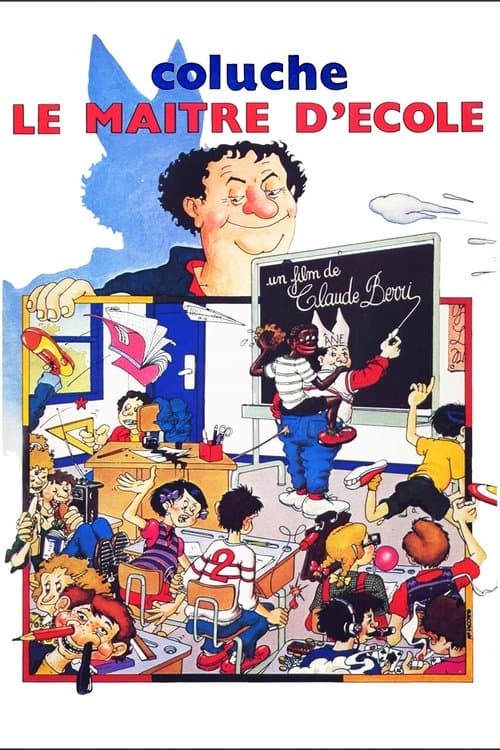
The School Teacher
Does this age rating seem accurate to you?
Detailed parental analysis
The Schoolmaster is a social comedy with a warm and tender tone, driven by popular humour that makes no secret of its clear-eyed view of the flaws in the French education system. The plot follows a young schoolteacher without solid pedagogical training who takes charge of a difficult class and discovers, through trial and error, what teaching truly means. The film is aimed primarily at adults and teenagers, even though it features children with disarming naturalism.
Underlying Values
This is the heart of the film. The narrative systematically sets two visions of school against each other: that of the institution, founded on constraint, grading and conformity, and that of the benevolent schoolmaster who bets on listening, curiosity and the pleasure of learning. This tension structures every scene and gives the film its critical force. The film does not veer into sentimentality: it also shows the distress of teachers, the pressure of inspection, and the limits of good intentions without resources. The hero's individualism, who improvises where the system fails, is both a narrative strength and a point for discussion: can one reform an institution by relying solely on the personal qualities of a single individual?
Social Themes
The film tackles weighty subjects head-on through the eyes of the pupils: unemployment, poverty, domestic violence, running away, and even capital punishment or homosexuality, treated in class as ordinary realities of life. These debates are not merely decorative: they reveal the social condition of the children and the gap between what official schooling teaches and what the pupils actually live. The attempted suicide of a fellow teacher illustrates, without heavy-handed pathos, the professional unease of the teaching profession at that time. It is a social portrait of the 1980s that still speaks today.
Parental and Family Portrayals
Families appear in the background but with real weight: marital disputes leading to a child running away, precarious economic conditions, parents who are absent or overwhelmed. The film does not explicitly judge these families but shows them as realities that the school must absorb without having the tools to do so. This is an interesting angle to discuss with a child or teenager: what can school do in the face of what the family cannot provide?
Substances
One scene shows a child smoking a cigarette, presented without explicit moral judgment. The image is dated and reflects the ordinary attitude of the 1980s towards tobacco, including among young people. It is not actively valorised, but neither is it condemned. A brief word is enough to contextualise what that era considered normal and what current standards have happily shifted.
Language
The language is colloquial and sometimes crude, with a few mild insults that belong to the popular register of the film. Nothing shocking for a secondary school pupil, but the tone is clearly that of an adult film speaking to adults, with no concessions to childish register.
Strengths
The film achieves something quite rare: writing about school without falling into didacticism or caricature. The relationship between the schoolmaster and his pupils is filmed with a rightness and warmth that stem from the authenticity of the interactions rather than from an idealised screenplay. The collective portrait of the class works well, the children exist individually, with their stories, their silences, their eruptions of real life in the school space. The film also has the merit of not concluding neatly: it leaves open the question of whether the enthusiasm of a single man can durably change anything, which gives it an intellectual honesty that is worth more than the expected happy ending.
Age recommendation and discussion points
The film can be watched with ease from age 10 onwards, with an available adult to contextualise the social subjects addressed and the tobacco scene. Two conversation points emerge after viewing: ask the child what they think of the difference between learning because you are forced to and learning because you want to, and discuss what the film's pupils experience outside school to understand why they behave as they do in class.
Synopsis
After having lost his job for having saved a child accused of shop lifting, Frédéric Barbier decides to become a school teacher with some funny results.The great comedy actor Coluche is excellent as a simple school teacher.
About this title
- Format
- Feature film
- Year
- 1981
- Runtime
- 1h 35m
- Countries
- France
- Original language
- FR
- Directed by
- Claude Berri
- Main cast
- Coluche, Josiane Balasko, Jacques Debary, Roland Giraud, Charlotte de Turckheim, André Chaumeau, Jean Champion, Georges Staquet, Claude Bertrand, Anne-Marie Jabraud
- Studios
- Renn Productions
Content barometer
- Violence1/5Mild
- Fear1/5Mild
- Sexuality1/5Allusions
- Language2/5Moderate
- Narrative complexity2/5Moderate
- Adult themes1/5Mild
Watch-outs
Values conveyed
- Compassion
- Autonomy
- empathy
- solidarity
- education
- perseverance