

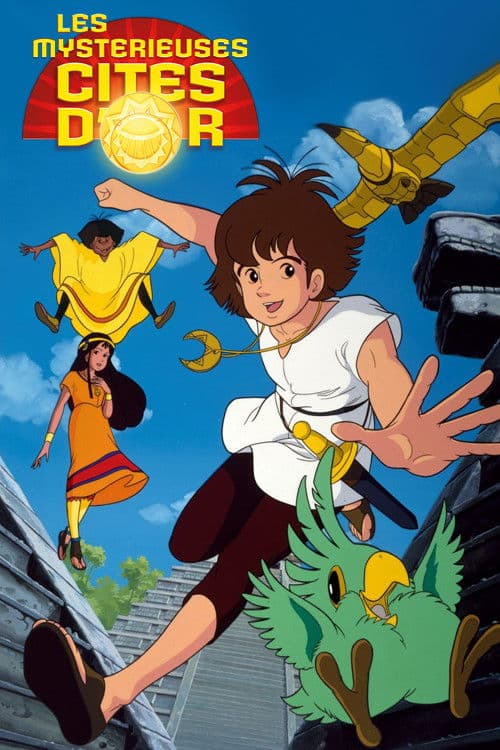
The Mysterious Cities of Gold
太陽の子エステバン
Does this age rating seem accurate to you?
Detailed parental analysis
The Mysterious Cities of Gold is an adventure animation series with an atmosphere that is both epic and melancholic, driven by sustained narrative tension and an air of historical mystery. The plot follows Esteban, a young orphan from the sixteenth century who sets sail for the New World in search of his father and the legendary cities of gold, accompanied by two other children of mysterious origins. The series is primarily aimed at children from eight years old and pre-adolescents, but its thematic and historical richness makes it a work that adults can watch alongside them without tedium.
Violence
Violence is present regularly and constitutes a genuine dramatic driver. The children are pursued on several occasions by Spanish soldiers, one scene shows an Olmec warrior stabbing a character before that character sacrifices himself, and an attempted human sacrifice targeting Zia is depicted explicitly. These sequences are not gratuitous: they serve to establish a sense of real danger and to give weight to the stakes. Violence remains within the bounds of the adventure-youth register, without gore or self-indulgence, but it is sufficiently intense to affect sensitive children. The Olmecs' plan to harvest cells from children to extend their own lives adds a dimension of cold, abstract threat that may disturb younger viewers.
Parental and Family Portrayals
The parental question lies at the heart of the series. Esteban is orphaned of his mother and separated from his father since childhood, Zia is abducted and torn from her father in the opening sequences, and the three child protagonists evolve in a world of adults who are often threatening or failing. The series does not seek to reassure on this point: parental absence is an open wound, not a convenient pretext. This honest treatment of loss and abandonment can resonate strongly with children who are themselves going through difficult family situations, and deserves to be anticipated by parents.
Social Themes
The Spanish conquest of South America is the central historical backdrop, and the series does not soften it. The conquistadors are portrayed as violent and greedy invaders, indigenous peoples as complex civilisations threatened with destruction. The children find themselves fighting alongside native populations against the occupier, which gives the series a clear political dimension. The historical figure of La Malinche, interpreter and companion of Cortés, appears in the series under the name Marinche: a controversial figure in Mexican memory, she embodies the tension between collaboration and betrayal, and can open a rich discussion on the complexity of historical figures.
Underlying Values
The series strongly values courage, perseverance, friendship and solidarity between children in the face of a hostile adult world. It also carries an implicit message about autonomy: the three protagonists make important decisions without reliable adult guardianship, which can be read as an invitation to responsibility or, depending on the child's age, as a destabilising representation. The quest for identity and origins is treated with genuine emotional depth, without easy resolution.
Discrimination
The series portrays Spanish conquistadors in a systematically negative manner, which reflects an assumed narrative stance rather than an involuntary stereotype. This choice is consistent with the historical perspective adopted, but it simplifies a complex reality. The figure of La Malinche, treated with a certain ambiguity, is one of the few elements that escapes this manichaeism. It may be useful to point out to the child that the series takes a point of view, and that real history is more nuanced than what the narrative presents.
Strengths
The series stands out for a narrative ambition that is rare for a production aimed at young audiences of its era. It weaves together adventure, pre-Columbian mythology, discreet science fiction and intimate drama without ever sacrificing one for the sake of another. The educational mini-documentaries broadcast at the end of each episode constitute an effective pedagogical device that anchors the fiction in concrete historical and geographical reality, and have clearly sparked a lasting interest in many children for the civilisations of South America. The series treats loss, identity and the quest for origins with an emotional sincerity that gives it a resonance far beyond its format.
Age recommendation and discussion points
The series is suitable from eight years old for emotionally resilient children, and fully recommended from nine to ten years old for serene viewing. Two angles of discussion are particularly worth pursuing after watching: ask the child what he or she thinks about the fact that the heroes are children who act alone, without adults to protect them, and explore with them the question of Spanish conquest by explaining that the series takes a particular stance and that real history is more complex.
Synopsis
The adventures of a young Spanish boy named Esteban who joins a voyage to the New World in search of the lost Cities of Gold and his father.
Where to watch
Availability checked on Apr 28, 2026
About this title
- Format
- TV series
- Year
- 1982
- Runtime
- 28m
- Countries
- France, Japan
- Original language
- JA
- Directed by
- 吉川惣司, 馬嶋満, Mitsuru Kaneko, Jean Chalopin
- Main cast
- Rei Sakuma, Masako Nozawa, Isao Sasaki, Junko Hori
- Studios
- Pierrot, DIC, NHK, CLT
Content barometer
- Violence3/5Notable
- Fear3/5Notable tension
- Sexuality0/5None
- Language0/5None
- Narrative complexity1/5Accessible
- Adult themes0/5None
Watch-outs
- Death
- Abuse
Values conveyed
- Courage
- Friendship
- Perseverance
- Autonomy
- curiosity
- teamwork