
The Lost Prince
Does this age rating seem accurate to you?
Detailed parental analysis
The Forgotten Prince is a family film with a bittersweet atmosphere, oscillating between the tenderness of a father-daughter ritual and the melancholy of unspoken grief. A busy father watches his teenage daughter drift away from the imaginary world he has built for her since childhood, and must find a way to reach her before it is too late. The film primarily targets families with children aged 8 to 12, but its themes about parenthood and grief speak as much to adults as to children.
Parental and Family Portrayals
The film strongly values imagination as an emotional language between parent and child, and presents the bedtime story ritual as an irreplaceable space for connection. Implicitly, it questions what happens when a child grows up and this shared language is no longer enough. The daughter's disobedience, when she goes out despite her father's prohibition, is treated with nuance: it is neither glorified nor severely condemned, but presented as a sign of normal adolescent emancipation. The film implicitly argues that parents must let go in order not to lose their children, which is a structuring and debatable message to discuss with a child or pre-adolescent.
Underlying Values
The film strongly values imagination as an emotional language between parent and child, and presents the bedtime story ritual as an irreplaceable space for connection. Implicitly, it questions what happens when a child grows up and this shared language is no longer enough. The daughter's disobedience, when she goes out despite her father's prohibition, is treated with nuance: it is neither glorified nor severely condemned, but presented as a sign of normal adolescent emancipation. The film implicitly argues that parents must let go in order not to lose their children, which is a structuring and debatable message to discuss with a child or pre-adolescent.
Social Themes
The mother's grief runs through the film in the background without ever being addressed directly. Her death is mentioned, her absence weighs on the family dynamic, but the narrative does not dwell on it at length. For a child who has experienced a recent loss, this discreet presence can resonate strongly, positively or painfully depending on the case. A forewarned parent would do well to anticipate this dimension before viewing.
Discrimination
The imaginary world built by the father rests on classical archetypes: a princess to be rescued, a heroic prince. These traditional gender roles are the material of the stories told, not a vision of the world defended by the film itself. The narrative does not explicitly question them either, which leaves the door open for discussion about why children's stories so often reproduce these patterns and what could be imagined instead.
Strengths
The film succeeds in building genuine emotion around the passage from childhood to adolescence, seen from the perspective of the parent who experiences it as a loss. The dream world, visually inventive, functions as a readable metaphor for the shared imagination between a father and his daughter, without ever becoming purely decorative. The writing takes time to show the complexity of a family relationship where love is not always enough to bridge the growing distance. It is a film that speaks to adults as much as to children, which is rare in the genre and constitutes its main strength.
Age recommendation and discussion points
The film is suitable from age 8 onwards, but it will be better understood and appreciated around age 10, when children begin to perceive the tension between the world of childhood and the one that is coming. Two angles of discussion are worth pursuing after viewing: why does the father struggle to accept that his daughter is growing up, and can disobeying a parent sometimes be a way of telling them something important?
Synopsis
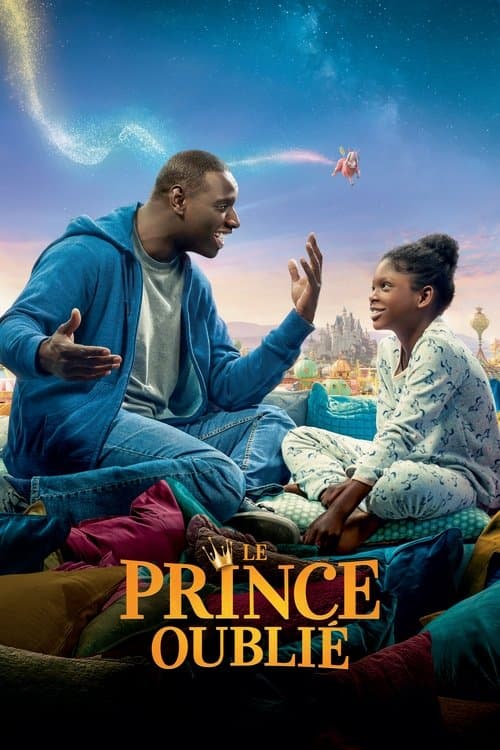
Djibi lives alone with Sofia, his 8-year-old daughter. Every night, he invents a story to put him to sleep. When Sofia falls asleep, these extraordinary stories come to life somewhere in an imaginary world inhabited by knights, pirates and other dragons. In this world that belongs only to them, Sofia is always the princess to save, and the brave Prince is none other than Djibi himself. But 3 years later, the entry of Sofia to the college will mark the end of her childhood. To the despair of her father, she no longer needs her stories at night. On the one hand, Djibi will have to accept that his daughter will grow up and move away from him. On the other hand, in the World of Stories, the Prince will have to face the most epic of all his adventures. Find your destiny in a world where it no longer has a place.
About this title
- Format
- Feature film
- Year
- 2020
- Runtime
- 1h 41m
- Countries
- Belgium, France
- Original language
- FR
- Directed by
- Michel Hazanavicius
- Main cast
- Omar Sy, Bérénice Bejo, François Damiens, Sarah Gaye, Keyla Fala, Néotis Ronzon, Philippe Vieux, Philippe Uchan, Lionel Laget, Philippe Hérisson
- Studios
- Prélude, Pathé, StudioCanal, TF1 Films Production, Belga Productions, Korokoro, Wallimage, Canal+, Ciné+, TF1, TMC, Belga Films, Beside Productions
Content barometer
- Violence1/5Mild
- Fear2/5A few scenes
- Sexuality0/5None
- Language0/5None
- Narrative complexity3/5Complex
- Adult themes0/5None
Watch-outs
- Grief
- Death / grief
- Gender stereotypes
Values conveyed
- Compassion
- Loyalty
- Autonomy
- family love
- imagination
- growing up
- empathy