

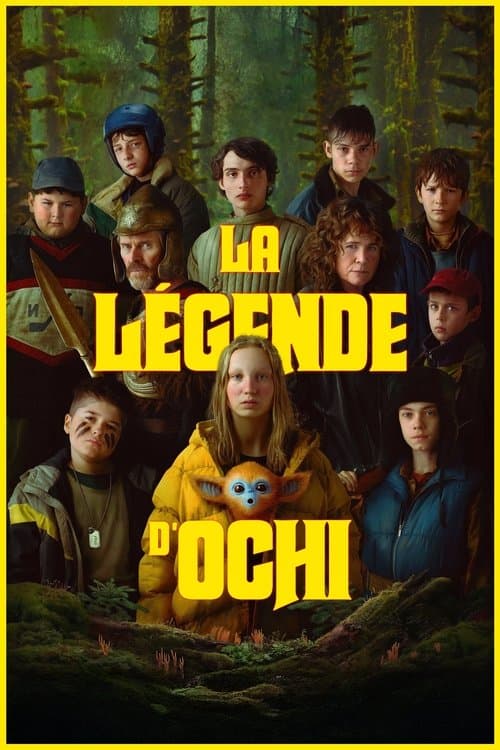
The Legend of Ochi
Does this age rating seem accurate to you?
Detailed parental analysis
The Legend of Ochi is an adventure tale with a dark and contemplative atmosphere, filmed in enchanting natural settings with the tonality of a visual fable. The story follows an adolescent girl who, against the wishes of her community, decides to protect a mysterious creature that everyone around her seeks to destroy. The film is primarily aimed at children from a certain age onwards and at families, but its unsettling atmosphere and its treatment of indoctrination situate it more towards pre-adolescents than towards young children.
Parental and Family Portrayals
Violence is present regularly and constitutive of the narrative. The hunting scenes involve children and adolescents armed with rifles and knives, active participants in hunts against creatures. Illustrations of bloodied corpses and a sheep carcass appear on screen. A creature bites the heroine and leaves her in a state of grave weakness with an implicit threat of death. Rifle shots are directed at characters in flight. This violence is not gratuitous: it serves to expose the absurdity of indoctrination and to make tangible the danger the heroine faces. It remains, however, sufficiently realistic and repeated to be anxiety-inducing for sensitive children or those under eight years old.
Violence
Violence is present regularly and constitutive of the narrative. The hunting scenes involve children and adolescents armed with rifles and knives, active participants in hunts against creatures. Illustrations of bloodied corpses and a sheep carcass appear on screen. A creature bites the heroine and leaves her in a state of grave weakness with an implicit threat of death. Rifle shots are directed at characters in flight. This violence is not gratuitous: it serves to expose the absurdity of indoctrination and to make tangible the danger the heroine faces. It remains, however, sufficiently realistic and repeated to be anxiety-inducing for sensitive children or those under eight years old.
Underlying Values
The film constructs its argument upon a firm critique of authoritarianism, community propaganda and the indoctrination of young people as political instruments. It opposes to this logic the values of empathy, curiosity and freely chosen emotional bonds. Non-verbal communication between the heroine and the creature is treated as a form of emotional intelligence superior to speech imposed by adults. It is useful to point out that this framework very explicitly valorises disobedience towards parental and community authority as a necessary moral act: an angle to contextualise with the child in order to distinguish reasoned disobedience from the rejection of all rules.
Social Themes
The film works in undertones the themes of propaganda and the construction of a designated enemy within a closed community. The organisation of children's hunting parties explicitly resembles an ideological juvenile militia, which gives the film a political dimension legible to pre-adolescents. The relationship between humans and wild nature also runs throughout the narrative, posing the question of coexistence with non-human otherness.
Discrimination
The film deliberately and critically stages an exclusively male group trained in violence, within which the heroine is the sole female figure, valued precisely because she refuses the codes imposed on boys. This contrast is narratively intentional and not incidental: it questions the way communities assign roles according to gender and reward conformity. This is a concrete point to open up with a child or teenager.
Substances
Tobacco is visible on screen, and an adult character explicitly offers a cigarette to the main adolescent. This scene is not trivial: it is part of a problematic adult-child relationship, which gives it a narrative context, but it nonetheless represents a normalisation of the passing of tobacco to a minor that should not be left without comment.
Language
The film contains a few crude terms in English, without reaching a marked density. The register remains occasional and is not characteristic of the film as a whole.
Strengths
The film stands out for its careful visual direction that transforms natural landscapes into the space of a tale, with lighting and cinematography that construct a rare atmosphere in contemporary family cinema. The bond between the heroine and the creature rests entirely on wordless communication, which makes it a concrete and moving demonstration of empathy as a universal language. The paternal figure, treated with ambivalence rather than as a pure antagonist, is one of the film's writing successes: it allows one to address with children the complexity of loving adults who transmit prejudices despite themselves. The narrative is simple, sometimes predictable, but this accessibility is also what makes it open to discussion after viewing.
Age recommendation and discussion points
The film is not recommended before age 8 due to its anxiety-inducing atmosphere and repeated scenes of violence, and can be viewed peacefully from age 10 to 11 onwards. After viewing, two angles are worth opening with the child: why does the heroine decide to disobey her father, and is disobedience always good or sometimes necessary? And also: what do we feel when we learn to fear something we don't really know?
Synopsis
In a remote village on the island of Carpathia, a shy farm girl named Yuri is raised to fear an elusive animal species known as ochi. But when Yuri discovers a wounded baby ochi has been left behind, she escapes on a quest to bring him home.
About this title
- Format
- Feature film
- Year
- 2025
- Runtime
- 1h 36m
- Countries
- United States of America, Finland
- Original language
- EN
- Directed by
- Isaiah Saxon
- Main cast
- Helena Zengel, Willem Dafoe, Emily Watson, Finn Wolfhard, Razvan Stoica, Carol Bors, Andrei Antoniu Anghel, David Andrei Baltatu, Eduard Mihail Oancea, Tomas Otto Ghela
- Studios
- A24, Encyclopedia Pictura, Neighborhood Watch, Year of the Rat, AGBO, Access Entertainment, IPR.VC
Content barometer
- Violence3/5Notable
- Fear3/5Notable tension
- Sexuality0/5None
- Language1/5Mild
- Narrative complexity1/5Accessible
- Adult themes2/5Present
Watch-outs
- Death
- Gender stereotypes
Values conveyed
- Friendship
- Acceptance of difference
- Compassion
- Autonomy
- courage
- empathy
- family