The Land Before Time
Does this age rating seem accurate to you?
Detailed parental analysis
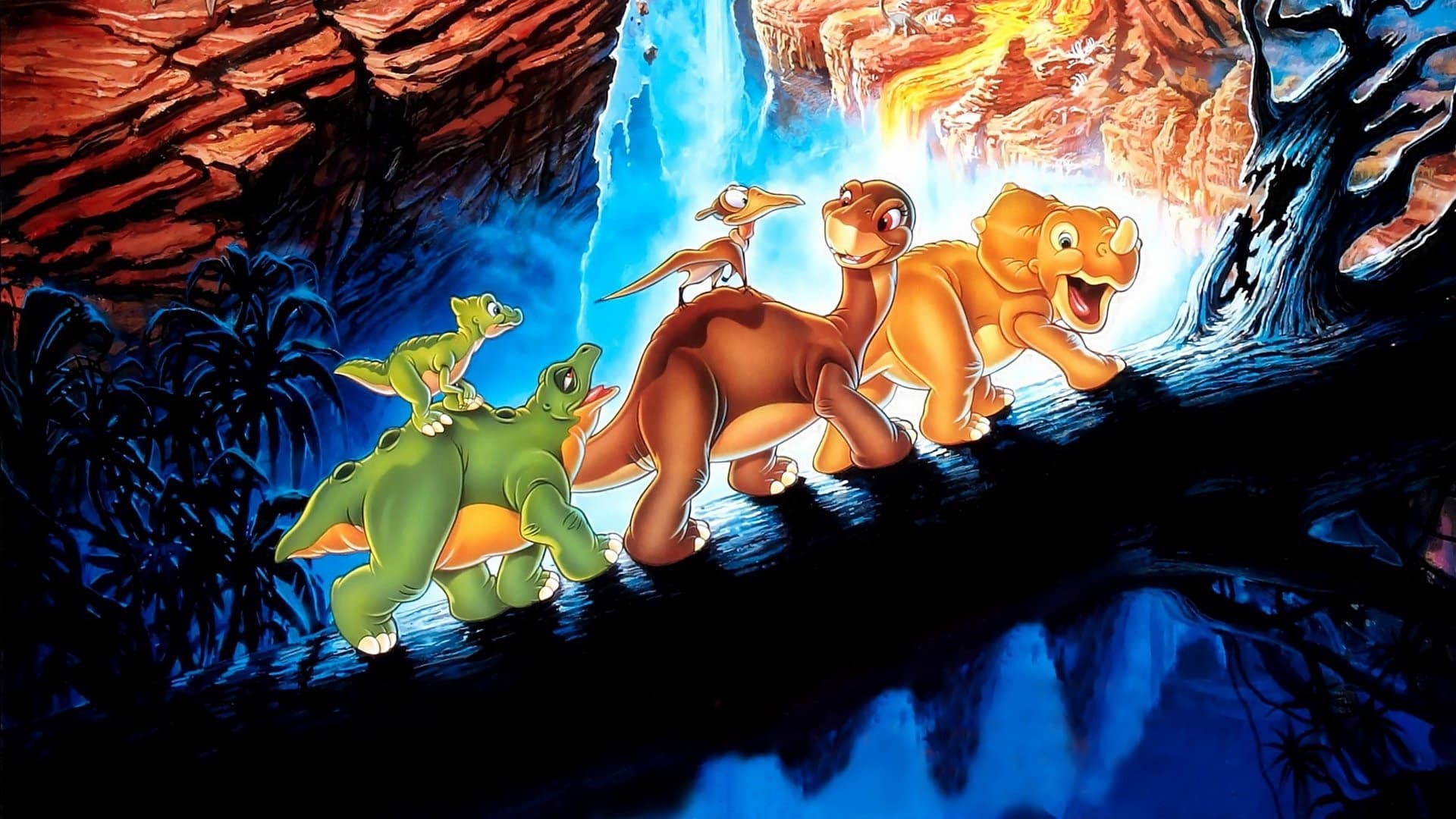
The Land Before Time is an animated film with a resolutely melancholic atmosphere and at times a harrowing one, considerably darker than what its appearance as a children's tale might suggest. The plot follows a young dinosaur who, after a family tragedy, must traverse a hostile world to reach a promised land alongside other juveniles of different species. The film targets young children, but its intense emotional content makes it more suited to attentive parental accompaniment than to independent viewing.
Violence
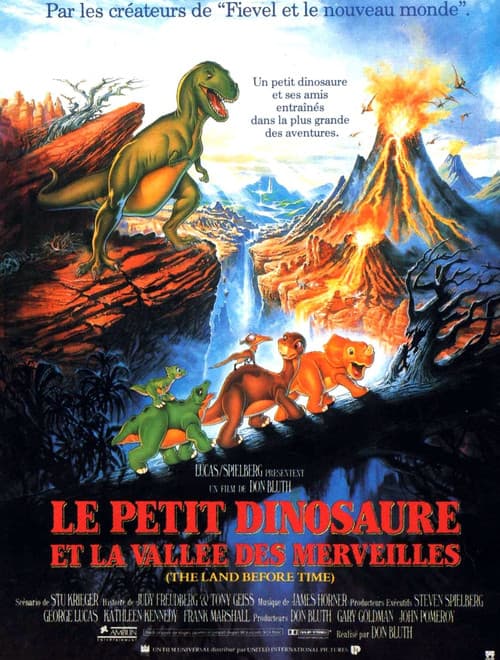
Violence is the primary dramatic engine of the film and its presence is sustained throughout the narrative. A carnivorous tyrannosaurus pursues the young protagonists on several occasions with explicit intent to kill, in sequences of genuine visual and sonic intensity. To this are added a succession of natural disasters: earthquakes, volcanic eruptions, landslides and fires that create an atmosphere of constant danger. The violence is neither gratuitous nor aestheticised for spectacle: it serves to anchor survival as a concrete stake and to give weight to the characters' courage. It remains that the accumulation of these sequences, combined with the fact that nineteen additional scenes were removed from the final edit for excessive intensity, speaks to the level of tension that the creators themselves deemed necessary to contain.
Parental and Family Portrayals
The death of Littlefoot's mother, occurring early in the film following a battle with the tyrannosaurus, is the most emotionally striking scene. It is treated without evasion, with a gravity that does not soften the reality of grief. The rest of the film is structured around parental absence: all the young dinosaurs are separated from their families and must move forward alone. Parental figures, when they appear briefly, are benevolent but powerless to protect their young. This narrative device places the child viewer in a position of direct identification with characters abandoned to themselves, which can resonate strongly with children sensitive to separation or loss.
Underlying Values
The film carries values of perseverance, mutual aid and courage in the face of adversity, and embodies them consistently throughout the narrative. Cooperation between different species is presented as the condition for survival, which gives the message concrete rather than moralising weight. Prejudice between species is shown as a legacy transmitted by adults, which the young protagonists learn to overcome through shared experience. It is one of the rare animated films of that era to treat intergroup mistrust as cultural conditioning rather than as a natural given, which opens a useful conversation with children.
Discrimination
Mistrust between dinosaur species is an explicitly constructed theme in the narrative: the young characters have been raised with the idea that certain species do not mix, and the film shows how this prejudice is transmitted by adults and progressively deconstructed by the children themselves. It is not a discrete subtext but a central narrative device, which makes it a concrete and accessible point of discussion for a child old enough to understand the notion of prejudice.
Strengths
The film possesses an emotional coherence rare for a production aimed at young children: it does not seek to reassure cheaply and assumes a grave tone that gives it genuine density. Death is treated with a sobriety that respects the intelligence of the young viewer, without indulgence or evasion. The structure of the initiatory journey is well constructed, each stage advancing both the action and the relationship between characters. On the sonic level, the musical score effectively accompanies variations in dramatic intensity. The film remains, thirty-five years after its release, an honest introduction to the difficult emotions that animated cinema can convey to childhood.
Age recommendation and discussion points
The film is not recommended before age 5 due to the death of a parent, repeated scenes of predation and the atmosphere of sustained danger. From age 5 or 6 onwards, with an adult present, it becomes a valuable emotional resource. Two angles of discussion merit being opened after viewing: how Littlefoot finds the strength to continue despite the loss of his mother, and why the adult dinosaurs in the film mistrust different species whilst the young ones, by contrast, learn to help one another.
Synopsis
An orphaned brontosaurus named Littlefoot sets off in search of the legendary Great Valley. A land of lush vegetation where the dinosaurs can thrive and live in peace. Along the way he meets four other young dinosaurs, each one a different species, and they encounter several obstacles as they learn to work together in order to survive.
Where to watch
Availability checked on Apr 28, 2026
About this title
- Format
- Feature film
- Year
- 1988
- Runtime
- 1h 9m
- Countries
- United States of America, Ireland
- Original language
- EN
- Directed by
- Don Bluth
- Main cast
- Gabriel Damon, Candace Hutson, Will Ryan, Judith Barsi, Helen Shaver, Pat Hingle, Bill Erwin, Burke Byrnes, Frank Welker
- Studios
- Universal Pictures, Amblin Entertainment, Don Bluth Entertainment, Don Bluth Ireland, Lucasfilm Ltd., U-Drive Productions
Content barometer
- Violence3/5Notable
- Fear4/5Intense
- Sexuality0/5None
- Language0/5None
- Narrative complexity0/5Simple
- Adult themes0/5None
Values conveyed
- Courage
- Acceptance of difference
- Perseverance
- friendship
- teamwork
- resilience