

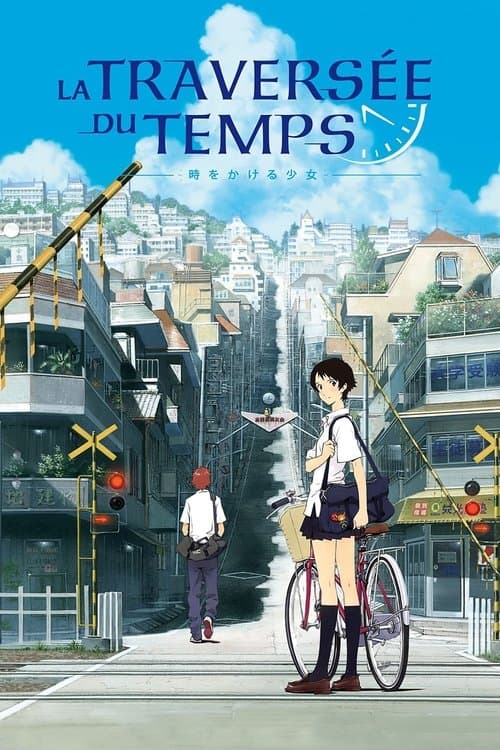
The Girl Who Leapt Through Time
時をかける少女
Does this age rating seem accurate to you?
Detailed parental analysis
The Traversal of Time is a Japanese animated film with a tone that is at once light and melancholic, blending adolescent comedy with reflection on the passage of time. The plot follows a high school girl who discovers she can travel back in time and exploits this ability without measuring the consequences for those around her. The film is clearly aimed at pre-adolescents and adolescents, whilst also touching an adult audience receptive to its emotional resonances.
Underlying Values
This is the heart of the film. The protagonist uses her temporal powers in a selfish manner, avoiding daily inconveniences, deferring difficult conversations, dodging the consequences of her actions. The narrative makes her progressively pay the price of this irresponsibility: each jump displaces misfortune without erasing it, and it is others who bear the effects. The lesson is structural, not moralistic: the film shows, without preaching, that fleeing the present amounts to sacrificing the people one loves. Emotional honesty, the capacity to own one's choices and to accept the irreversibility of time are presented as adult virtues to be built, not as self-evident truths.
Violence
Two sequences involving a train create genuine tension, notably the final scene where characters find themselves in immediate danger facing a train hurtling at full speed. These moments are intense but never gory or explicitly bloody. A hazing scene shows a student sprayed then struck by a thrown fire extinguisher, and a young girl in the crowd is injured as a result. These elements serve a clear narrative purpose: they illustrate the invisible collateral damage of irresponsibility. The violence remains moderate in overall intensity, but the high-stakes sequences merit being anticipated with younger children.
Language
The language is overall mild, with a few light insults from the adolescent register (translations of terms such as 'idiot', 'useless', 'witch'). A joke about masturbation is made between two boys and repeated once. It carries no narrative weight and falls into the realm of adolescent comic gimmickry, but its presence may surprise in a film otherwise restrained.
Sex and Nudity
Nudity is brief and non-sexual: part of the protagonist's torso is visible during a bathing scene, and her back as well as the strap of her bra appear during a medical examination. These moments are innocuous but real, and warrant mention for parents of younger children.
Parental and Family Portrayals
The adults in the family are present but in the background: the protagonist's aunt plays a role of discreet mentor, dispensing advice without imposing solutions. The parents are little visible without their absence being dramatised. This setting reflects the narrative's tendency to place individual responsibility at its centre, without recourse to a structuring adult authority.
Strengths
The film achieves what few adolescent animations manage to do: embody emotional maturity without ever departing from the register of the everyday. The screenplay uses temporal fantasy not as a pretext for action but as a revealer of its heroine's psychology, which lends it rare depth. The narration skilfully builds tension through slightly offset repetitions that give the viewer a step ahead of the protagonist, creating empathy and frustration simultaneously. The writing of friendships is subtle, true and free of easy sentimentality. The film also addresses, between the lines, the difficulty of transitioning from adolescence to adulthood, with all that this entails of acceptance of loss and powerlessness.
Age recommendation and discussion points
The film is fully suitable from age 10 for mature children, and constitutes a sound choice for adolescents from age 12 onwards. Two discussion points merit being opened after viewing: ask the child whether they would remake their recent choices if they could travel back in time, and explore with them why avoiding a difficult conversation often ends up creating more damage than having tackled it honestly.
Synopsis
When 17-year-old Makoto Konno gains the ability to 'leap' backwards through time, she immediately sets about improving her grades and preventing personal mishaps. However, she soon realises that changing the past isn't as simple as it seems, and eventually, will have to rely on her new powers to shape the future of herself and her friends.
About this title
- Format
- Feature film
- Year
- 2006
- Runtime
- 1h 44m
- Countries
- Japan
- Original language
- JA
- Directed by
- Mamoru Hosoda
- Main cast
- Riisa Naka, Takuya Ishida, Mitsutaka Itakura, Ayami Kakiuchi, Mitsuki Tanimura, Yuki Sekido, Utawaka Katsura, Midori Ando, Fumihiko Tachiki, Keiko Yamamoto
- Studios
- Madhouse, Happinet Pictures, KADOKAWA, KADOKAWA Shoten, Q-TEC, Memory-Tech, Studio Chizu
Content barometer
- Violence2/5Moderate
- Fear2/5A few scenes
- Sexuality1/5Allusions
- Language1/5Mild
- Narrative complexity3/5Complex
- Adult themes0/5None
Watch-outs
- Bullying
- Mockery
Values conveyed
- Courage
- Friendship
- Acceptance of difference
- Loyalty
- Autonomy
- responsibility
- maturity
- empathy