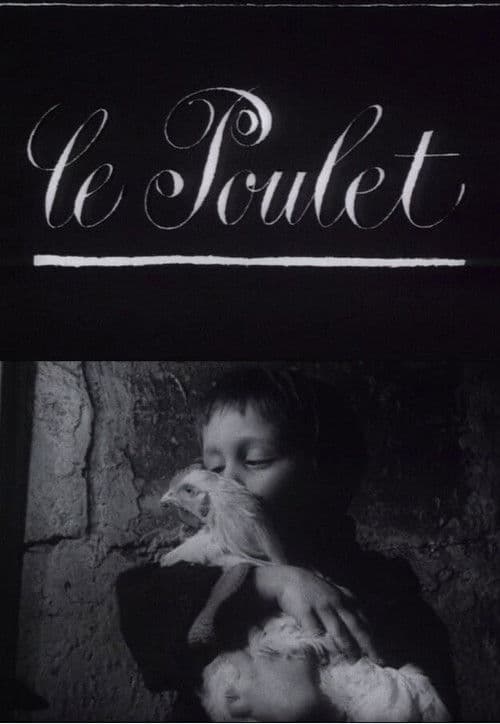
The Chicken
Does this age rating seem accurate to you?
Detailed parental analysis
The Chicken is a French short film in black and white with a gentle and contemplative tone, tinged with the quiet melancholy characteristic of New Wave cinema. The story follows a child who, during a Sunday family outing, becomes attached to a chicken destined for the dinner table and deploys all his ingenuity to save it. The film is aimed primarily at young children, but its slowness and sobriety also make it an object of rediscovery for nostalgic adults.
Underlying Values
The film places at the heart of its narrative a child's capacity to feel, to decide and to act according to his own moral compass, in the face of adults who prioritise domestic logic over empathy. The child's ingenuity and perseverance are clearly valued, and the final resolution shows that parental love can bend a practical decision. It is a generous message, but it is worth discussing with the child the boundary between emotional attachment and the reality of animal consumption, without the film itself taking a dogmatic stance.
Parental and Family Portrayals
The father embodies a quiet but firm authority: he makes decisions, drives, and does not hesitate to scold the child or leave him alone in the car. The mother is confined to domestic tasks and a literally secondary position in the family car. These representations are dated and faithfully reflect the hierarchical relationships of the 1960s without questioning them. The ending slightly nuances this picture by showing both parents capable of yielding to affection, but the structure of authority remains intact throughout the film.
Discrimination
Gender roles are marked and not challenged by the narrative: father as decision-maker and driver, mother withdrawn and as cook. For a young child, these images may go unnoticed, but they merit a brief discussion after viewing, particularly if the family organisation at home differs. It is not a film that caricatures or mocks, but one that reproduces without critical distance an ordinary patriarchal family model for its time.
Social Themes
The film addresses in a concrete and unembelished way the reality of meat consumption: plucked chickens at the butcher's, explicit discussion of killing and eating the animal. For a child aged 4 to 6 years, this confrontation with animal death and the food chain may be unsettling and merits being anticipated by parents. The film is neither activist nor moralising on this point, but it does not look away either.
Strengths
The Chicken is a precious testimony to French everyday life in the 1960s, filmed with an economy of means that forces attention to the details of gesture and gaze. The direction places rare trust in the child's performance and the duration of silences, which gives the film an emotional authenticity difficult to manufacture. It is also a discreet pedagogical document on rural life and markets of the period, and a natural introduction to a certain idea of classical French cinema, far from effects and contemporary acceleration.
Age recommendation and discussion points
The film is suitable from 4 to 5 years old for children comfortable with direct representations of animals destined for consumption, and entirely appropriate from 6 years old. Two angles of discussion are worth pursuing after viewing: ask the child why he thinks the parents finally changed their mind, and take the opportunity of the butcher's scene to talk simply and honestly about the provenance of meat.
Synopsis
The Chicken [Le Poulet] is a 1965 French short comedy film directed by Claude Berri. The film follows a father, mother, and son who go to visit a chicken farm. The son catches and brings home a chicken. The father plans to eat it if the chicken doesn't lay eggs. The boy aims to save the chicken and comedy ensues. It won an Oscar in 1966 for Best Short Subject.
About this title
- Format
- Short film
- Year
- 1965
- Runtime
- 15m
- Countries
- France
- Original language
- FR
Content barometer
- Violence1/5Mild
- Fear2/5A few scenes
- Sexuality0/5None
- Language0/5None
- Narrative complexity0/5Simple
- Adult themes0/5None
Watch-outs
- Death
- Gender stereotypes
Values conveyed
- Perseverance
- Compassion
- Autonomy
- empathy
- resourcefulness