
The Breadwinner
Does this age rating seem accurate to you?
Detailed parental analysis
Parvana is an animated film with a grave and poetic tone, set in Afghanistan under Taliban rule in the 1990s. The story follows a young girl who, after her father's unjust arrest, disguises herself as a boy to support her family and attempt to secure his release. The film is primarily aimed at pre-teens and teenagers, but its emotional intensity and the harshness of certain scenes make it unsuitable for young children.
Violence
The film is entirely structured around war, totalitarianism and the oppression of women under an authoritarian regime. The prohibition on women leaving alone, working, studying, or dressing freely is shown in its concrete and daily consequences for an ordinary family. Famine, extreme poverty and the exploitation of children through labour are also present. These subjects are treated with a honesty that gives the film genuine documentary value, but which demands sufficient maturity to avoid being simply overwhelming.
Social Themes
The film is entirely structured around war, totalitarianism and the oppression of women under an authoritarian regime. The prohibition on women leaving alone, working, studying, or dressing freely is shown in its concrete and daily consequences for an ordinary family. Famine, extreme poverty and the exploitation of children through labour are also present. These subjects are treated with a honesty that gives the film genuine documentary value, but which demands sufficient maturity to avoid being simply overwhelming.
Underlying Values
The narrative places at its centre individual resistance against collective oppression, imagination as a tool for survival, and the transmission of knowledge as an act of rebellion. The critique of anti-intellectualism and the destruction of books is explicit and conveyed with conviction. The film values female autonomy without ever turning it into a slogan: it is necessity that drives Parvana to act, and it is this necessity that makes her courage credible. Solidarity between women, notably between Parvana and her friend Shauzia, is a discreet yet powerful counterweight to the isolation imposed by the regime.
Parental and Family Portrayals
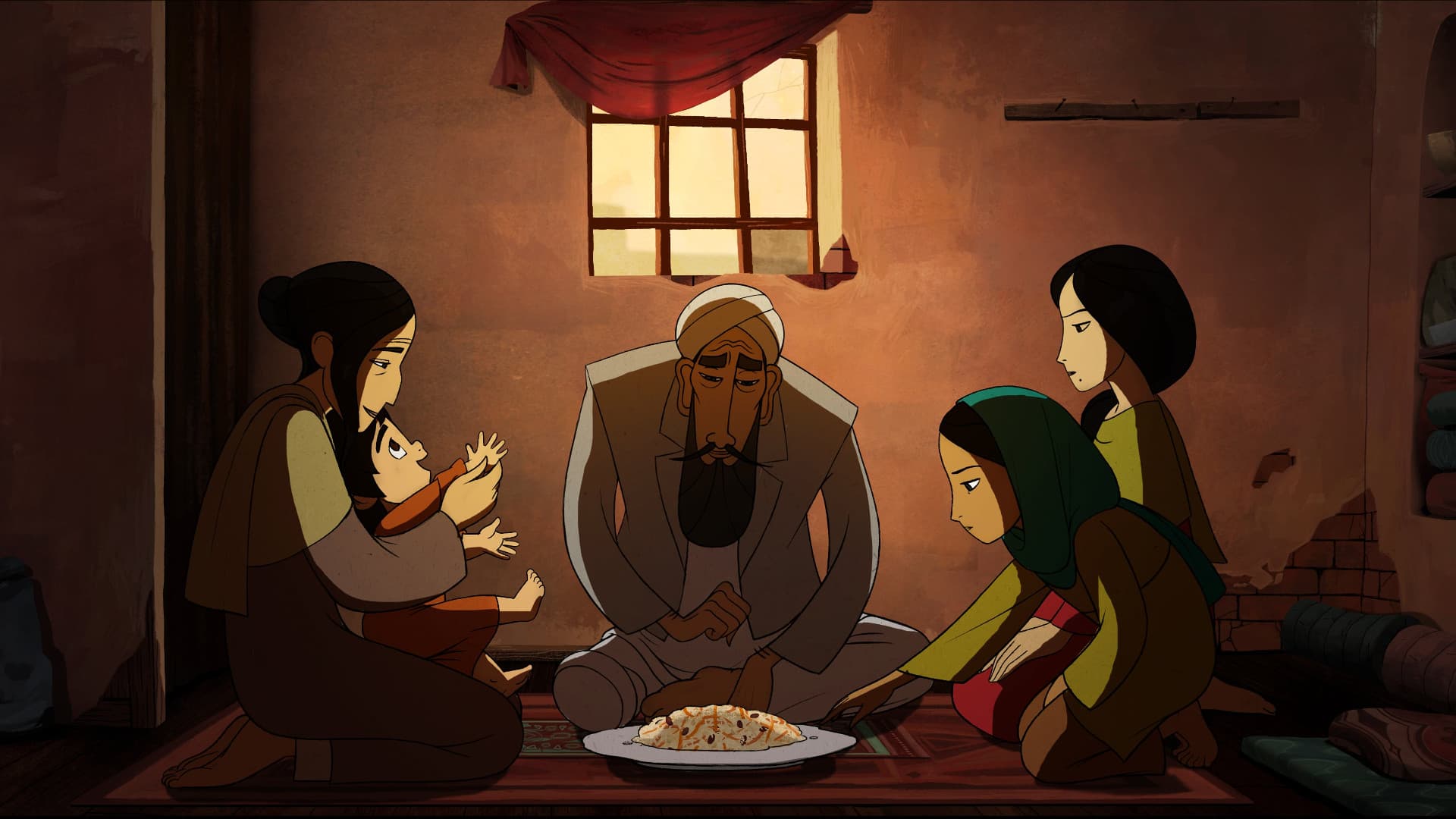
The paternal figure is central despite his physical absence: Parvana's father is an educated, gentle man who has passed on to her a love of stories and reading. His unjust arrest is the driving force of the narrative and his relationship with his daughter is one of the film's finest. The mother, initially shown in a state of prostration and despair, evolves towards a form of active resistance. The arranged marriage of the eldest daughter, accepted by the mother as a survival strategy, is presented without complacency but also without simplistic judgment: it is a decision made under extreme duress, which makes it a particularly rich subject for discussion.
Discrimination
The film represents in a direct and documented manner the systemic discrimination based on gender under Taliban rule. Women are beaten, humiliated, deprived of freedom of movement and access to public space. This representation is not stereotyped: it is precise, contextualised, and the film takes care to show that Afghan men themselves are victims of a system that crushes them. The question of discrimination is not treated as an abstract subject but as a reality lived by characters to whom one becomes attached.
Strengths
The film constructs a particularly skilful narrative device by interweaving Parvana's realistic account with a tale she invents to comfort her younger brother, whose animated images in a different style function as a space of symbolic and emotional respite. This dual structure allows the film to address very heavy themes without overwhelming the viewer, and gives it a literary depth rare in animation. The characterisation is refined: none is reduced to a function, and the mother's contradictions or the complicity between the two young girls are treated with genuine intelligence. The film also constitutes a serious and sensitive introduction to a geopolitical reality that few works aimed at young audiences dare to approach with such honesty.
Age recommendation and discussion points
The film is not recommended before age 11 and can be watched with ease from age 13 onwards, with parental accompaniment recommended between 11 and 13. Two angles of discussion emerge after viewing: why must Parvana disguise herself as a boy in order to have the right to exist in public space, and what does this tell us about the way societies construct the roles assigned to girls and boys? One can also return to the mother's decision regarding Soraya's marriage, and ask the child what they would have done in her place.
Synopsis
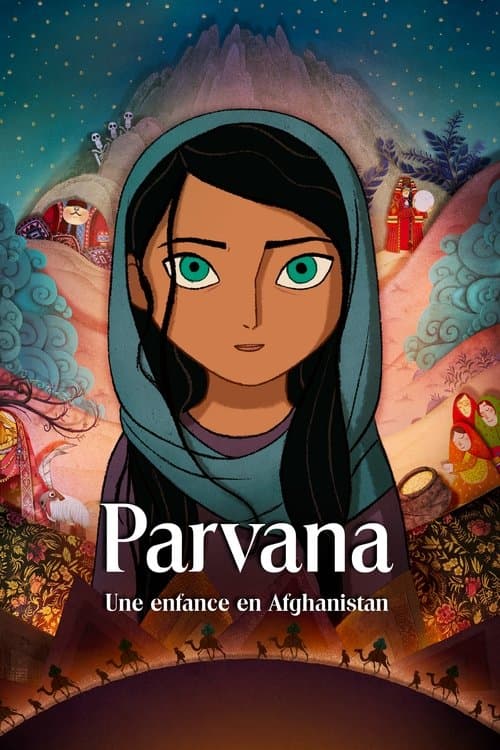
A headstrong young girl in Afghanistan, ruled by the Taliban, disguises herself as a boy in order to provide for her family.
About this title
- Format
- Feature film
- Year
- 2017
- Runtime
- 1h 33m
- Countries
- Canada, Ireland, Luxembourg, United States of America
- Original language
- EN
- Directed by
- Nora Twomey
- Main cast
- Saara Chaudry, Soma Bhatia, Noorin Gulamgaus, Laara Sadiq, Ali Badshah, Shaista Latif, Kanza Feris, Kawa Ada, Kane Mahon, Ali Kazmi
- Studios
- Aircraft Pictures, Cartoon Saloon, Melusine Productions, Jolie Pas, GKIDS
Content barometer
- Violence3/5Notable
- Fear4/5Intense
- Sexuality0/5None
- Language0/5None
- Narrative complexity3/5Complex
- Adult themes0/5None
Values conveyed
- Courage
- Perseverance
- Autonomy
- resilience
- friendship
- solidarity
- imagination