
The Boxtrolls
Does this age rating seem accurate to you?
Detailed parental analysis
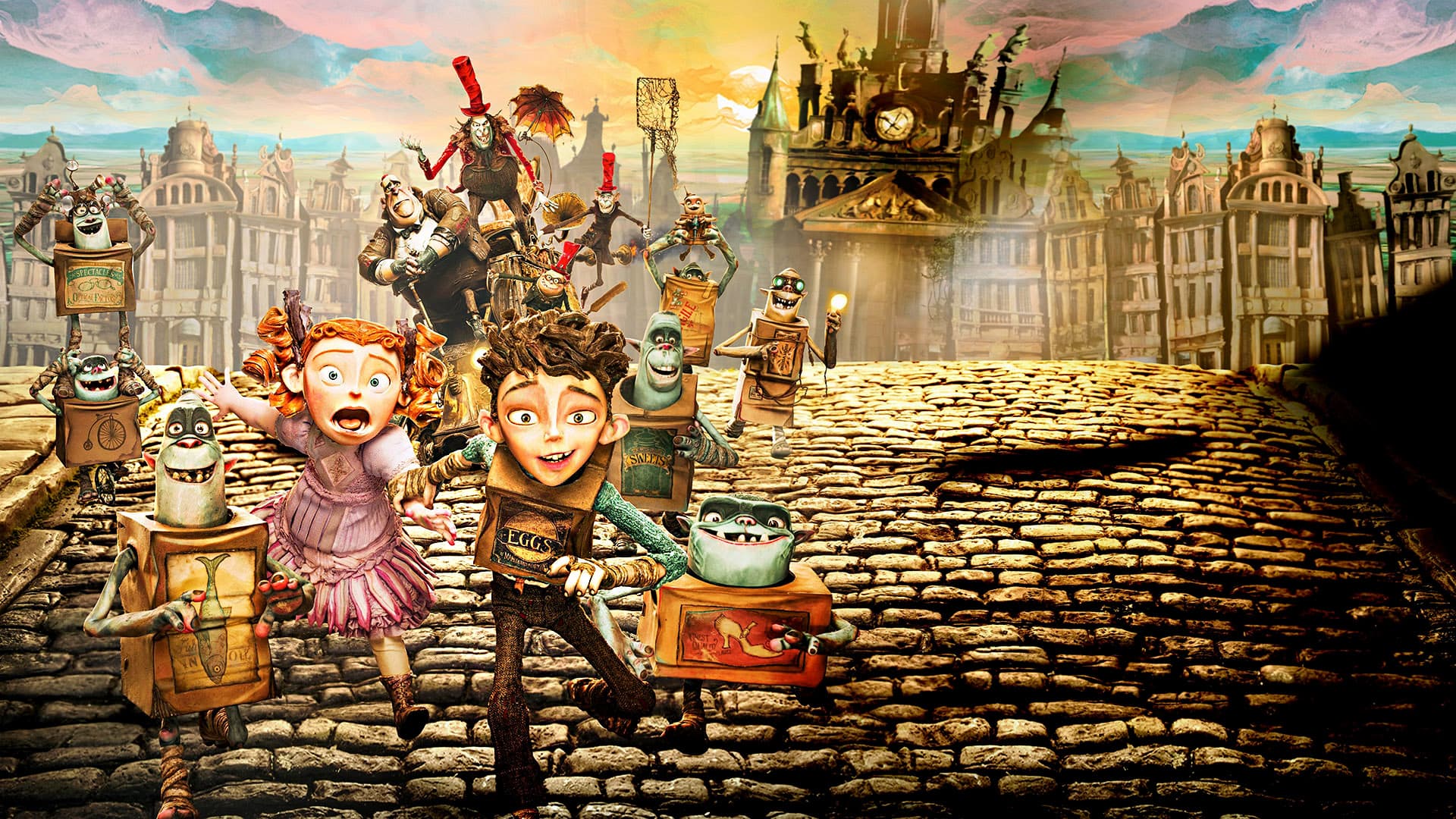
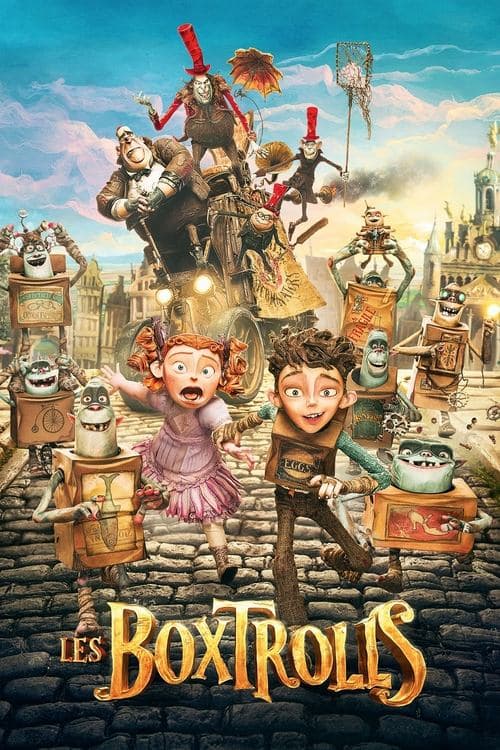
The Boxtrolls is an animated film with a dark, baroque and deliberately grotesque style, immersing the viewer in a Victorian town populated by strange creatures living beneath the cobblestones. The story follows a young boy raised by these underground creatures, who are threatened with extermination by an ambitious and unscrupulous monster hunter. The film targets children from around 8 years old, but its oppressive atmosphere and certain tense sequences make it unsuitable for younger viewers.
Violence
Violence is present recurrently and constitutes a central narrative device. The main villain threatens a baby to coerce its father, attempts to strangle a child with a scarf, and sends the young hero down into a running boiler. The Boxtrolls are captured and crushed by an industrial machine, a visually brutal scene even though the creatures survive it. These sequences are not gory in the strict sense, but they are designed to create genuine tension and can provoke intense fear in children under 7 or 8 years old. The violence remains in service of the narrative and is never presented as gratuitous: the film clearly condemns the villain's actions.
Underlying Values
The film constructs a solid argument about the manipulation of the masses: the villain fabricates a fictional threat to consolidate his power and climb the social ladder, and the population accepts this narrative without questioning it. This mechanism is shown with a pedagogical clarity rare for a film aimed at children. In parallel, the narrative values self-questioning: several characters, including secondary antagonists, become aware of their complicity and choose to change sides. Critique of class struggle is also present, with the wealthy depicted as superficial and obsessed with their rank, whilst the marginalised demonstrate more authentic humanity.
Parental and Family Portrayals
The film presents two contrasting parental figures that are explicitly commented upon. On one hand, a Boxtroll adoptive father who embodies unconditional and protective love, even across the most radical difference. On the other, an aristocrat who sacrifices his relationship with his daughter on the altar of his social ambitions, and whose emotional absence is clearly presented as a moral failure. This contrast is one of the film's strongest emotional axes and offers material for direct discussion with children about what it means to be a good parent.
Discrimination
The film uses the villain's cross-dressing, disguising himself as a singer to infiltrate high society, as a comedic and narrative device. This disguise is not presented as a critique of cross-dressing in itself, but as an illustration of the character's duplicity. Furthermore, the fear of the Boxtrolls rests on a scapegoating mechanism explicitly denounced by the narrative: the creatures are demonised on the basis of lies, and the film shows how fear of the other can be instrumentalised for political ends. This questioning is one of the film's most interesting points for discussion with a child.
Social Themes
Political critique is more present than one might expect in a family animated film. The narrative illustrates with precision how a demagogue builds his legitimacy by designating an imaginary enemy, by fostering fear and by promising security in exchange for power. This pattern is sufficiently clear to be discussed with a child of 9 or 10 years old, and sufficiently subtle to remain relevant for an adult.
Strengths
The film distinguishes itself through coherent and inventive artistic direction, which constructs an immediately recognisable visual universe, between gothic tale and steampunk machinery. The writing of secondary characters is carefully crafted, notably the villain's henchmen who develop moral conscience as the narrative progresses, which is rare in the genre. The argument about propaganda and collective manipulation is treated with a narrative intelligence that far exceeds the expected level of a children's animated film. Finally, the relationship between the young hero and his adoptive parents is treated with an emotional sincerity that avoids the usual conveniences of the genre.
Age recommendation and discussion points
The film is not recommended before age 7 due to its dark atmosphere and several sequences of intense tension, and can be watched comfortably from 8 or 9 years old. Two angles of discussion merit being opened after viewing: why did the town's inhabitants so readily believe the villain's lies about the Boxtrolls, and what is it that makes us afraid of someone we do not yet know.
Synopsis
An orphaned boy raised by underground creatures called Boxtrolls comes up from the sewers and out of his box to save his family and the town from the evil exterminator, Archibald Snatcher.
About this title
- Format
- Feature film
- Year
- 2014
- Runtime
- 1h 40m
- Countries
- United States of America
- Original language
- EN
- Directed by
- Graham Annable, Anthony Stacchi
- Main cast
- Ben Kingsley, Isaac Hempstead Wright, Elle Fanning, Dee Bradley Baker, Toni Collette, Jared Harris, Nick Frost, Richard Ayoade, Tracy Morgan, Simon Pegg
- Studios
- LAIKA
Content barometer
- Violence3/5Notable
- Fear4/5Intense
- Sexuality0/5None
- Language0/5None
- Narrative complexity2/5Moderate
- Adult themes0/5None
Watch-outs
- Abuse
Values conveyed
- Courage
- Acceptance of difference
- friendship
- empathy
- truth