

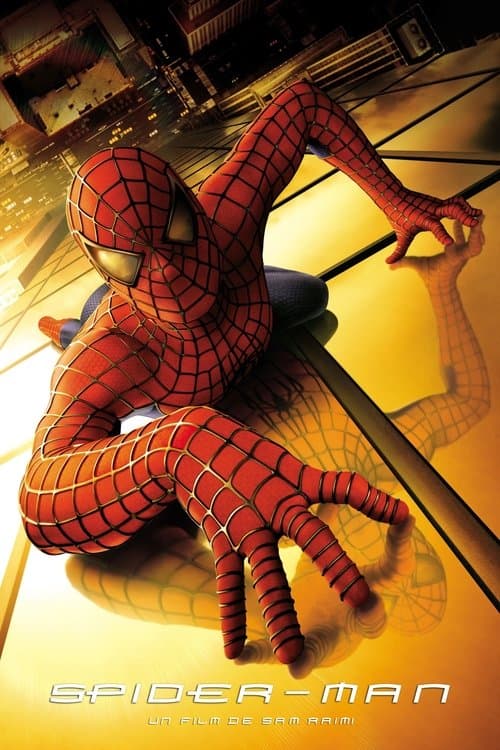
Spider-Man
Does this age rating seem accurate to you?
Detailed parental analysis
Spider-Man is a superhero film with an atmosphere that is at once adventurous and melancholic, rooted in the Marvel universe. The plot follows an ordinary teenager who, after being bitten by a genetically modified spider, acquires extraordinary powers and must choose between personal life and responsibility to others. The film is primarily aimed at teenagers and young adults, but its readability and relatively accessible tone have led many families to introduce it from middle school onwards.
Violence
Violence is present throughout and serves as the film's spectacular driving force. The fights are intense, with marked physical impacts, characters crashing through doors and walls, and visible blood on faces after confrontations. Two scenes exceed the register of ordinary stylised action: the death of a character by impalement, with visible blood, and a sequence in which civilians are vaporised in what resembles a gas chamber, with convulsions, eyes rolling back and the sight of skeletons disintegrating. This latter scene in particular may provoke a genuine reaction of fear or revulsion in younger viewers. The violence is nonetheless narratively motivated: it is never gratified for its own sake, and the narrative explicitly poses the question of the moral cost of using force.
Underlying Values
The structuring message of the film, stated plainly, is that with great power comes great responsibility. This is a solid moral framework coherent with the narrative as a whole: the hero learns at his own cost that inaction in the face of injustice has real and irreparable consequences. The film values integrity, personal sacrifice and the prioritisation of protecting others over individual interest. There is no problematic grey area here: these values are affirmed clearly and embodied in the narrative choices, making it a particularly effective basis for discussion with a young adolescent.
Parental and Family Portrayals
Parental figures occupy a central place in the emotional construction of the film. The hero is an orphan, raised by an uncle and aunt whose roles are affectionate, benevolent and morally exemplary. The relationship with the uncle is particularly developed: it carries the film's main ethical message and concludes with a loss that triggers the character's transformation. The film treats the grief of this substitute father figure with genuine sensitivity, which may resonate with children who have themselves experienced absences or family losses.
Sex and Nudity
Sexual content remains very restrained. A young woman whose t-shirt is wet allows the contours of her body to be seen in a brief scene. A few light remarks about the physical changes of adolescence and hormones are made without vulgarity. There is neither nudity nor explicit scene. These elements are incidental and pose no particular problem for adolescents, but may warrant a word for younger children to whom the film might be shown.
Language
Coarse language is rare and unremarkable. There are a few ordinary-register English expletives as well as one instance of blasphemy. Nothing that constitutes a real problem for the intended adolescent audience.
Strengths
The film achieves what few superhero adaptations manage to do: it anchors the spectacular in genuine emotional vulnerability. The main character is treated as a credible adolescent, torn between the desire for normality, the feeling of being misunderstood, and the brutal discovery that moral choices have concrete consequences. The narrative arc around guilt and responsibility is sufficiently well written to sustain a genuine conversation with a young viewer. The film also possesses undeniable cultural transmission value: it introduced to an entire generation a moral vocabulary on individual responsibility that remains relevant far beyond the superhero context.
Age recommendation and discussion points
The film is appropriate from age 12 with parental accompaniment, and without major reservations from age 13-14. Two angles of discussion are worth opening after viewing: firstly, what it concretely means to have a responsibility to others when one has the capacity to act, and secondly, how the hero manages the guilt linked to an irreparable past mistake, which touches on emotions that many adolescents know well.
Synopsis
After being bitten by a genetically altered spider at Oscorp, nerdy but endearing high school student Peter Parker is endowed with amazing powers to become the superhero known as Spider-Man.
About this title
- Format
- Feature film
- Year
- 2002
- Runtime
- 2h 1m
- Countries
- United States of America
- Original language
- EN
- Directed by
- Sam Raimi
- Main cast
- Tobey Maguire, Willem Dafoe, Kirsten Dunst, James Franco, Cliff Robertson, Rosemary Harris, J.K. Simmons, Joe Manganiello, Gerry Becker, Bill Nunn
- Studios
- Marvel Enterprises, Laura Ziskin Productions, Columbia Pictures
Content barometer
- Violence3/5Notable
- Fear3/5Notable tension
- Sexuality1/5Allusions
- Language1/5Mild
- Narrative complexity3/5Complex
- Adult themes0/5None
Values conveyed
- Courage
- Perseverance
- Loyalty
- responsibility
- sacrifice
- friendship