

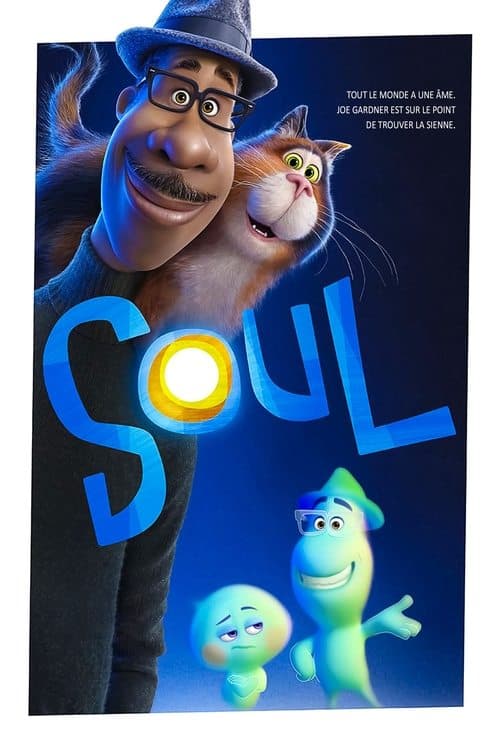
Soul
Does this age rating seem accurate to you?
Detailed parental analysis
Soul is a Pixar animated film with a contemplative and sometimes melancholic atmosphere, oscillating between whimsical comedy and philosophical meditation on the meaning of life. The plot follows a jazz musician whose soul is projected into a metaphysical world before he can realise his dream, and who must find a way to return to the world of the living. Despite its animated characters and inventive settings, the film is primarily aimed at adults and older teenagers; children under nine often find it boring or fail to grasp its stakes.
Underlying Values
The film builds its entire narrative around a central idea: the passion or particular talent that makes one want to live is not enough to constitute a full life. Joe, the hero, is obsessed with success in jazz to the point of ignoring everything else, and it is precisely this narrowing that the film puts into crisis. The message that emerges values small ordinary moments, connection with others and self-giving, against the race for individual achievement. This is a useful counterpoint to discuss with a child or teenager already under school or competitive pressure, even if the film does not fundamentally question the idea that finding one's vocation remains desirable. A solid angle for discussion: can you love what you do without making it the sole reason for living?
Social Themes
The film addresses death directly and repeatedly: the main character dies in the opening minutes, and much of the narrative unfolds partly in a stylised afterlife. Death is neither violent nor horrific in its visual treatment, but it is present as a central narrative reality and not as a distant threat. Abstract concepts such as pre-birth, destiny or the meaning of existence are staged concretely, which can trigger profound questions in sensitive children or those who have experienced recent bereavement.
Discrimination
The film offers a positive and authentic representation of the African-American community, with a main hero and a majority of human characters who are Black, embodied by actors corresponding to this identity. This choice is deliberate and intentional. There is nonetheless a legitimate debate about the fact that the main character spends most of the film in a non-human form, which concretely diminishes the visibility of this representation on screen. This is not a narrative flaw in itself, but it is an observation that deserves mention if the child or teenager is attentive to questions of representation.
Parental and Family Portrayals
Joe's mother occupies a significant place in the narrative. She is presented as a loving but pragmatic woman, sceptical of her son's artistic dreams and concerned with material stability. This tension between personal aspiration and parental expectation is handled with nuance: the mother is neither a caricatural obstacle nor an ideal model, making her an honest family portrait that can be discussed with a teenager.
Language
The word 'hell' is pronounced several times in a scene involving young souls, in a context that is not one of swearing but of a literal reference to a concept. It is not crude language in the usual sense, but it is worth flagging for families most attentive to religious vocabulary or registers perceived as coarse.
Strengths
Soul is a film of rare ambition for its genre: it poses philosophical questions about the purpose of existence without ever oversimplifying them or imposing a single answer. The universe of pre-life is visually inventive and coherent in its internal logic, which makes the abstract metaphor concrete and accessible. The soundtrack, which blends live jazz and electronic compositions, has real emotional density and can serve as an entry point into jazz culture for curious children. The film also succeeds in making an adult, imperfect and obsessive character endearing without absolving him of his flaws, which is narratively more demanding than the classical heroic schema.
Age recommendation and discussion points
The film is suitable from age nine onwards, but it truly finds its audience from age eleven or twelve, those who can sustain an hour and forty minutes of contemplative narrative and make sense of the existential questions it raises. Two concrete angles for discussion after viewing: ask the child what they think their own 'spark' is and whether that is enough to make a life happy, then explore together the scene between Joe and his mother to discuss the tension between personal dream and family expectations.
Synopsis
Joe Gardner is a middle school teacher with a love for jazz music. After a successful audition at the Half Note Club, he suddenly gets into an accident that separates his soul from his body and is transported to the You Seminar, a center in which souls develop and gain passions before being transported to a newborn child. Joe must enlist help from the other souls-in-training, like 22, a soul who has spent eons in the You Seminar, in order to get back to Earth.
About this title
- Format
- Feature film
- Year
- 2020
- Runtime
- 1h 40m
- Countries
- United States of America
- Original language
- EN
- Studios
- Pixar
Content barometer
- Violence1/5Mild
- Fear2/5A few scenes
- Sexuality0/5None
- Language1/5Mild
- Narrative complexity3/5Complex
- Adult themes0/5None
Values conveyed
- Friendship
- Compassion
- empathy
- perseverance
- meaning of life