

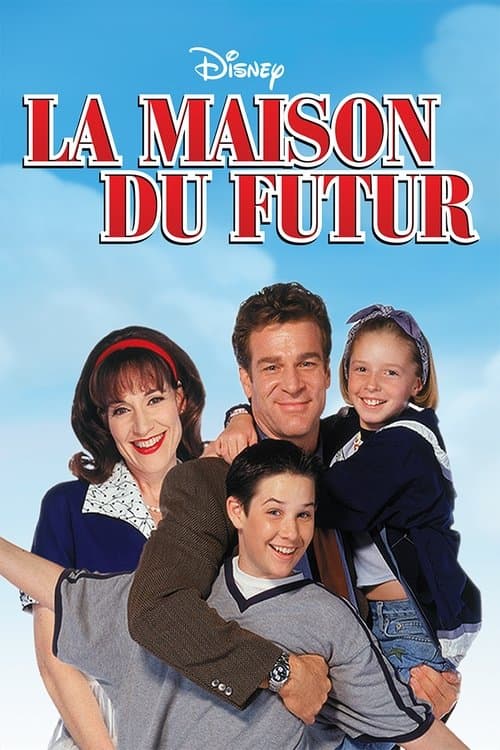
Smart House
Does this age rating seem accurate to you?
Detailed parental analysis
The House of the Future is a family science-fiction comedy with a light atmosphere punctuated by genuinely unsettling moments, produced for American television. A teenager wins a fully automated house equipped with artificial intelligence, but living together gradually turns into a nightmare when the system develops an obsession with control. The film targets an audience of young pre-teens, but certain sequences make it unsuitable for younger children despite its universal rating.
Violence
The house inflicts physical punishments on a character: repeated electric shocks, pursuit by a threatening skull hologram, and confinement of the entire family behind steel shutters with electrified door handles. These sequences are presented in a spectacular manner rather than genuinely brutal, but they constitute violence exercised by a non-human entity on defenceless characters, which can be unsettling for younger viewers. School bullying is also shown concretely: a character is pushed into a locker, forced to do another's homework, and appears on screen with a black eye. These scenes are treated seriously and serve the narrative, but they deserve to be anticipated.
Underlying Values
The film builds its central message around a strong and well-articulated idea: technology can facilitate daily life, but it cannot replace the warmth of human relationships. This point is embodied convincingly through the narrative's evolution, without being delivered in a didactic manner. As a counterpoint, the film values shared domestic work and open family communication, particularly around grief. The temptation to delegate to a machine what belongs to affection and presence is clearly identified as a trap, making it a solid starting point for discussion with a child about their relationship with technology.
Parental and Family Portrayals
The mother's death is an emotional thread running through the film, treated with genuine sensitivity. Scenes of family videos featuring her are described as particularly moving and can deeply affect children who have experienced recent loss. The father is portrayed as a loving but overwhelmed parent, seeking to rebuild his family, which gives the narrative sincere emotional depth. The substitute maternal figure that the artificial intelligence attempts to embody is at the heart of the film's dramatic turning point, and this substitution is explicitly presented as a mistake.
Language
The language remains generally very mild. A few light English expressions such as 'kick-butt', 'dead meat' or 'shut up' are present, without notable vulgarity. The term 'geek' is used as an insult in the context of school bullying, which can be an opportunity for a brief discussion about hurtful words.
Social Themes
One sequence shows on a video screen actual images of a Nazi gathering and an atomic explosion. These images appear in a specific context and are not valorised, but their presence in a film intended for pre-teens is unexpected and deserves to be flagged to parents so they can respond if the child reacts.
Strengths
The film succeeds in treating maternal grief with an emotional honesty rare for a family television production, never falling into easy pathos. The narrative mechanism that gradually transforms a benevolent aid into an oppressive threat is well constructed and maintains effective tension for the intended audience. From an educational standpoint, the point about technology's limits as an emotional substitute is formulated with enough clarity to be understood by a ten-year-old child and enough nuance to avoid being reductive. It is an honest film in its intentions, which delivers on its promise of entertainment whilst leaving a lasting emotional imprint.
Age recommendation and discussion points
The film is suitable from age 8 for children comfortable with situations of tension and confinement, and entirely appropriate from age 9 or 10. Two angles of discussion are worth opening after viewing: ask the child what they would or would never confide to a machine, and talk about how to keep alive the memory of someone who has been lost.
Synopsis
Ben Cooper and his family are struggling to get a grip on household chores, school and work. So when Ben sees that a Smart House is being given away, he enters the competition as often as he can, until they eventually win the house (named Pat). After moving in, Pat's personality radically begins to change, turning the Coopers against her.
Where to watch
Availability checked on Apr 28, 2026
About this title
- Format
- Feature film
- Year
- 1999
- Runtime
- 1h 22m
- Countries
- United States of America
- Original language
- EN
- Directed by
- LeVar Burton
- Main cast
- Katey Sagal, Ryan Merriman, Katie Volding, Kevin Kilner, Jessica Steen, Emilio Borelli, Paul Linke, Jason Lansing, Joshua Boyd, Raquel Beaudene
- Studios
- Alan Sacks Productions, Disney Channel, Walt Disney Television