Shrek the Third
Does this age rating seem accurate to you?
Detailed parental analysis
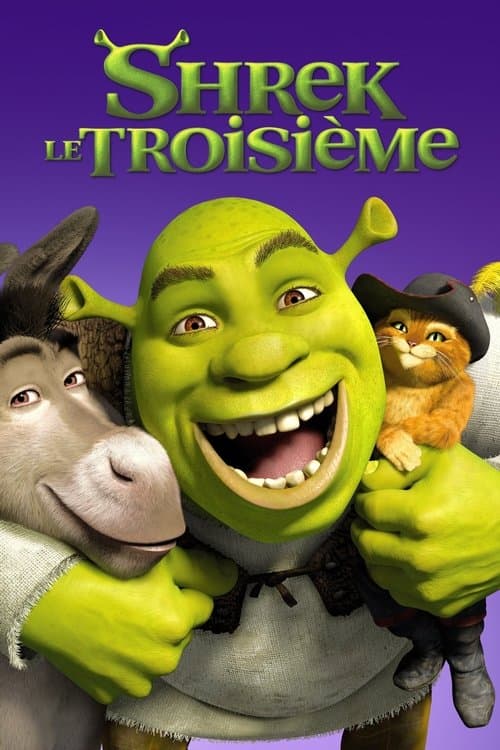
Shrek the Third is a family animated comedy with an upbeat and irreverent tone, the third instalment of a franchise that appears on the surface to address children but multiplies winks intended for adults. The plot follows Shrek forced to accept an heir to the throne of the Far Far Away Kingdom, while Fiona awaits him at home pregnant. The film targets a broad family audience, with a marked preference for school-age children and their parents.
Underlying Values
The film carries two well-constructed structuring messages. The first, addressed to children, asserts that appearance or the past does not determine what one can become: characters who are villains are invited to reinvent themselves, and redemption is presented as accessible to all. The second, more subtle and intended for adults in the audience, explores the fear of fatherhood through Shrek: the character must accept a responsibility he did not choose, and his inner progression constitutes the most honest emotional arc of the film. These two threads coexist without contradiction, which makes it genuine subject matter for conversation with an inquisitive child eager to understand why his father laughed or fell silent at a particular moment.
Discrimination
The film deliberately plays with the codes of traditional fairy tales in order to overturn them: passive princesses become autonomous, determined fighters, Snow White exchanges gentleness for a hard rock warrior temperament, and it is the women who save the men in peril. This reversal is not discreet; it is staged as a recurring narrative gag. The intention is clearly parodic and positive, but it is worth naming with a child: why do we laugh when a princess fights? What does that tell us about what we expected before?
Parental and Family Portrayals
Parenthood is a central theme and is treated with genuine emotional sincerity, which sets this instalment apart from the two preceding ones. Shrek embodies a figure of fatherhood in the making, hesitant and frankly terrified, whose nightmares about baby ogres constitute the most memorable sequence of the film. This portrayal avoids the cliché of the incompetent father to show something truer: the fear of living up to expectations, the worry of passing on one's own flaws. Fiona, for her part, copes with her companion's temporary absence and demonstrates a solidity that neither removes her vulnerability nor her character.
Violence
Violence remains light and comedic throughout the vast majority of the film. One exception merits attention: Shrek accidentally kills a character off-screen, and the sequence is treated in a humorous manner without any moral reflection on the act. It is not graphic, but the complete absence of consequence surrounding a death, even an accidental one, may surprise. Shrek's nightmares involve babies who cause chaos and trigger a stampede, which can frighten the youngest or most sensitive children. The rest of the confrontations are choreographed as classical physical comedy, without real tension.
Substances
Two implicit references merit being flagged. Teenagers emerge from a van filled with smoke and mention incense: the scene is constructed as an allusion to soft drugs, sufficiently coded to pass over children's heads but readable for teenagers and adults. Furthermore, Puss uses a horn sound to cover a verbal allusion to a sexual practice, a classical double-register technique. Neither one nor the other constitutes a message of endorsement, but their presence in a film branded as family entertainment may surprise a parent who does not anticipate it.
Sex and Nudity
The film uses double register on several occasions to slip sexual innuendo over the heads of young children, for the benefit of parents. These moments remain discreet and do not constitute a sexualisation of the characters. There is no nudity nor any explicit or suggestive scene in the strict sense.
Strengths
The film does not attain the emotional richness of the first two instalments, and several family critics note this with a degree of disappointment. That said, the sequence of Shrek's nightmares is inventive and genuinely funny for an adult, and the arc on the fear of fatherhood offers a sincere emotional entry point for parents who see their own ambivalence reflected in a green ogre. The subversion of fairy tale feminine archetypes is carried out with coherence and genuine comic energy. The film functions as an object of light transmission between generations: there is sufficient parodied cultural references to fuel a conversation after viewing.
Age recommendation and discussion points
The film is suitable from age 6 accompanied, and can be watched serenely from age 7 or 8 for a child without particular sensitivity to fear or adult humour. Two concrete angles to address after viewing: why is Shrek so afraid of becoming a father, and what does that say about what adults sometimes feel facing major responsibilities? And also: does it surprise us that princesses who fight like warriors, and if so, why?
Synopsis
The King of Far Far Away has died and Shrek and Fiona are to become King & Queen. However, Shrek wants to return to his cozy swamp and live in peace and quiet, so when he finds out there is another heir to the throne, they set off to bring him back to rule the kingdom.
About this title
- Format
- Feature film
- Year
- 2007
- Runtime
- 1h 33m
- Countries
- United States of America
- Original language
- EN
- Studios
- DreamWorks Animation, Pacific Data Images
Content barometer
- Violence2/5Moderate
- Fear2/5A few scenes
- Sexuality1/5Allusions
- Language1/5Mild
- Narrative complexity1/5Accessible
- Adult themes1/5Mild
Values conveyed
- Courage
- Acceptance of difference
- Forgiveness
- friendship
- family
- self acceptance