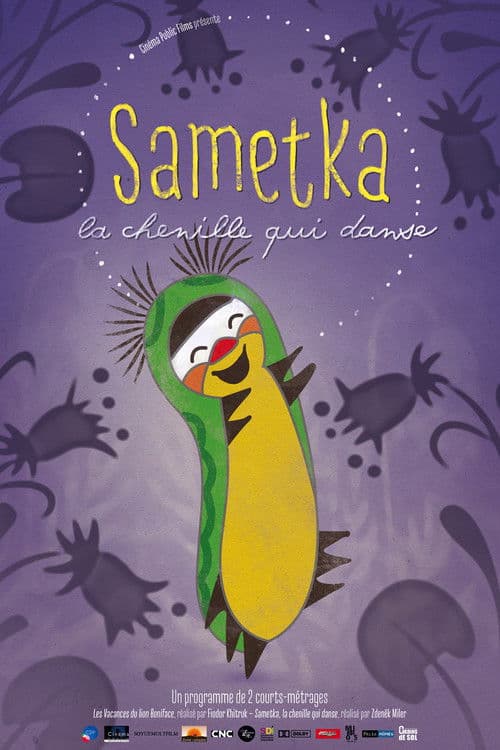
Sametka
Does this age rating seem accurate to you?
Detailed parental analysis
Sametka is a cheerful Soviet animated short film on the surface, yet it carries a biting satire of show business and celebrity. The story follows a caterpillar with a gift for dancing who, after being discovered by an opportunistic businessman, finds himself thrust into the spotlight much to the dismay of his young owner. The film is primarily aimed at young children, but its critical perspective on show business speaks equally to parents watching alongside them.
Underlying Values
The film constructs an explicit and sustained critique of entertainment capitalism: the businessman smokes with satisfaction, exploits the caterpillar's talent without scruple, and commercialises products bearing the caterpillar's image, including cigarettes. The message is clear and unapologetic: celebrity commodifies the living and destroys authentic bonds. In counterpoint, the narrative affirms that a wild animal belongs in its natural habitat and not in a home or on a stage. These two structural values, anti-exploitation and return to nature, form the moral heart of the film and offer rich material for discussion with a child.
Substances
The businessman smokes cigarettes repeatedly and overtly pleasantly, and the merchandise bearing the caterpillar's image includes cigarettes. Tobacco consumption is directly associated with the character of the cynical capitalist, conferring on it a negative symbolic charge rather than a direct valorisation. That said, the visual presence is real and repeated, worth noting for very young children.
Violence
The film contains a few sequences liable to startle the youngest viewers: a visible explosion that frightens the caterpillar, a chase scene with groupies, some of whom fall from a helicopter, and the destruction of a house during a frenzied search. These moments are treated in a comedic and burlesque register rather than a dramatic one, but their accumulation gives the film an agitated energy that may disorient very sensitive children or those under three years of age.
Social Themes
The critique of industrialised show business and the commercial logic that transforms the living into a commercial product constitutes the underlying subject of the film. The merchandising of cigarettes bearing an animal's image is a deliberately absurd and grating image that points towards the logic of consumer capitalism. For a Soviet children's film from 1968, this satire has a clearly legible ideological dimension, without being impenetrable to a young viewer of today.
Strengths
The film has the conciseness and effectiveness of the finest animated shorts from the Soviet school: in a few minutes, it establishes recognisable characters, distils satire legible at several ages, and constructs a complete narrative arc. Burlesque humour works for children whilst the critique of show business speaks to adults, making it a rare object. The figure of the smoking and opportunistic businessman is drawn with effective economy of means. The film also raises, without heavy didacticism, the question of what it means to own an animal, making it a useful pedagogical trigger for conversation.
Age recommendation and discussion points
The film is suitable from four years of age onwards, the visual agitation and a few sequences of fright being better absorbed beyond three years than from it. Two angles merit being addressed after viewing: why the businessman transforms the caterpillar into a product to sell and what this says about the way adults sometimes treat what does not belong to them, and what it truly means to care for an animal by respecting what it needs.
Synopsis
A boy has a velvetbean caterpillar as a pet. He teaches it to dance and it becomes a world sensation.
About this title
- Format
- Short film
- Year
- 1968
- Runtime
- 17m
- Countries
- Czechoslovakia
- Original language
- CS
- Studios
- Krátký film Praha – Studio animovaných filmů
Content barometer
- Violence2/5Moderate
- Fear2/5A few scenes
- Sexuality0/5None
- Language0/5None
- Narrative complexity0/5Simple
- Adult themes2/5Present
Watch-outs
Values conveyed
- Acceptance of difference
- Autonomy
- friendship
- loyalty
- wonder
- empathy