Roald Dahl's Matilda the Musical
Does this age rating seem accurate to you?
Detailed parental analysis
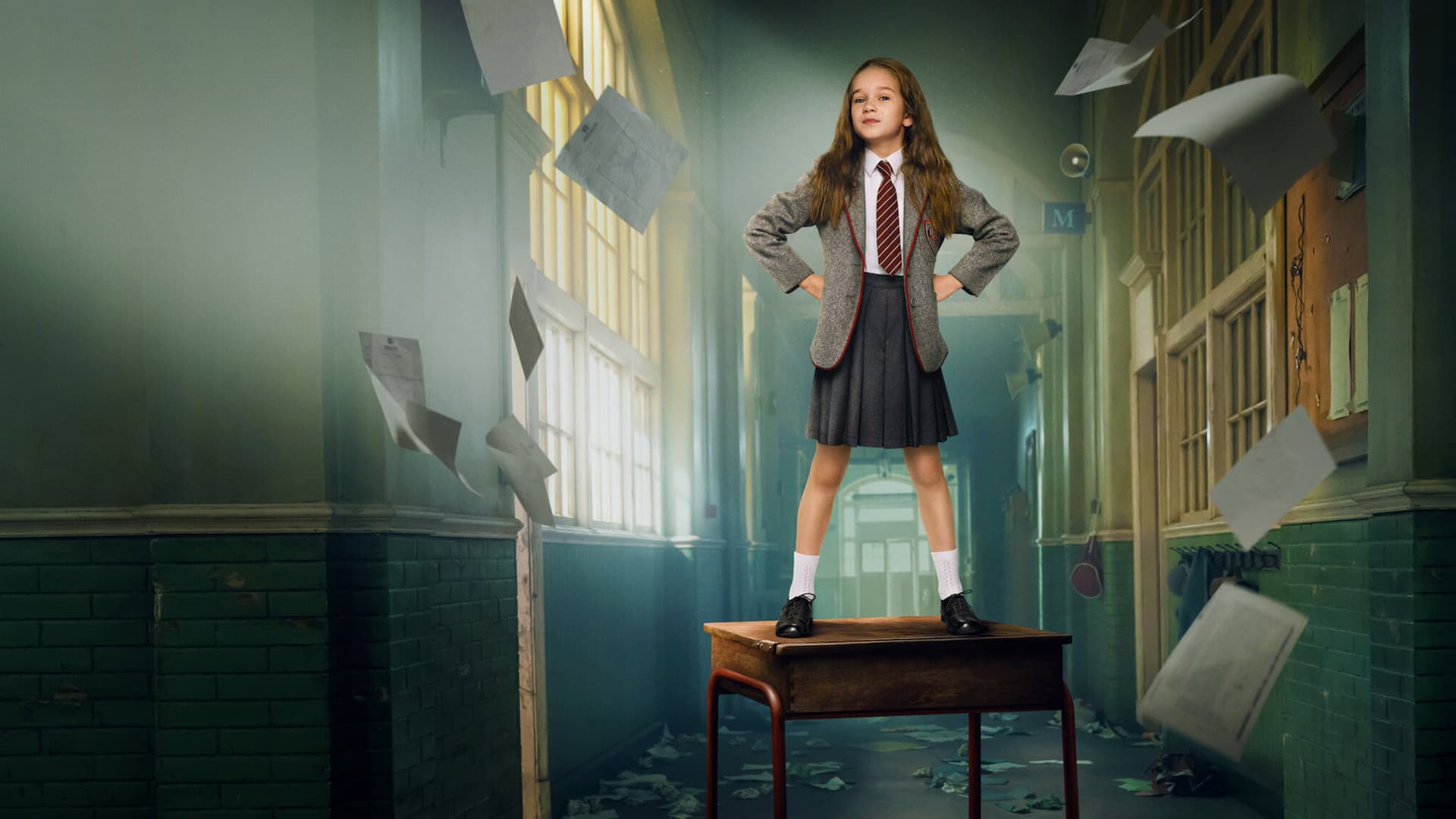
Matilda the Musical is a dark and exuberant adaptation of Roald Dahl's novel, driven by a baroque fairy tale aesthetic where the absurd and the unsettling constantly intertwine. The story follows a young girl endowed with telekinetic powers who grows up in an indifferent family and confronts a tyrannical school headmistress, seeking in books and her own determination the means to free herself. The film targets a young pre-adolescent audience, but its emotional intensity and the stylised brutality of certain scenes make it something to weigh seriously for children under eight years old.
Parental and Family Portrayals
Parental maltreatment is at the heart of the film and is not softened. Matilda's parents are neglectful, contemptuous and physically brutal: they throw her into her room, lock her in, and make her understand at every turn that she is a burden. The treatment is deliberately caricatural and comic-book-like, which lessens the traumatic impact for older children, but does not eliminate it. For a younger or more sensitive child, the depiction of a family that does not want its child can resonate painfully. The film constructs in counterpoint the idea that a loving family can be formed outside biological ties, notably around the relationship with her teacher, Mrs Honey. This is one of the film's strongest messages, and one of the most useful to put into words after viewing.
Violence
School violence is spectacular and repeated. Headmistress Trunchbull throws a child over a wall by his plaits, locks pupils in a wooden cage lined with spikes, and forces a boy to eat an entire cake in front of his classmates. These scenes are treated with cartoonish black humour, but their physical intensity remains real, particularly for children under eight who do not yet have the resources to distance themselves from the register of the absurd. The climax sees Matilda use her telekinesis to create a chain monster that expels the headmistress, resulting in an off-screen explosion. Violence here has a clear narrative purpose: it documents injustice in order to better legitimise resistance, and does not revel in gore. Still, the accumulation of scenes of physical intimidation can leave an impression on the youngest or most anxious children.
Underlying Values
The film explicitly valorises intelligence, reading and critical thinking as tools of emancipation in the face of abusive adults. This is a structurally sound message. It also valorises resistance to unjust authority, which merits discussion: the film does not always clearly distinguish between the abusive authority that must be contested and the benevolent authority that must be respected. Revenge is also present and clearly presented as deserved: Matilda dyes her father's hair green, glues his hat to his head, and contributes to the headmistress's definitive expulsion. These acts are treated as moral victories, without questioning the limits of retaliation. For a child, it is worth discussing the difference between justice and revenge, and the role of the trusted adult in resolving conflicts.
Language
The register of insults is present and targeted at children: they are called worms, idiots, repugnant creatures, larvae. The choice of vocabulary is consistent with the logic of excessive fairy tale, and serves to characterise the monstrosity of authoritative figures. Nevertheless, certain terms are repeated often enough to establish a register. Nothing obscene, but a young child may retain the form without retaining the ironic distance the film grants it.
Substances
Alcohol consumption is present incidentally: the parents prepare cocktails at home, without the scene making it a narrative issue. The mention is too peripheral to open a useful discussion, but sufficient to signal that the film is not entirely free of the subject.
Strengths
The film is driven by dense and inventive musical writing, where songs advance the narrative rather than interrupt it. The direction faithfully recreates Roald Dahl's skewed and slightly nightmarish universe, with an artistic direction that treats the darkness of the tale as a visual material in its own right rather than as an obstacle to be circumvented. The performance of the young lead actress is remarkable for its precision and intensity. From an educational standpoint, the film offers a rare and affirmed representation of a child who thinks, reads, constructs her own narratives and resists through intelligence rather than force. The narrative arc around chosen family is handled with genuine emotional sensitivity, without artificial sentimentality.
Age recommendation and discussion points
The film is not recommended before age eight without attentive parental guidance, and can be viewed serenely from age nine for most children. Two discussions deserve to be opened after viewing: first, the difference between an unjust authority that can be contested and a benevolent authority that must be respected, drawing on the film's contrasting examples; second, the question of whether revenge and justice are the same thing, and what Matilda could have done differently or additionally.
Synopsis
An extraordinary young girl discovers her superpower and summons the remarkable courage, against all odds, to help others change their stories, whilst also taking charge of her own destiny. Standing up for what's right, she's met with miraculous results.
About this title
- Format
- Feature film
- Year
- 2022
- Runtime
- 1h 57m
- Countries
- United Kingdom
- Original language
- EN
- Directed by
- Matthew Warchus
- Main cast
- Alisha Weir, Emma Thompson, Lashana Lynch, Stephen Graham, Andrea Riseborough, Sindhu Vee, Carl Spencer, Lauren Alexandra, Winter Jarrett Glasspool, Andrei Shen
- Studios
- Working Title Films, The Roald Dahl Story Company