

Rio
Does this age rating seem accurate to you?
Detailed parental analysis
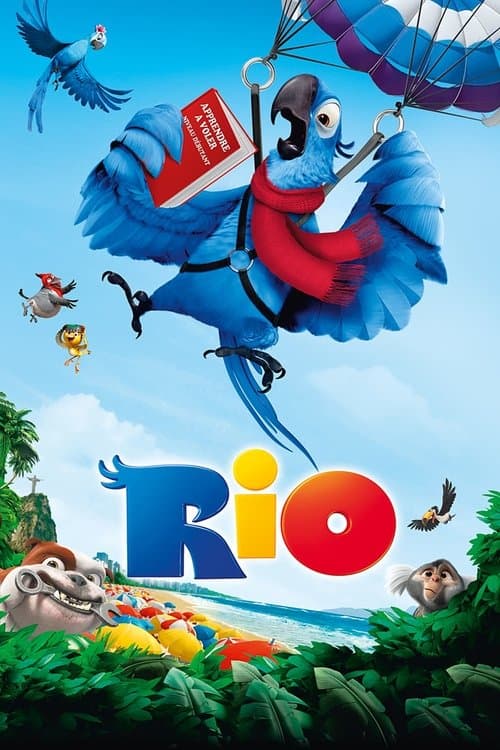
Rio is an animated adventure comedy with a joyful, colourful and musical atmosphere, driven by a constant carnival-like energy. The plot follows Blu, a domesticated blue macaw who has never learned to fly, forced to leave Minnesota and travel to Rio de Janeiro in order to save his species by mating with the last female of his kind. The film primarily targets children from ages 6-7 and their families, without excluding adults who will find it an enjoyable visual and musical form of entertainment.
Sex and Nudity
The central narrative pretext is the mating of two birds to save the species, which leads to several seduction sequences with explicit commentary, notably advice on how to seduce a female. A line such as 'Baby got beak' constitutes a riff on an expression with adult sexual connotations, audible to parents but likely opaque to young children. More directly visible to all, the film multiplies close-ups of female characters in very skimpy bikinis, including a shot focused on moving buttocks during a carnival scene. Blu's inability to fly is presented at times as a metaphor for masculine inadequacy, an angle that children generally do not decode but that adults will clearly identify. These elements do not constitute explicit sexuality, but their accumulation merits being known to parents before viewing with young children.
Violence
The film's violence is largely cartoon in nature, but the character of the cockatoo Nigel introduces a frankly menacing tone. He physically torments a small bird by pinning it under his claws until its eyes bulge out, a brief scene but intense enough for sensitive children. The chases with poachers, a circular saw that threatens the chained characters, and several free falls by Blu constitute a sustained level of peril, never gory but regularly stressful. The violence always serves the narrative and leads to reassuring resolutions, which lessens its impact without erasing it.
Discrimination
The film deploys a series of Brazilian stereotypes presented without critical distance: passion for football, omnipresence of samba, carnival exuberance systematically associated with local characters. The relationship between Fernanda and the street child Fernando reproduces a pattern of benevolent patronage in which the wealthy adopt the poor, without the film ever questioning the social dimension of this gap. These representations are not malicious in intent, but they reduce a complex culture to its most exportable clichés, which can be a useful starting point for discussion with a curious child or one of Brazilian origin.
Underlying Values
The film's guiding thread is the courage to overcome one's fears, embodied by Blu who must learn to fly in order to exist fully. Freedom as an aspiration opposed to comfortable domestication runs throughout the narrative and constitutes its most honest message: Blu must choose between the security of a risk-free life and belonging to something greater than himself. Collaboration and loyalty are valued in a coherent way, without being preachy. The message about exotic animal trafficking is present but remains incidental to the narrative structure, sufficiently clear for children without stifling the adventure.
Language
The film contains a recurring register of mild insults, primarily in English in the original version: 'idiot', 'stupid', 'useless', 'dumb', 'shut up'. These expressions appear mainly in the villain's mouth and in comic exchanges. Without being shocking, this level of language is worth noting for families who wish to avoid this type of vocabulary among young children.
Social Themes
Exotic animal trafficking structures the crux of the plot and gives the film an accessible ecological dimension, without ever veering into documentary or didacticism. Deforestation and the threat of extinction of the Spix's macaw are factual realities that the film employs without distorting them. This is one of the strongest entry points for extending the conversation after the film on biodiversity and the illegal trade in wild species.
Strengths
The film's artistic direction is its unquestionable strong point: the recreation of Rio de Janeiro, the carnival sequences and the jungle cinematography exude genuine visual generosity. The soundtrack weaves together samba, Brazilian funk and original compositions with a coherence that goes beyond mere ornamentation, and several musical numbers function as genuine choreographed sequences. The pacing is well-maintained, the secondary characters bring real flair, and the film succeeds in sustaining an infectious good humour without tipping into sentimentality. For a school-age child, Blu's fear of something he is supposed to know how to do naturally is an authentic and relatable emotional device.
Age recommendation and discussion points
The film is broadly appropriate from age 7 onwards, with parental accompaniment recommended for sensitive 6-7 year-olds in response to frightening characters and scenes of repeated peril. Two angles of discussion are worth opening after viewing: why is Blu afraid to do something that is natural for him, and what does that tell us about our own fears in the face of things we are supposed to know how to do, on the one hand; and on the other, does what the film shows of Brazil correspond to the reality of an entire country, or to a simplified image that we can question together.
Synopsis
Captured by smugglers when he was just a hatchling, a macaw named Blu never learned to fly and lives a happily domesticated life in Minnesota with his human friend, Linda. Blu is thought to be the last of his kind, but when word comes that Jewel, a lone female, lives in Rio de Janeiro, Blu and Linda go to meet her. Animal smugglers kidnap Blu and Jewel, but the pair soon escape and begin a perilous adventure back to freedom -- and Linda.
About this title
- Format
- Feature film
- Year
- 2011
- Runtime
- 1h 30m
- Countries
- United States of America
- Original language
- EN
- Studios
- Blue Sky Studios, 20th Century Fox Animation, 20th Century Fox
Content barometer
- Violence2/5Moderate
- Fear3/5Notable tension
- Sexuality2/5Mild
- Language1/5Mild
- Narrative complexity1/5Accessible
- Adult themes0/5None
Watch-outs
- Ethnic or racial stereotypes
- Sexuality
- Violence
Values conveyed
- Courage
- Acceptance of difference
- Loyalty
- Autonomy
- friendship
- teamwork
- self-confidence