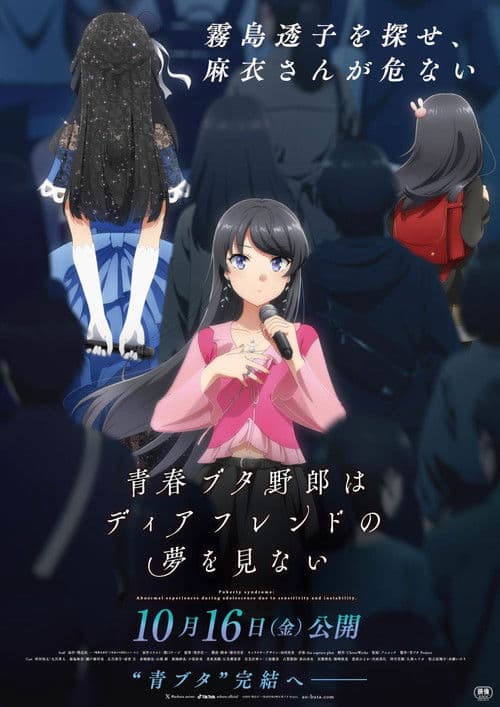
Rascal Does Not Dream of a Dear Friend
青春ブタ野郎はディアフレンドの夢を見ない
Does this age rating seem accurate to you?
Detailed parental analysis
Rascal Does Not Dream of a Dear Friend is an adolescent drama with a densely emotional atmosphere, blending subtle fantasy and psychological introspection in a tone that is both melancholic and luminous. The plot follows a sixth-form student confronted with a new enigma touching on identity and friendship, extending the existential questions that define the franchise. The film is primarily aimed at teenagers and young adults already familiar with the series, but remains accessible to any adolescent receptive to coming-of-age narratives.
Underlying Values
The film carries a structurally positive message: confronting one's inner fears, accepting vulnerability, and leaning on others are presented as acts of courage, not weakness. Characters who avoid their suffering pay a narrative price, whilst those who choose to face it evolve visibly. The narrative treats friendship as a real and demanding force, not as a comfortable given. This moral architecture is solid and consistent with the entire franchise, making it a strong foundation for discussion.
Sex and Nudity
The film adopts the franchise's usual suggestive conventions without exceeding them. Female characters appear in revealing clothing, notably rabbit costumes and miniskirts, and certain exchanges include allusions to sexuality, including jokes about sex and masturbation. The male protagonist is depicted bare-chested on several occasions. These elements fall within an assumed adolescent register rather than aggressive sexualisation, but they are sufficiently recurring to warrant discussion with a younger or more sensitive child.
Social Themes
Depression, suicidal ideation and self-harm are addressed with seriousness and sensitivity, consistent with the spirit of the series. These themes are neither trivialised nor sensationalised: they are treated as realities that characters must learn to name and face. School bullying and cyberbullying are also present, situated within a narrative trajectory of reconstruction rather than fixed victimisation. For an adolescent going through similar difficulties themselves, the film may resonate strongly, positively or painfully depending on their state of mind.
Parental and Family Portrayals
Parental figures are marked by absence, separation or emotional abandonment. Family breakdown is a background condition that weighs on several characters and feeds their psychological fragility. Parents are not caricatured as antagonists, but their structural failings are a driver of the adolescent distress depicted. This is a relevant angle for discussion to anticipate with a child whose own family situation is equally complex.
Violence
One character administers sleeping pills to another without consent. The act is narratively framed but not trivial: it deserves to be explicitly discussed with the child, as the film does not condemn it with the clarity one might expect. Beyond this, physical violence is absent or very marginal.
Language
The register includes mild insults such as 'idiot' or 'stupid', as well as aggressive formulations such as 'go die'. These elements are occasional and do not constitute a strong marker of the film, but they contribute to an adolescent register that may surprise a younger pre-adolescent.
Strengths
The Rascal Does Not Dream franchise has developed over time a rare emotional writing style in the adolescent drama landscape: it treats psychological disorders, identity dissociations and affective ruptures with a precision that avoids both self-indulgence and oversimplification. This film perpetuates that standard. The central relationship between characters is constructed with subtlety, without easy resolution. For an adolescent capable of engaging with it, the film offers a space for projection and verbalisation of feelings difficult to articulate otherwise. It also has the quality of situating its weighty themes within a narrative that remains watchable, carried by a balance between surface lightness and emotional depth.
Age recommendation and discussion points
The film is not recommended before the age of 14 due to the density of themes addressed, notably suicidal ideation, self-harm and situations of family breakdown. For an adolescent aged 15 or 16, it is fully relevant viewing, provided they are ready to discuss it afterwards. Two concrete angles for discussion: why some characters seek to disappear or fade away rather than ask for help, and how the franchise represents the psychological difficulties of adolescents compared to what a young person actually lives or observes around them.
Synopsis
Faced with the truth about Miori and Touko Kirishima, Sakuta must make a choice. This will be his final case of Adolescence Syndrome!
About this title
- Format
- Feature film
- Year
- 2026
- Countries
- Japan
- Original language
- JA
- Directed by
- Soichi Masui
- Main cast
- Asami Seto, Kaito Ishikawa, Sora Amamiya, Aya Yamane, Konomi Kohara, Manaka Iwami, Reina Ueda, Nao Toyama, Atsumi Tanezaki, Maaya Uchida
- Studios
- CloverWorks, KADOKAWA, Aniplex
Content barometer
- Violence1/5Mild
- Fear2/5A few scenes
- Sexuality2/5Mild
- Language2/5Moderate
- Narrative complexity0/5Simple
- Adult themes1/5Mild
Values conveyed
- Courage
- Friendship
- Acceptance of difference
- empathy
- understanding