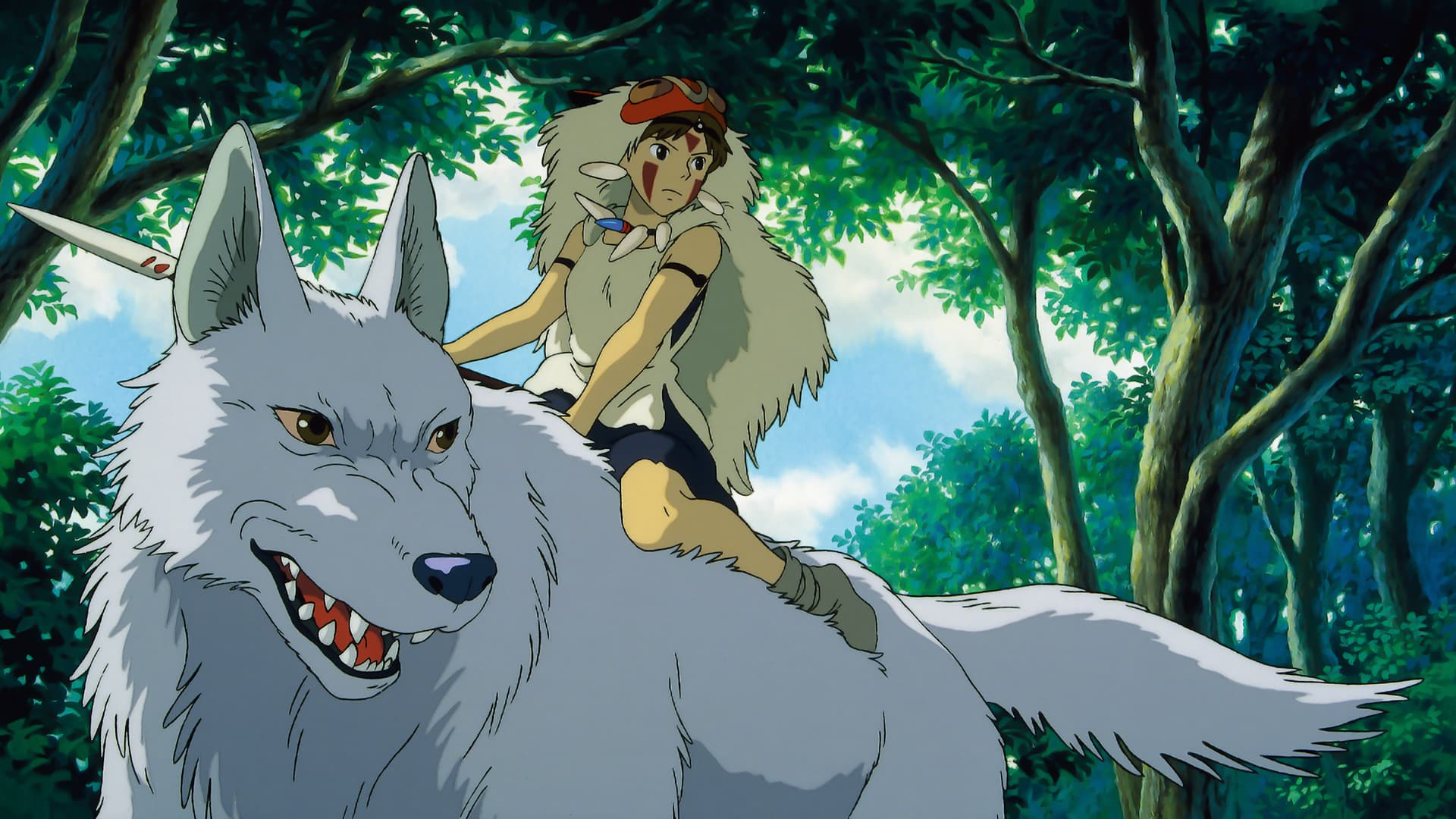

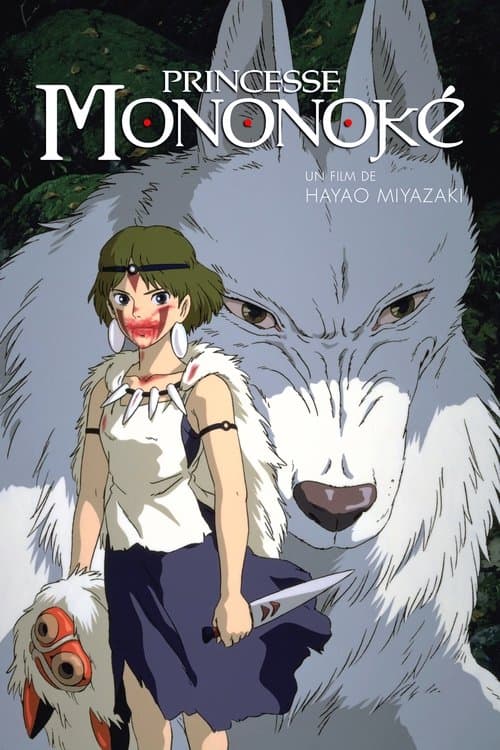
Princess Mononoke
もののけ姫
Does this age rating seem accurate to you?
Detailed parental analysis
Princess Mononoke is a Studio Ghibli animated film with a dark, epic and contemplative atmosphere, driven by visual violence markedly more pronounced than most of the studio's other works. The plot follows Ashitaka, a young warrior struck by a deadly curse, who finds himself at the heart of a violent conflict between a human industrial city and the animal-gods of the forest. The film addresses adolescents and adults above all, not young children despite its animated format.
Violence
Violence is the most striking element of the film and far exceeds what one would typically expect from an animated feature. There are depictions of beheadings and severed limbs with visible blood, soldiers dying in masses from firearms and fire, and divine creatures whose flesh disintegrates or is devoured by blackish parasitic forms. This violence is not gratuitous: it serves a reflection on the consequences of war and the destruction of nature, and no side is spared or presented as entirely just. It remains nonetheless intense, repeated and graphic, making it unsuitable for sensitive or younger children, and justifying genuine preparation for adolescents.
Social Themes
Ecology forms the narrative backbone of the film: the tension between human development and the preservation of the natural world is treated with rare sincerity and complexity. Neither humans nor the forest are monolithically good or bad. The film raises concrete questions about resource exploitation, the economic survival of marginalised populations and the irreversible damage caused to the environment. It is particularly fertile ground for discussion amongst adolescents, especially as the film refuses simple answers.
Underlying Values
The narrative explores the cycle of vengeance as an engine of collective destruction: San is driven by hatred of humans, Ashitaka's curse was born from the anger of a wounded god, and most characters are imprisoned by grudges that blind them. The film does not valorise vengeance, but it shows its power of attraction and its ravages with clear-sightedness. In counterpoint, Ashitaka embodies a form of compassion and empathy that resists corruption, without ever slipping into naivety. These tensions make the film a solid basis for reflection on the difficulty of breaking cycles of hatred.
Discrimination
The film actively subverts expected representations: San is a figure of wild power rather than a passive princess, and Lady Eboshi leads an industrial community with unchallenged authority. That same community welcomes women who have been reduced to prostitution, a reality evoked verbally without being developed graphically, but which draws a nuanced social portrait where marginalised people find dignity and role. These representations can open useful discussion on how animated films construct or deconstruct gender stereotypes.
Substances
A brief instance of alcohol consumption is present in the film, without particular emphasis and without significant narrative bearing.
Strengths
Princess Mononoke is a work of rare narrative and visual ambition in world animation. Its writing refuses easy manichaeism and builds characters whose motivations are all comprehensible, including those of the antagonists. The representation of the animal-gods and the forest creates a coherent mythological universe, anchored in Japanese cultural references (Shinto, relationship to nature as a living and sacred entity) that can open genuine intellectual curiosity in adolescents. The film treats the themes of death, curse and the irreversibility of acts with a gravity that respects the viewer's intelligence. It is one of the rare animated films to offer a genuine tragedy in the dramatic sense of the term, without softening its edges for the sake of a family audience.
Age recommendation and discussion points
The film is not recommended for children under 12 years old due to graphic violence and certain visually distressing sequences. For a sensitive adolescent aged 12 to 13, preparation and accompanied viewing remain advisable. From age 14 onwards, viewing is straightforward for the vast majority. After the film, two angles of discussion naturally impose themselves: why is it so difficult to exit a conflict when each side has good reasons to hate the other, and what does it say about our current way of treating nature and those who depend on it to live.
Synopsis
Ashitaka, a prince of the disappearing Emishi people, is cursed by a demonized boar god and must journey to the west to find a cure. Along the way, he encounters San, a young human woman fighting to protect the forest, and Lady Eboshi, who is trying to destroy it. Ashitaka must find a way to bring balance to this conflict.
Where to watch
Availability checked on Apr 04, 2026
About this title
- Format
- Feature film
- Year
- 1997
- Runtime
- 2h 15m
- Countries
- Japan
- Original language
- JA
- Directed by
- Hayao Miyazaki
- Main cast
- Yoji Matsuda, Yuriko Ishida, Yuko Tanaka, Kaoru Kobayashi, Masahiko Nishimura, Tsunehiko Kamijô, Akihiro Miwa, Mitsuko Mori, Hisaya Morishige, Sumi Shimamoto
- Studios
- Studio Ghibli, dentsu, Tokuma Shoten, Nippon Television Network Corporation, Nibariki, TNDG
Content barometer
- Violence4/5Strong
- Fear4/5Intense
- Sexuality1/5Allusions
- Language1/5Mild
- Narrative complexity2/5Moderate
- Adult themes1/5Mild
Watch-outs
- Death
- Violence
Values conveyed
- Courage
- Perseverance
- Compassion
- respect for nature
- empathy
- moral complexity
- coexistence
- sacrifice
- tolerance