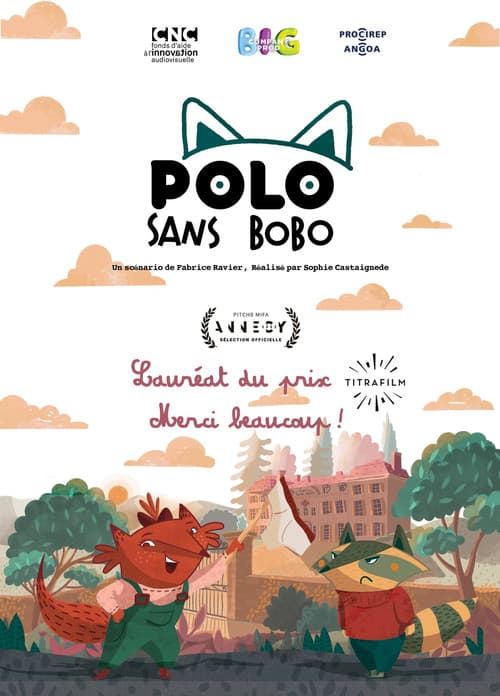
Polo sans bobo
Does this age rating seem accurate to you?
Detailed parental analysis
Polo sans bobo is a family comedy with a warm atmosphere, tinged with moments of genuine emotion. The story follows Polo, a young boy who, whilst trying to escape his family frustrations, becomes entangled in the life of a hospitalised girl and his own fears. The film is aimed primarily at school-age children, with an accessible and compassionate tone, although certain subjects covered warrant parental attention.
Parental and Family Portrayals
Family lies at the heart of the narrative and its representations are contrasted. Polo clearly feels that his mother pays more attention to other children than to him, which generates frustration that is expressed and visible. This experience of feeling familial injustice is treated with a certain honesty, without being trivialised. In parallel, Juliette, the other central character, is an orphan: her parents died in a car accident. Parental absence is thus doubly present in the film, experienced on one side as emotional deprivation, on the other as irreplaceable loss. The resolution comes through the constitution of a new form of family, driven by Polo's request to adopt Juliette, which gives the film a conclusion oriented towards recomposition and belonging.
Social Themes
The film addresses serious illness and the risk of dying in a direct but sober manner, through the character of Juliette and other hospitalised children. Without lapsing into sentimentality, the narrative does not shy away from medical reality: a child refuses her operation and loses consciousness, which may leave an impression on young viewers. These sequences provide a natural opening for talking with children about illness, fear of medical care and death, without excessive dramatisation.
Underlying Values
The film consistently upholds the idea that feeling in one's place, loved and belonging to a group, is a deep necessity. Music, through Polo's guitar playing, is presented as a space for personal expression and pleasure, not as a vehicle for performance. Solidarity amongst children and the capacity to overcome one's own fears in order to help others structure the moral purpose of the narrative, without ever slipping into heavy-handed moralising.
Language
The conflict between Polo and Alphonse gives rise to a scene where Polo calls the other a beast, accompanied by an episode of throwing tomatoes. The register remains within the bounds of familiar, everyday childhood discourse, without serious insult or vulgarity. It is nonetheless a moment that can open discussion about how to manage anger and disputes amongst children.
Strengths
The film manages to address potentially heavy subjects, grief, illness, feelings of abandonment, without overwhelming the lightness that remains its dominant tone. The emotional construction is sufficiently nuanced for children to identify with the characters without being overwhelmed. The space given to music as a creative practice, and not as a performance to be valued, is a genuine pedagogical intention. The conclusion centred on adoption and the choice to make a family gives the film a lasting affective resonance, rare in children's comedy.
Age recommendation and discussion points
The film is suitable from age 5 onwards, with an adult present for younger children who might be affected by the themes of grief and illness. Two angles are worth discussing after viewing: how Polo expresses his feeling of being less loved, and whether this is a fair way of seeing things; and what it means to be part of a family, whether by birth or by choice.
Synopsis
Polo is furious! He has to move in with his mother, who is a doctor at a hospital in the countryside. From that moment on, he has only one goal: to escape and return home. When he meets Juliette, a young patient who is as resilient as she is irritating, his plan is thrown into disarray.
About this title
- Format
- Short film
- Year
- 2025
- Runtime
- 26m
- Countries
- France
- Original language
- FR
- Studios
- Canal+, Région Auvergne-Rhône-Alpes
Content barometer
- Violence1/5Mild
- Fear2/5A few scenes
- Sexuality0/5None
- Language1/5Mild
- Narrative complexity0/5Simple
- Adult themes0/5None