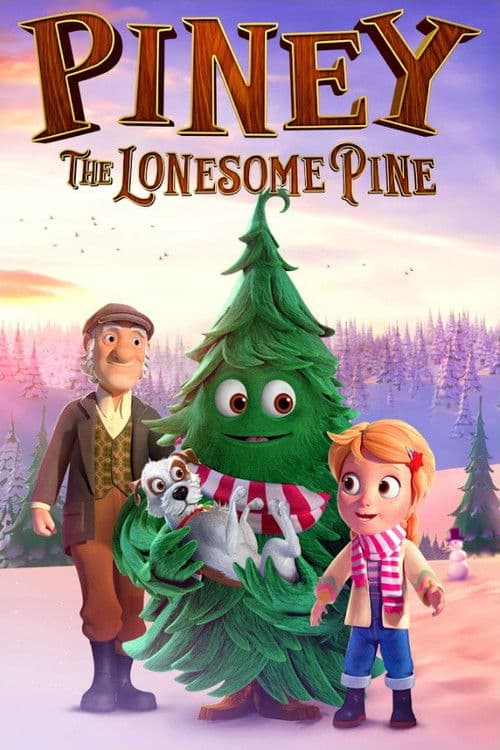
Piney: The Lonesome Pine
Does this age rating seem accurate to you?
Detailed parental analysis
Piney the Little Lost Fir Tree is a children's animated film with a warm and gently melancholic atmosphere, carried by a soft and contemplative sensibility. The story follows Georgie, a child who befriends a small fir tree named Piney and sets out to find him after he is accidentally swept away from the family farm. The film is primarily aimed at young children, around 4 to 8 years old.
Underlying Values
The film builds its narrative around solid and coherent values: lasting friendship withstands distance and time, perseverance is rewarded, and the care given to a living being over several years is presented as an act of love in itself. The relationship between Georgie and his grandfather illustrates a benevolent transmission between generations, without authoritarianism or conflict. These values are conveyed naturally, without heavy-handed didacticism, which makes them all the more effective for a young audience.
Social Themes
The film discreetly touches on an ecological dimension through Georgie's relationship with nature and trees, without turning it into a manifesto. Piney's growth over four years and the care the child gives him establish a sensitivity to living things that can open a natural conversation about respect for the environment and the cycle of plant life.
Parental and Family Portrayals
The grandfather figure is central and particularly positive: he supports Georgie in his quest, accompanies him without taking his place and embodies a gentle and reassuring authority. This portrayal offers a model of intergenerational relationship founded on listening and trust, rare and precious in animated cinema for young children.
Strengths
The film draws its strength from its assumed simplicity and the duration of the relationship it depicts: four years of care and attachment between a child and a tree is an unusual timeframe for a children's story, and it gives the bond between the two characters genuine emotional depth. The ending, in which Piney is transformed into a book, is a poetic image of transformation and persistence in another form, potentially unsettling for very young children but rich in meaning for those who can discuss it. The film has the quality of not resolving all its tensions artificially, which gives it an appreciable emotional honesty.
Age recommendation and discussion points
The film is suitable from age 4 for supervised viewing, and fully accessible from age 5 or 6 for independent viewing. The ending merits discussion: asking the child what he thinks happens to Piney when he becomes a book, and whether in his view friendship can continue in a different form, are two concrete angles for transforming a potentially unsettling image into reflection on transformation and memory.
Synopsis
A cheerful Welsh girl grows a talking pine named PINEY to be her Christmas tree, but when he's accidentally removed from her grandfather's Christmas tree farm, the plucky family dog leads him on a journey across the countryside while the girl and her grandpa frantically search to get them home before Christmas. Piney's unexpected journey is filled with love, hope and inspiration.
About this title
- Format
- Short film
- Year
- 2019
- Runtime
- 25m
- Original language
- EN
Content barometer
- Violence0/5None
- Fear1/5Mild
- Sexuality0/5None
- Language0/5None
- Narrative complexity0/5Simple
- Adult themes0/5None
Watch-outs
- Grief
- Death / grief
Values conveyed
- Friendship
- Perseverance
- Compassion
- Loyalty
- family
- hope