
Persepolis
Does this age rating seem accurate to you?
Detailed parental analysis
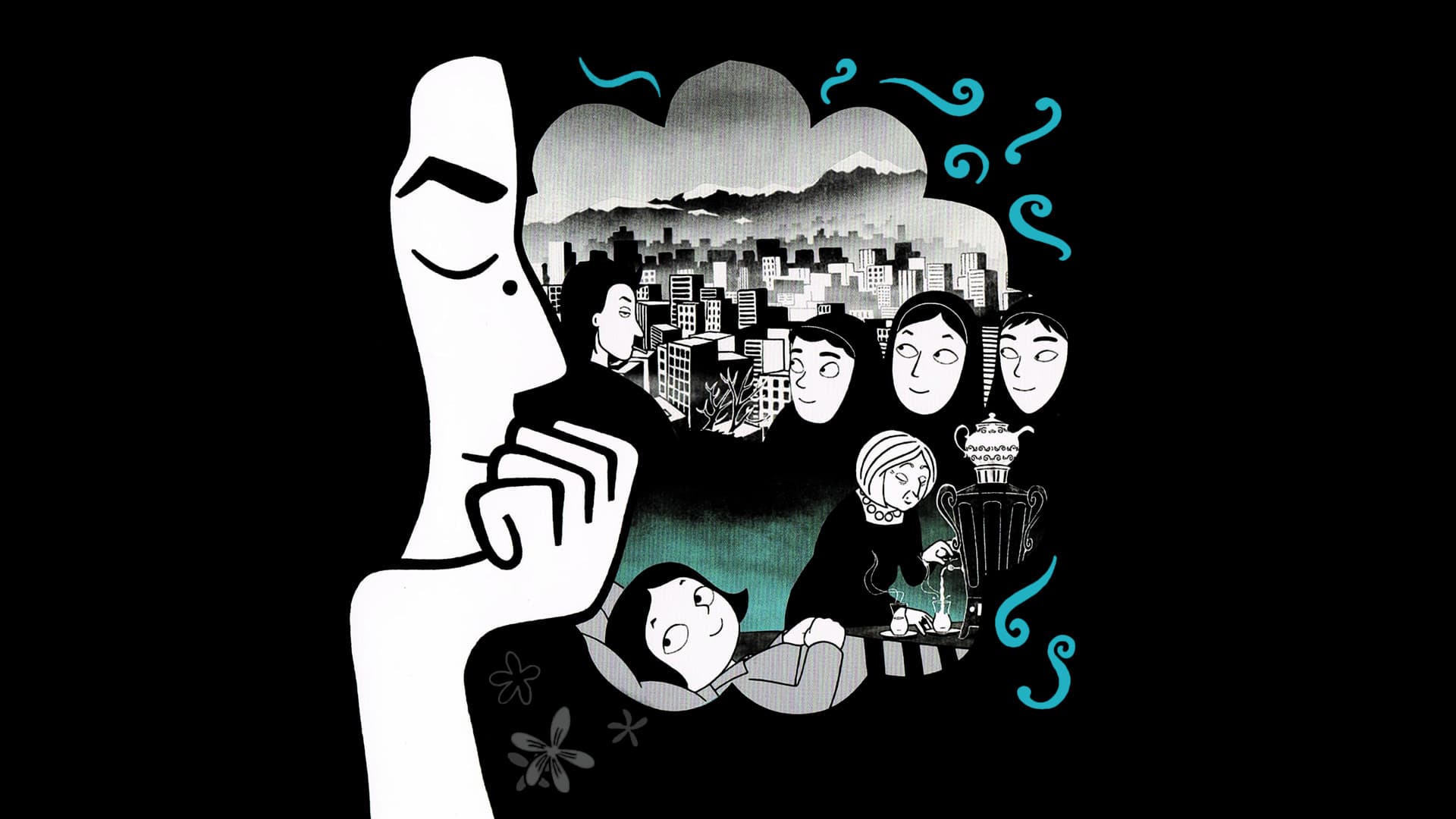
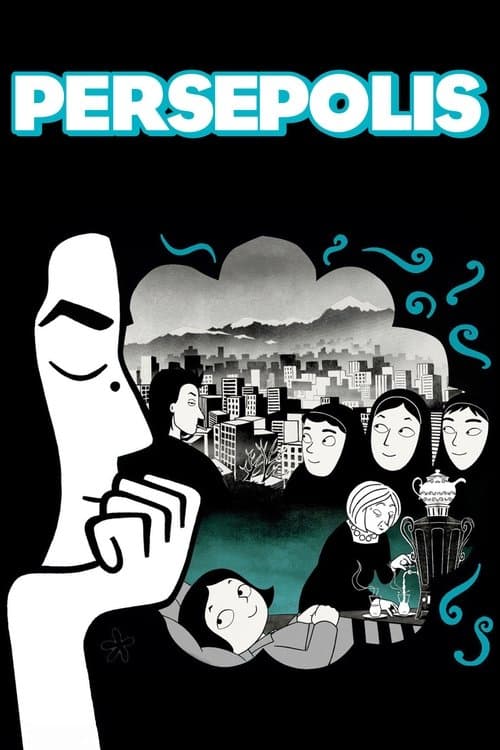
Persepolis is an animated film with black and white graphics, an atmosphere that is both intimate and politically dense, where dark humour coexists with great gravity. It traces the autobiographical journey of a young Iranian woman from her childhood under the 1979 Islamic revolution through her exile in Europe and her eventual return to her country. The film is aimed at an adult audience and, at a stretch, at an advanced teenage audience: the animation should not mislead, this is not a film for children.
Social Themes
The Iranian revolution, the Iran-Iraq war, theocratic dictatorship and exile form the entire framework of the narrative. Political repression is shown recurrently: arrests, executions, bombings, disappearances. These elements are not incidental, they are the central experience that the film seeks to convey. The film thus offers a concrete and memorable entry into a contemporary history little known to young Western audiences, and makes it possible to discuss what it means to live under an authoritarian regime, exile as a rupture of identity, and the compromises that oppression imposes on ordinary individuals.
Underlying Values
Individual freedom is the central and absolute value of the film, embodied by a heroine who constantly refuses to obey rules she deems illegitimate, whether they come from the Iranian regime or European social norms. The film also values family transmission as an act of resistance: memory, convictions and dignity are passed from generation to generation against all odds. Religious and political institutional authority is systematically represented as oppressive or hypocritical, which merits contextualisation with a teenager to distinguish legitimate criticism of a specific regime from any indiscriminate rejection of religious practice. Marjane's individualism, assumed and sometimes radical, is celebrated but the film does not spare her the painful consequences of her choices.
Parental and Family Portrayals
Family is a moral force in this film, notably through the figure of the grandmother, a character of great integrity whose advice structures Marjane's ethical path. The parents are loving, educated, progressive, and their relationship with their daughter is at the heart of the film's emotional narrative. This representation is unusual in its warmth and consistency: the family is not an obstacle to emancipation but its foundation. For a teenager, this is an interesting angle for discussion about what it means to support a child without constraining them.
Violence
Violence is political and historical rather than spectacular. Executions and bombings are evoked or shown in a stylised manner, without gore, but without sanitisation either. Certain sequences, notably those depicting the human consequences of war, may leave a lasting impression on a young viewer, precisely because the film treats them with gravity and without self-indulgent aesthetic distance. Violence is never presented as desirable: it is always the sign of an unjust order to be named and rejected.
Substances
Tobacco, alcohol and cannabis appear in the film, consumed by both adolescents and adults. These consumptions take place in specific contexts: partying as a space of clandestine resistance in Iran, desolation during Marjane's depressive period in Europe. The film does not glorify these behaviours, but it does not explicitly condemn them either: they are part of a realistic portrait. This is a point to address directly with a teenager, distinguishing between realistic representation of a life trajectory and incitement.
Sex and Nudity
Marjane has romantic and sexual relationships in adulthood and adolescence, evoked without graphic explicitness. The film treats these experiences as a normal part of the protagonist's journey, with their elements of desire, disillusionment and learning. Nothing hypersexualised or titillating: the tone remains autobiographical and psychological.
Language
The film contains strong language and crude language on several occasions, both in the original version and in dubbed versions. It is occasional and contextually consistent with the assertive character of the protagonist, but it is worth noting for parents sensitive to this register.
Strengths
Persepolis is a remarkable film for the precision of its autobiographical writing: it succeeds in telling a complex political story through the intimate and sensitive experience of a child and then a young woman, without ever reducing one to the other. Humour, omnipresent, does not lighten the subject matter but gives it depth: it says something true about the way individuals survive psychologically under oppression. The stripped-down black and white graphics are not a budgetary constraint but a visual language consistent with memory and subjectivity. It is also a first-rate pedagogical tool on the Iranian revolution, exile, and the question of identity shared between two cultures: few films allow these subjects to be addressed with as much subtlety and accessibility simultaneously.
Age recommendation and discussion points
Persepolis should be reserved for an audience of at least 14 years old, and preferably 16 years old for a serene viewing and full understanding of its political and existential stakes. Two angles of discussion are essential after the film: ask the teenager what they think of Marjane's courage in the face of rules she deems unjust, and where they themselves draw the line between legitimate resistance and mere rebellion. And explore together what the film says about religion and political power, distinguishing between criticism of a specific theocratic regime and any generalisation.
Synopsis
In 1970s Iran, Marjane 'Marji' Satrapi watches events through her young eyes and her idealistic family of a long dream being fulfilled of the hated Shah's defeat in the Iranian Revolution of 1979. However as Marji grows up, she witnesses first hand how the new Iran, now ruled by Islamic fundamentalists, has become a repressive tyranny on its own.
Where to watch
Availability checked on Apr 03, 2026
About this title
- Format
- Feature film
- Year
- 2007
- Runtime
- 1h 35m
- Countries
- France, United States of America
- Original language
- FR
- Directed by
- Vincent Paronnaud, Marjane Satrapi
- Main cast
- Chiara Mastroianni, Danielle Darrieux, Catherine Deneuve, Simon Abkarian, Gabrielle Lopes Benites, François Jérosme, Tilly Mandelbrot, Sophie Arthuys, Arié Elmaleh, Mathias Mlekuz
- Studios
- Société des Producteurs de L'Angoa, Sony Pictures Classics, PROCIREP, Soficinéma, France 3 Cinéma, Diaphana Films, Sofica EuropaCorp, Celluloid Dreams, The Kennedy/Marshall Company, La Région Île-de-France, Fondation GAN pour le Cinéma, 2.4.7. Films, French Connection Animations, CNC