

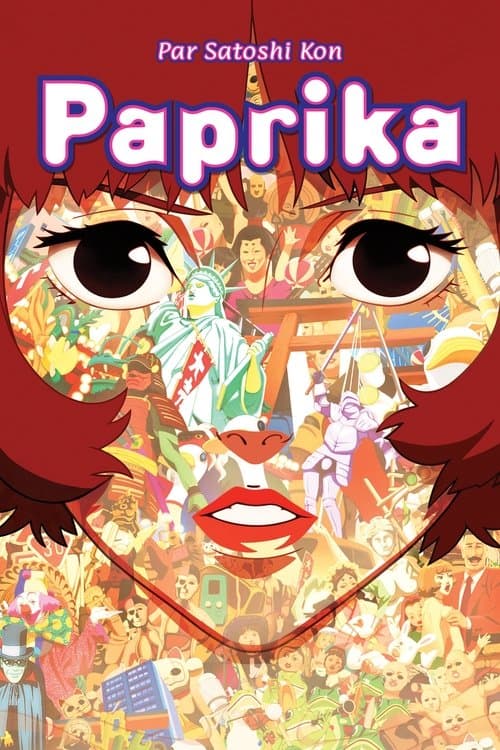
Paprika
パプリカ
Does this age rating seem accurate to you?
Detailed parental analysis
Paprika is a Japanese animated fantasy film with a dreamlike, hypnotic and at times profoundly unsettling atmosphere. The plot follows a psychotherapist who uses an experimental device to enter her patients' dreams, until the technology is hijacked for purposes of mental manipulation. The film addresses itself unambiguously to an adult audience: its narrative density, surrealist imagery and certain sequences of violence or sexual content make it unsuitable for children and young adolescents alike.
Sex and Nudity
The film contains several sequences with explicit sexual charge. One scene depicts an assault that is particularly disturbing: a woman is pinned to a table, a man's hand literally penetrates her body, travels up to her head which he tears off, revealing a naked woman underneath. Female nudity is visible and the dimension of bodily violation is treated in a visual and direct manner, without any modesty. An upskirt camera angle under Paprika's skirt also appears. These sequences can disturb even adult viewers, and some feel that the film treats them with a lightness that fails to do justice to their gravity. For an unprepared adolescent, these images raise a genuine question of exposure.
Violence
Violence is present on a recurring basis: characters shot with visible blood, fatal falls from heights, strangulations, slaps, characters locked in cages. These scenes are not particularly graphic in the manner of horror cinema, but their frequency and their treatment rooted in reality contrast with the film's dreamlike wrapper. Death is shown with a minimum of visual honesty. Violence serves dramatic tension without being gratuitous, but it is sufficiently present to exclude younger audiences.
Underlying Values
The film carries a structured reflection on the misuse of technology designed to heal but diverted to control. This ambivalence between care and power lies at the moral heart of the narrative. In parallel, it strongly valorises plural identity, the freedom of imagination and the capacity to rebuild oneself through dreams. Individual heroism is central, but the film does not reduce it to performance: it is the integration of one's hidden aspects that enables action. This is rich material for a conversation about creators' responsibility towards their tools, and about what we do with our shadows.
Discrimination
The character of Dr. Tokita, who is obese, is regularly called 'fat' or 'chubby' by his colleagues, and his body is treated visually as a source of comedy or embarrassment. This representation is never questioned by the narrative, which seems to accept it as a comedic trait. This is a concrete angle to discuss with an adolescent: how an intelligent film can simultaneously offer profound reflection on identity and reproduce without hesitation mockery of physical appearance.
Social Themes
The technology for entering dreams functions as a direct metaphor for contemporary questions around mind control, inner surveillance and the boundary between therapy and manipulation. The film anticipates questions about artificial intelligence, brain-machine interfaces and the use of psychological data, even if these terms do not appear in it. For a secondary school student or adult, this subtext is one of the film's most stimulating elements.
Strengths
Paprika is a work of rare visual inventiveness, whose sequences of collective dreaming chain together images of striking density and symbolic coherence. The film achieves what few works manage to do: render dream logic credible without reducing it to arbitrary chaos. The narrative construction, demanding and non-linear, requires sustained attention but rewards the patient viewer with solid internal coherence. The main character is treated with unusual psychological depth for the genre, and the question of fragmented identity finds a resolution that is both surprising and just. This is a film that leaves a lasting mark and lends itself to multiple viewings.
Age recommendation and discussion points
Paprika is not recommended before age 16 due to its sequences of assault with sexual connotation, its nudity and its narrative density which demands genuine maturity to be fully processed. For a secondary school student aged 16 or over, it is a remarkable cinematic experience, provided you watch it with them and then open two conversations: firstly, what the film shows of female bodies and whether this treatment seems fair to them or not; secondly, what would happen if a technology actually allowed access to others' dreams and who you would trust to control it.
Synopsis
When a machine that allows therapists to enter their patient's dreams is stolen, all hell breaks loose. Only a young female therapist can stop it and recover it before damage is done: Paprika.
About this title
- Format
- Feature film
- Year
- 2006
- Runtime
- 1h 30m
- Countries
- Japan
- Original language
- JA
- Studios
- Madhouse, Sony Pictures