Old Mother Snow
Does this age rating seem accurate to you?
Detailed parental analysis
Lady Seasons is a contemplative and somewhat unsettling short film, rooted in the imagination of traditional European fairy tales. The story follows two sisters driven by necessity to cross a nocturnal forest to meet a supernatural figure tasked with testing them. The film is primarily aimed at children from five or six years old, but its atmosphere of an initiatory tale and its questions about generosity, work, and family precarity make it solid material for discussion with children up to ten or twelve years old.
Underlying Values
The film rests on a moral framework typical of the Grimm fairy tale: generosity is rewarded, selfishness is punished, and inner transformation remains possible. The elder sister, who exploits her younger sibling and covets undeserved rewards, eventually changes after the ordeal imposed by Lady Seasons. This cycle of redemption is legible and coherent, but it deserves discussion with the child: punishment precedes transformation here, which raises the question of whether one acts rightly out of conviction or fear of consequences. The film also conveys a vision of family responsibility in which children bear a real burden: helping a suffering parent, contributing to the household's resources, not shirking collective needs. This message of intrafamilial solidarity is sincere, but it comes with a tension between duty and the desire for autonomy that older children will feel.
Parental and Family Portrayals
The central parental figure is a lone mother, wounded, economically fragile, who works night shifts under dangerous conditions. The father is absent, evoked implicitly through a nocturnal accident that is understood to have changed the family's configuration. These elements are not dramatised frontally but form the affective context of the narrative. For a young child, this representation of a precarious household and a vulnerable mother can prompt genuine anxiety, particularly since the maternal figure is not reassuring in the conventional sense. It is useful to discuss this after viewing, especially for children who themselves live in single-parent or economically difficult family situations.
Violence
Physical violence is absent from the film, but several scenes establish a muted tension. The sickle wielded by Lady Seasons, the threatening nocturnal forest with its sounds evoking wolves, the mother returning injured: these elements fit within the logic of the cautionary tale, where fear is a deliberate pedagogical tool. The figure of Lady Seasons, with her pointed teeth and a house evoking the archetype of the Slavic witch, may mark sensitive children despite her ultimately benevolent intentions. The ambiguity between threatening appearance and protective intention is precisely what gives the character her depth, and constitutes a good entry point for discussing with the child the difference between appearance and intention.
Social Themes
Economic precarity runs through the film in a concrete and unsentimental way: a mother who cannot afford shoes, children who must contribute to family subsistence, dependence on physical labour under difficult conditions. These representations are treated without sentimentality but with a documentary realism that grounds the fairy tale in an identifiable social world. For children from privileged backgrounds, this offers a useful opening towards realities different from their own.
Strengths
The film takes advantage of the short format's concision to maintain a narrative tension and emotional coherence rare in productions aimed at young children. Its grounding in the heritage of the Grimm fairy tale gives it a symbolic density that can be revisited with the child as they grow: the initiatory ordeals, the ambivalent figure of the benevolent witch, the motif of the nocturnal journey as a space of transformation. The construction of the Lady Seasons character is particularly successful in that it refuses the convenient binary of monster or fairy, instead proposing a complex figure of authority who teaches through experience rather than injunction. The film also offers an honest representation of sibling relationships with their jealousies and internal injustices, without idealising the bond between the two sisters.
Age recommendation and discussion points
The film is suitable from five or six years old for children who are not sensitive to nocturnal atmospheres and unsettling figures, and perfectly accessible without reservation from seven or eight years old. Two angles of discussion merit being opened after viewing: ask the child why, in their opinion, the elder sister changes her attitude at the end, and whether punishment alone is enough to make someone better; and wonder together about what it means to help someone you love when you do not want to.
Synopsis
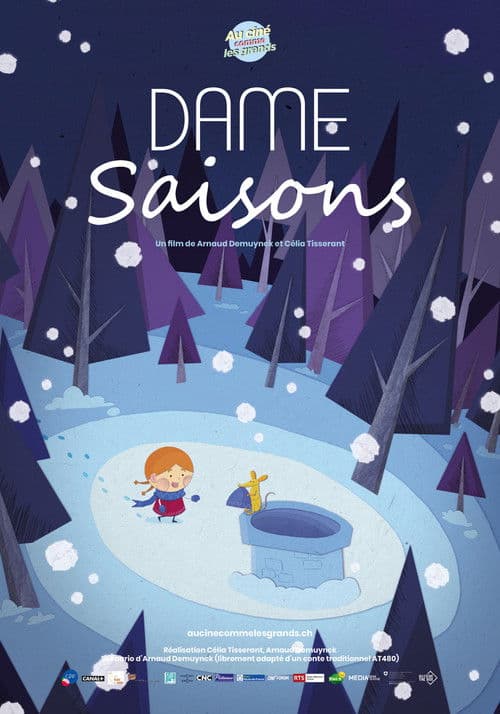
Thumbeline and Fingerita live alone with their mother at the edge of a forest overlooking a village. Thumbeline, a rather sulky teenager, isn’t as helpful as her little sister Fingerita who willingly offers to go and gather firewood in the forest. When her hat falls into an old well, she climbs down to get it and discovers the enchanting world of Old Mother Snow, who makes the snow fall every time she shakes her eiderdown.
About this title
- Format
- Short film
- Year
- 2021
- Runtime
- 30m
- Countries
- France
- Original language
- FR
Content barometer
- Violence1/5Mild
- Fear3/5Notable tension
- Sexuality0/5None
- Language0/5None
- Narrative complexity0/5Simple
- Adult themes0/5None
Watch-outs
- Grief
- Death / grief
Values conveyed
- Perseverance
- Compassion
- Loyalty
- sisterhood
- helpfulness
- growth
- kindness