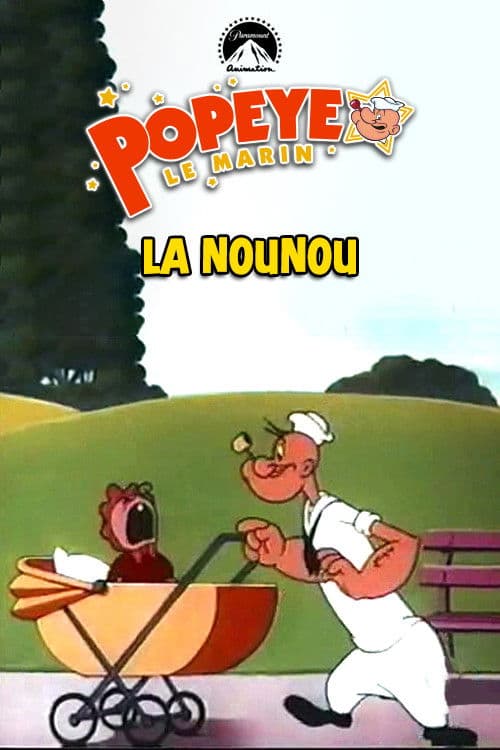
Nurse to Meet Ya
Does this age rating seem accurate to you?
Detailed parental analysis
The Nurse is a brisk and comical animated short film designed for young children. The plot revolves around the rivalry between Popeye and Bluto, both candidates for the position of nanny to little Swee'Pea, each seeking to impress Olive Oyl. The film is rooted in the tradition of American cartoons from the 1950s, with frenetic energy and humour built entirely on slapstick violence.
Violence
Violence is the sole comedic device in the film and constitutes its entire content. It is constant, repeated and inventive: exchanges of blows, bones shattered and shown in X-ray, Bluto crushed like an accordion, launched from a cannon, transformed into a trapeze puppet and chased by a dog. Nothing in the narrative questions this register, which is instead celebrated as proof of competence and seduction. For a very young child, the clearly cartoonish and unreal nature of the violence may soften its raw impact, but the frequency and variety of the beatings remain highly prominent for a short film lasting only a few minutes.
Underlying Values
The film implicitly suggests that physical strength and the capacity to inflict more pain than one's rival are the legitimate criteria for obtaining a woman's approval and custody of a child. Violence is not a last resort: it is the first and only tool deployed, presented as natural and effective. This pattern, repeated in virtually all Popeye cartoons from the period, deserves to be named explicitly with a child, because it remains invisible behind the laughter.
Discrimination
Olive Oyl exists in this film only as a passive prize between two competing men: she does not act, does not decide and has no visible inner life. This role of inert spectator, typical of the frozen love triangle in the Famous Studios series of the 1950s, confines the female character to a purely decorative and rewarding function. This is a bias substantial enough to flag to a child, even a young one.
Substances
The spinach consumed by Popeye to trigger his physical transformation constitutes a narrative convention specific to the character. It does not function as a valorisation of substance consumption in the literal sense, but its role as a magical trigger for physical power can give rise to a brief amusing explanation about the difference between fiction and reality.
Strengths
The film belongs to a tradition of classic American cartoon that forged a universal visual language for slapstick. The inventiveness of the gags, the rapid pace and the absurd escalation of situations have an internal coherence particular to the genre. For a parent, this short film is also a gateway to a conversation about the history of popular animation and how comedic codes evolve from one era to another. Beyond this interest in cultural transmission, the film offers no particular narrative or emotional depth.
Age recommendation and discussion points
The film is accessible from around 4 or 5 years old in terms of comprehension and emotional impact, provided it is watched with an adult. Two simple questions to ask afterwards: why is Popeye fighting to be the nanny rather than simply taking good care of the baby, and did Olive have any say in all this?
Synopsis
Olive is playing nanny in the park as Popeye and Bluto bicycle past. They fight over her, waking the baby. Then they take turns trying to stop the baby crying or sabotaging the other's efforts. Popeye does impressions of a dog and an airplane and juggles cannonballs; Bluto does some rope twirling and a snake-charmer act.
About this title
- Format
- Short film
- Year
- 1955
- Runtime
- 6m
- Countries
- United States of America
- Original language
- EN
- Directed by
- Izzy Sparber
- Studios
- Famous Studios
Content barometer
- Violence3/5Notable
- Fear1/5Mild
- Sexuality0/5None
- Language0/5None
- Narrative complexity0/5Simple
- Adult themes1/5Mild
Watch-outs
- Violence
- Gender stereotypes
Values conveyed
- Courage
- humor
- care
- persistence