

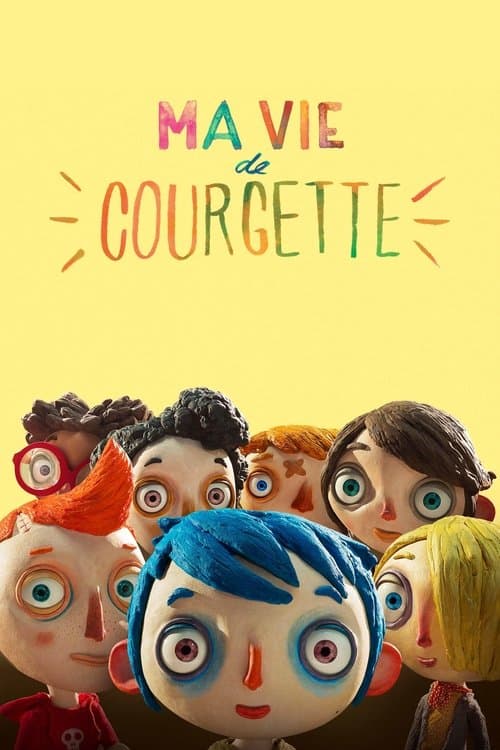
My Life as a Zucchini
Does this age rating seem accurate to you?
Detailed parental analysis
My Life as a Courgette is an intimate animated film with a bittersweet atmosphere that addresses the wounds of childhood abandonment with rare candour. The plot follows Icarus, known as Courgette, a small boy placed in a foster home after a family tragedy, and who learns to rebuild his life through contact with other equally damaged children. The film is primarily aimed at children from a certain age onwards and the adults accompanying them, but its thematic gravity makes it unsuitable for the very young.
Parental and Family Portrayals
Parental figures constitute the painful heart of the film. Courgette's mother is alcoholic, verbally and physically violent towards her son, and dies accidentally in a fall down the stairs in which the child feels implicated. The other children in the home carry equally heavy histories: a father who is both murderous and suicidal, sexual abuse, outright abandonment. The film does not seek to soften these realities. What is remarkable is that the care institution is represented as a restorative and benevolent space, with protective and attentive adults, which is a significant inversion of the usual cliché. The biological family is systematically failing, and it is the chosen family, that of the foster home and then adoption, which embodies the possibility of a better life.
Underlying Values
The film constructs a message of resilience without sentimentality: wounds do not disappear, but they can be traversed through speech, connection and the protection of trustworthy adults. Reconstituted family and adoption are presented as legitimate and precious forms of kinship. Friendship between vulnerable children is shown as a space of genuine mutual support, not idealised solidarity. The film does not preach, but its entire narrative structure argues for the value of care, listening and connection as conditions for reconstruction.
Violence
Violence in this film is exclusively familial and psychological in nature. It is neither graphic nor aestheticised: the death of Courgette's mother is suggested rather than shown, and accounts of parental violence are evoked through the children's words. An episode of bullying between children, with mockery and humiliation, is represented with a realism that can touch young viewers. Violence here serves a clear narrative and emotional purpose: it explains the characters' wounds and makes their reconstruction all the more meaningful. There is no gratuitousness in the treatment, but the accumulation of traumatic accounts can weigh on sensitive children.
Social Themes
The film directly addresses the reality of foster care placement, a subject rarely treated in animated cinema for young people. The question of guardianship, children's rights and the role of the State in child protection is present in the background, through adoption procedures and discussions between adults. This is a rare and pedagogically valuable angle for helping a child understand that some of their peers live very different family realities.
Substances
Courgette's mother's alcoholism is a central element of the narrative, shown as destructive and directly linked to domestic violence and death. This is not an incidental consumption but a structuring element of the story. The dependency is presented here without romanticism or excuse, as a reality that destroys family bonds.
Sex and Nudity
A scene shows children awkwardly discussing sexual reproduction using childlike euphemisms, in a naive and comic register that corresponds to the natural curiosity of that age. Sexual abuse by a father towards his daughter is mentioned verbally, without visual representation, but its evocation remains heavy and deserves to be anticipated by the parent.
Strengths
The film is a rare formal and narrative achievement in animated cinema for young people. Its writing trusts in the intelligence of children without ever condescending or sugar-coating, which gives it a striking emotional authenticity. Character construction is economical and just: each child in the home exists in a few brushstrokes, without heavy archetype. The melancholic tone is balanced by moments of lightness and childish humour, avoiding melodrama without ever minimising the gravity of situations. The film also offers a rare and counter-intuitive portrait of a child protection institution functioning well, which makes it a valuable pedagogical tool for talking with a child about what it means to be protected and loved by benevolent adults.
Age recommendation and discussion points
The film is best reserved for children of at least 8 years old who are capable of tolerating emotionally intense narratives, but a serene and fully rewarding viewing experience is more appropriate around 10-11 years old, with parental accompaniment for the more sensitive. After viewing, two angles of discussion merit being opened: why does Courgette feel responsible for his mother's death, and how do the adults at the home help the children to rebuild themselves, which allows one to address the notion of guilt and the protective value of trustworthy adults.
Synopsis
After his mother’s death, Zucchini is befriended by a kind police officer, Raymond, who accompanies him to his new foster home filled with other orphans his age. There, with the help of his newfound friends, Zucchini eventually learns to trust and love as he searches for a new family of his own.
Where to watch
Availability checked on Apr 03, 2026
About this title
- Format
- Feature film
- Year
- 2016
- Runtime
- 1h 6m
- Countries
- France, Switzerland
- Original language
- FR
- Directed by
- Claude Barras
- Main cast
- Gaspard Schlatter, Sixtine Murat, Paulin Jaccoud, Michel Vuillermoz, Raul Ribera, Estelle Hennard, Elliot Sanchez, Lou Wick, Brigitte Rosset, Natacha Koutchoumov
- Studios
- Gébéka Films, Rita Productions, Blue Spirit, KNM, RTS, SRG SSR, Auvergne-Rhône-Alpes Cinéma, France 3 Cinéma, Hélium Films
Content barometer
- Violence2/5Moderate
- Fear3/5Notable tension
- Sexuality1/5Allusions
- Language1/5Mild
- Narrative complexity2/5Moderate
- Adult themes3/5Marked
Values conveyed
- Friendship
- Acceptance of difference
- Compassion
- resilience
- empathy
- hope