
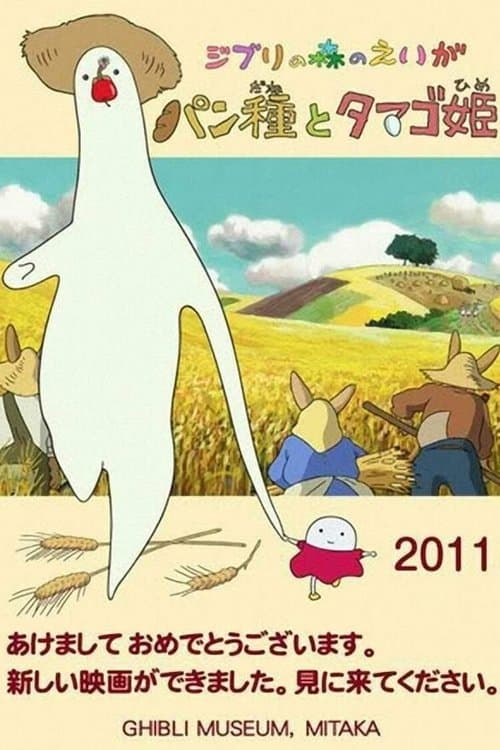
Mr. Dough and the Egg Princess
パン種とタマゴ姫
Does this age rating seem accurate to you?
Detailed parental analysis
An animated short film produced for the Ghibli Museum, 'Sourdough and Princess Egg' is a bittersweet fantastical fable lasting around twelve minutes, carried by an atmosphere that is both warm and slightly unsettling. The story follows a piece of risen dough and a young princess held captive by a witch as they attempt to escape together. The film is primarily aimed at young children, but its visual world and symbolic density also speak to the adults accompanying them.
Violence
The film rests on a logic of solidarity between two beings that are ostensibly incompatible, one ordinary and the other royal, who survive only by helping one another. The servitude imposed on the princess by the witch is presented as an obvious injustice, which gives the narrative a simple and clear moral backbone for a young audience. Courage in the face of a malevolent figure of authority is valued without ambiguity. These values are conveyed through action rather than discourse, which makes them all the more accessible.
Underlying Values
The figure of Baba Yaga functions as an abusive adult authority who confines and exploits a child. This pattern, drawn from Slavic folklore, is one of the oldest in children's literature: it stages the domination of a malevolent adult over a defenceless child. The film offers no visible benevolent parental figure, which places both protagonists in a situation of forced autonomy. This context can open a useful conversation about the difference between legitimate authority and abusive authority.
Parental and Family Portrayals
The figure of Baba Yaga functions as an abusive adult authority who confines and exploits a child. This pattern, drawn from Slavic folklore, is one of the oldest in children's literature: it stages the domination of a malevolent adult over a defenceless child. The film offers no visible benevolent parental figure, which places both protagonists in a situation of forced autonomy. This context can open a useful conversation about the difference between legitimate authority and abusive authority.
Strengths
The film draws on the tradition of the folk tale with remarkable narrative economy for a twelve-minute format: each visual element carries meaning, and the world is coherent without ever being weighed down by explanations. The pairing of a character as humble as a piece of risen dough with a royal figure is a stroke that says something true about the value of ordinary beings. The atmosphere skilfully oscillates between warmth and unease, which holds attention without ever tipping into prolonged anxiety. For a young child, it is a concrete and sensitive introduction to the structure of the tale: captivity, flight, mutual aid, deliverance.
Age recommendation and discussion points
The film is accessible from age 4 or 5 for children comfortable with slightly frightening tale-like worlds, but those who are more sensitive will benefit from waiting until age 6 or 7 to avoid being disturbed by the witch and the pursuit dynamic. Two angles of discussion are worth pursuing after viewing: ask the child why Sourdough and the princess managed to escape together when neither would have succeeded alone, and ask them what makes Baba Yaga unjust, to help them distinguish between a legitimate rule and an order one has the right to refuse.
Synopsis
The story of a tiny Egg-girl who is forced to serve the evil Boar-like witch Baba Yaga. But after a blob of Dough comes to life, she befriends him and both escape from the witch's home at a Water mill on a cliff and set off to see the world. The soundtrack is Joe Hisaishi's arrangement of Vivaldi's La Folia
About this title
- Format
- Short film
- Year
- 2010
- Runtime
- 12m
- Countries
- Japan
- Original language
- JA
- Directed by
- Hayao Miyazaki
- Studios
- Studio Ghibli
Content barometer
- Violence1/5Mild
- Fear3/5Notable tension
- Sexuality0/5None
- Language0/5None
- Narrative complexity0/5Simple
- Adult themes0/5None
Watch-outs
- Abuse
Values conveyed
- Courage
- Acceptance of difference
- Autonomy
- friendship
- freedom