

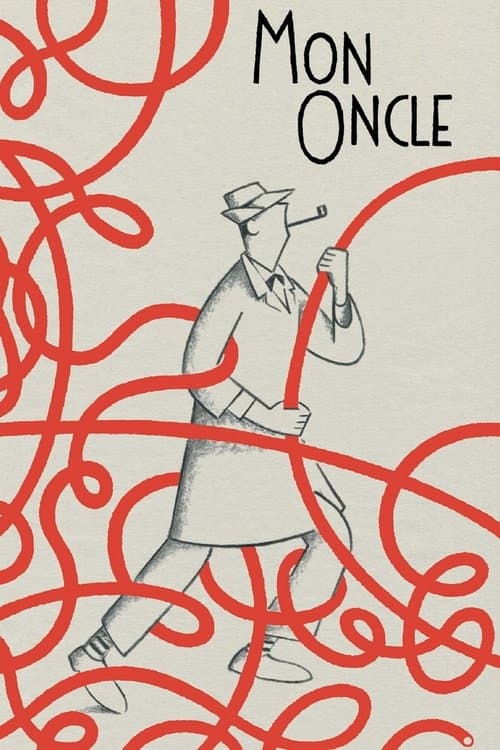
Mon Oncle
Does this age rating seem accurate to you?
Detailed parental analysis
My Uncle is a gentle and contemplative comedy, carried by a warm atmosphere and discreet visual humour that tends more towards a smile than outright laughter. The plot follows a young boy torn between the modern and sterile world of his parents and the free and whimsical universe of his uncle, in a working-class Parisian neighbourhood. The film is aimed primarily at adults and teenagers capable of savoring slow cinema, founded on observation rather than action.
Underlying Values
The film constructs a structural opposition between two worldviews: on one side the ultramodern Arpel house, a symbol of alienating bourgeois comfort, absurd automation and superficial sociability; on the other, Uncle Hulot's working-class neighbourhood, a place of wandering, spontaneous connections and vibrant disorder. The narrative clearly takes the side of the latter universe and consistently critiques consumerism, the social mechanics of appearances and the obsession with property. This critique is delivered without didactic heavyhandedness, through repeated visual gags that eventually sketch a coherent vision of the world. It is a rich angle to explore with a teenager: the film never states that modernity is bad, but it shows with precision what is lost when it becomes an end in itself.
Parental and Family Portrayals
Gérard's parents lie at the heart of the film's social satire. The father, Mr. Arpel, is presented as an authoritarian man, concerned with appearances and convinced that his son's future depends on discipline and integration into his mechanised working world. The mother is confined to the role of housewife absorbed by staging her interior and worried about the neighbours' gaze. These two parental figures are caricatured, but not malicious: their affection for their son is genuine, simply shaped by values that stifle rather than foster development. The film offers concrete material for discussing with a child or teenager what it means to do right as a parent, and the difference between guidance and constraint.
Discrimination
The film's gender representations fully belong to the codes of the 1950s and are presented without explicit distance in the narrative: Mrs. Arpel is confined to the home, neighbourhood gossip and domestic management, whilst her husband embodies economic and social authority. Tati caricatures these roles to underline their absurdity rather than validate them, but the distinction is not always clear to an uninformed young viewer. This makes it a good entry point for a discussion about the evolution of family roles over the past sixty years.
Substances
Tobacco is visible on several occasions, notably Uncle Hulot's pipe which forms part of his character. Alcohol is present peripherally without constituting a narrative issue. These elements belong to the cultural context of the time and are never valorised or commented upon: they are part of the backdrop without functioning as a model.
Social Themes
The film is a document on 1950s France in the midst of industrial reconstruction and accelerated modernisation. The critique of suburban development, the gadgetification of daily life and the rise of the consumer middle class is inscribed in every shot. These themes retain obvious contemporary resonance, making it a relevant pedagogical tool for a secondary school student approaching the Trente Glorieuses, consumer society or post-war urban transformation.
Strengths
The film is a remarkable stylistic exercise in the art of letting image and sound speak rather than dialogue. The soundtrack, constructed from precise sound effects and recurring music, almost entirely replaces speech and imposes an uncommon sensory attention in cinema. The direction rests on meticulous observation of human behaviour, with comedic precision that grows with each viewing. For a teenager interested in cinematic language, it is a concrete lesson in what a filmmaker can express without resorting to words. The tenderness that binds uncle and nephew is filmed with effective restraint, and the film manages to move without ever forcing.
Age recommendation and discussion points
The film is accessible from 8 or 9 years old for children receptive to visual humour, but it reaches its full value around 12 years old, particularly for the discussion it enables on models of success, family roles and the place of freedom in an orderly life. Two concrete angles to explore after viewing: ask the child in which universe they would like to live, that of the Arpels or that of Uncle Hulot, and why; and reflect together on what the film says about the way adults decide what is good for children.
Synopsis
Genial, bumbling Monsieur Hulot loves his top-floor apartment in a grimy corner of the city, and cannot fathom why his sister's family has moved to the suburbs. Their house is an ultra-modern nightmare, which Hulot only visits for the sake of stealing away his rambunctious young nephew. Hulot's sister, however, wants to win him over to her new way of life, and conspires to set him up with a wife and job.
Where to watch
Availability checked on Apr 26, 2026
About this title
- Format
- Feature film
- Year
- 1958
- Runtime
- 1h 56m
- Countries
- France, Italy
- Original language
- FR
- Directed by
- Jacques Tati
- Main cast
- Jacques Tati, Jean-Pierre Zola, Adrienne Servantie, Lucien Frégis, Betty Schneider, Jean-François Martial, Dominique Marie, Yvonne Arnaud, Adelaide Danieli, Alain Bécourt
- Studios
- Gaumont Distribution, Specta Films, Alter Films, Film del Centauro, Cady Films, gray-film
Content barometer
- Violence0/5None
- Fear0/5None
- Sexuality0/5None
- Language0/5None
- Narrative complexity3/5Complex
- Adult themes1/5Mild
Watch-outs
- Alcohol
- Gender stereotypes
Values conveyed
- Friendship
- freedom
- family
- playfulness
- individuality