

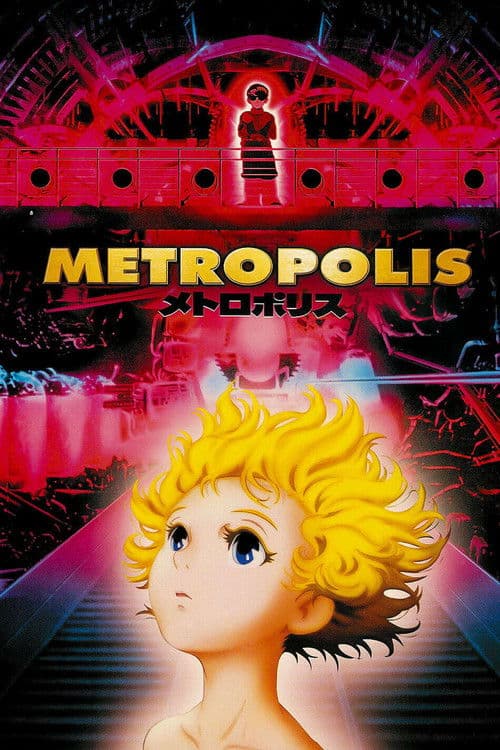
Metropolis
メトロポリス
Does this age rating seem accurate to you?
Detailed parental analysis
Metropolis (2001) is a Japanese animated film with a dark and melancholic atmosphere, blending dystopian science fiction with retro-futuristic aesthetics. The plot follows a young boy who, in a stratified megalopolis, discovers a mysterious android at the heart of a political and industrial conspiracy. Despite its appearance as an animated film, it is primarily aimed at a teenage and adult audience, and is not designed for young children.
Violence
Violence is present significantly and intensifies as the narrative progresses. Several characters are shot with visible blood on their wounds, a teenage character kills multiple individuals in cold blood, and a robot is destroyed by a bullet to the head with explicit visual representation. The climax offers massive destruction on a city-wide scale, with the spectacular collapse of a gigantic building. This violence is not gratuitous in the strict sense: it serves a narrative about dehumanisation and power relations, but its visual intensity remains real and may disturb younger or sensitive viewers.
Social Themes
The film is a dense reflection on class struggle, labour exploitation and structural inequalities in a society divided between an elite dominating the heights of the city and a working mass relegated to the basements. The question of the place of machines and artificial beings in society, and the fear they provoke in those who feel threatened by them, runs throughout the narrative. These themes offer rich material for discussion with a teenager about the mechanisms of social domination and what technology reveals about human relations.
Underlying Values
The narrative directly questions the concentration of power, the legitimacy of authority and the excesses of a system where wealth and technology serve to establish absolute domination. The figure of the all-powerful leader is presented as corrupt and destructive. Conversely, the film values compassion and genuine attachment between beings, even artificial ones, as the only possible resistance to dehumanisation. Revenge is also present as a driving force for several characters, without being fully questioned in its consequences.
Parental and Family Portrayals
The paternal figure is central but deeply ambivalent: the android's father is both an obsessive creator and manipulator, unable to distinguish his project of power from his attachment to his creation. The relationship between the young protagonist and his uncle, who acts as his guardian, is more benevolent but remains secondary. The film offers no stable family model, and adult authority figures are largely deficient or corrupt.
Sex and Nudity
The female android character is shown naked on several occasions, with sensitive areas obscured. The nudity is linked to her nature as an artificial creation and her awakening to consciousness, without explicit erotic dimension, but her representation as a young naked woman is worth flagging for parents of younger children.
Language
The film contains a few instances of crude language, including the terms 'fuck' and 'bastard', used sparingly in moments of tension. The presence is limited and not systematic, but sufficient to be mentioned.
Discrimination
Discrimination is an explicitly treated subject in the narrative: robots and androids are despised, feared and persecuted by part of the human population, notably by an organised movement that considers them a threat to be eliminated. This treatment functions as a readable metaphor for the mechanisms of rejection of the other, and the film does not validate these attitudes, it shows them in their violence and absurdity. This is a particularly fertile angle for discussion with a teenager.
Strengths
Metropolis is an ambitious work that draws on a dual cultural heritage, that of Fritz Lang's expressionist silent film and that of Osamu Tezuka's manga, to construct a visually rich universe. The art direction coherently blends art deco influences, monumental sets and careful animation that gives the city an almost physical presence. The narrative, though sometimes dense, poses genuine philosophical questions about consciousness, identity and the legitimacy of power, making it a film conducive to reflection and discussion. The soundtrack, which blends jazz and orchestral music, contributes to a memorable and singular atmosphere.
Age recommendation and discussion points
This film is not recommended before age 12 due to visual violence, nudity and thematic complexity, and is best watched from age 14 onwards for a teenager comfortable with dark narratives and political questions. Two angles of discussion are particularly worthwhile after viewing: why does the film's society fear robots so much, and how does this resemble fears found in the real world; and how far can a person in power go in the name of their convictions before becoming the real danger.
Synopsis
In the midst of societal conflict in the futuristic city of Metropolis, Kenichi and his uncle Shunsaku Ban set out to uncover the mystery behind the first human-like robot, Tima.
About this title
- Format
- Feature film
- Year
- 2001
- Runtime
- 1h 53m
- Countries
- Japan
- Original language
- JA
- Studios
- Bandai Visual, Destination Films, TOHO, dentsu Music and Entertainment, King Records, Madhouse, KADOKAWA Shoten, Tezuka Productions, IMAGICA, STUDIO4℃, Sony Pictures Television Japan, dentsu
Content barometer
- Violence4/5Strong
- Fear3/5Notable tension
- Sexuality2/5Mild
- Language2/5Moderate
- Narrative complexity2/5Moderate
- Adult themes0/5None
Watch-outs
- Death
- Violence
Values conveyed
- Compassion
- friendship
- empathy
- courage
- justice