Marona's Fantastic Tale
Does this age rating seem accurate to you?
Detailed parental analysis
The Extraordinary Journey of Marona is a contemplative and melancholic animated film with an inventive and colourful visual aesthetic that contrasts with the emotional depth of its subject matter. The story is told from the perspective of a female dog who, at the threshold of death, recalls in memory the various owners who have passed through her life. The film is aimed at a discerning family audience, but its resolutely sorrowful tone and adult themes make it more suited to children over 10 years old and teenagers than to young children.
Violence
The film opens with a direct and unsparing scene: the dog is struck by a car and lies dying on the road, bleeding. This opening image is powerful and immediately establishes a grave tone. Later, an elderly ill woman throws a plate that injures the dog and causes bleeding. These scenes are not gratuitous; they serve the film's purpose of exploring the fragility of life and the impermanence of happiness, but their emotional impact is real and may be difficult for a sensitive child to process, particularly one who is attached to animals. Violence is never aestheticised or made spectacular; rather, it is presented with a restraint that makes it all the more weighty.
Parental and Family Portrayals
The film depicts a gallery of contrasting and often failing parental and family figures. We encounter an overwhelmed single mother, unstable or absent adults, and characters whose bohemian lifestyle leaves little room for emotional stability. No parental figure is presented as an accomplished model, which reflects a clear-eyed and unidealised vision of adult life. It is precisely this realism that gives the film its density, but it merits being accompanied by a conversation with the child about what they have observed and felt in response to these portraits.
Underlying Values
The film's central value is unconditional love and gratitude for moments of happiness, however fleeting and painful. The narrative does not preach; it shows: the dog does not accuse, does not judge, she loves. This philosophical stance, akin to a gentle form of stoicism, is beautiful but deserves to be discussed with a child, as it can also be read as a passive acceptance of mistreatment. It is helpful to assist the child in distinguishing the dog's affective generosity, which is a quality, from tolerance of abandonment or neglect, which should not be presented as a human ideal.
Sex and Nudity
One scene depicts the mating of the canine protagonist's parents, treated in an abstract and stylised manner, without anatomical realism. Another scene shows a human couple in bed with floating hearts, suggesting an intimate relationship without showing anything explicit. These two moments are brief and integrated into the narrative without emphasis, but their presence in an animated film may surprise parents who are not expecting them.
Substances
Several scenes show adults consuming alcohol, in bars or at home, without this being presented as problematic or commented upon. Characters also smoke, including a dog catcher whose cigarette contributes to his menacing character. These elements are present recurrently and participate in the portrayal of an ordinary adult world, but they are never valorised explicitly nor associated with any form of glamour.
Strengths
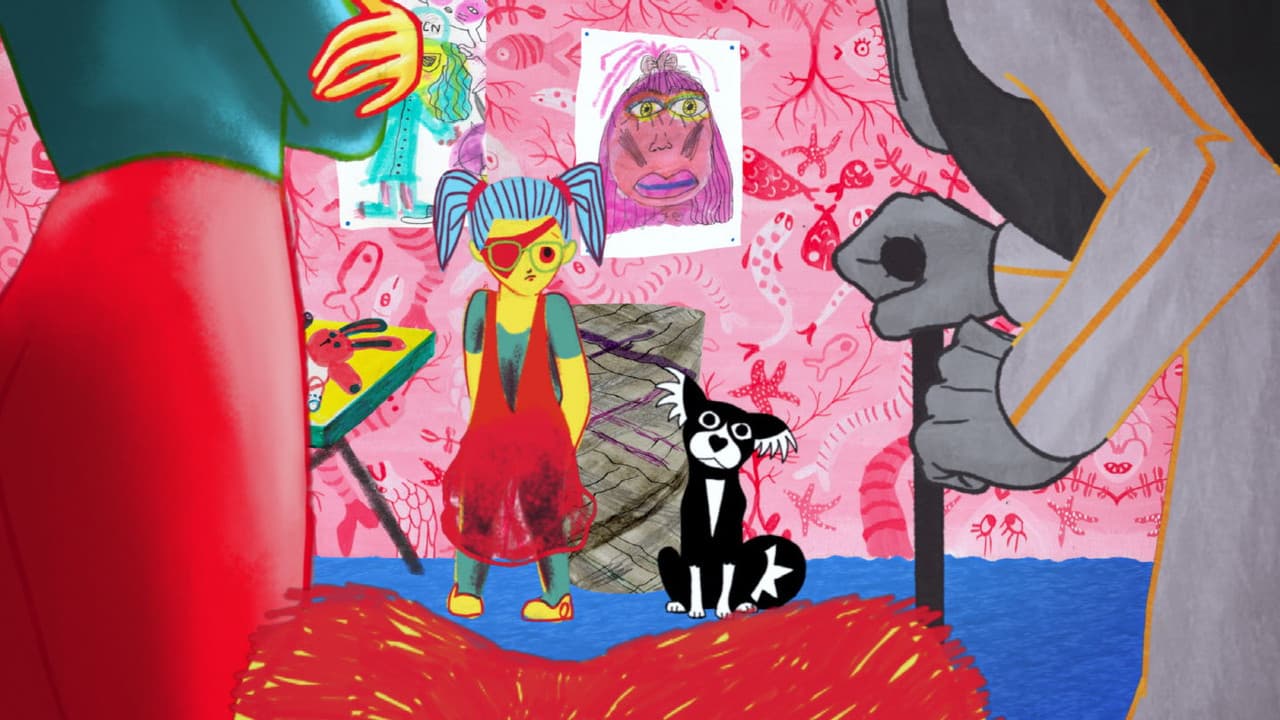
The film distinguishes itself through a singular and generous artistic direction, in which each sequence adopts a visual style particular to the master whom Marona accompanies at that moment in her life. This coherence between form and content is rare and gives the film genuine narrative intelligence. The choice of an animal point of view allows complex human subjects, abandonment, loneliness, death, to be addressed with a distance that makes them accessible without softening them. The film also offers an honest reflection on responsibility towards domestic animals, without ever falling into easy sentimentality. It is a work that respects the intelligence of its viewer, regardless of age.
Age recommendation and discussion points
The film is not recommended before the age of 10, and is fully suitable from 12 years old for serene viewing. For children between 10 and 12 years old, it is preferable to accompany them and anticipate a strong emotional reaction. After viewing, two angles of discussion naturally present themselves: asking the child whether Marona's unconditional love seems admirable or unjust, and why, and why certain adults in the film failed to care for her, which opens a concrete conversation about responsibility towards animals and what it means to commit oneself to someone vulnerable.
Synopsis
Marona, an innocent and empathetic little female dog, remembers the life she has shared with different masters, whom she has loved unconditionally.
About this title
- Format
- Feature film
- Year
- 2020
- Runtime
- 1h 32m
- Countries
- Belgium, France, Romania
- Original language
- FR
- Directed by
- Anca Damian
- Main cast
- Lizzie Brocheré, Bruno Salomone, Thierry Hancisse, Nathalie Boutefeu, Shirelle Mai-Yvart, Maïra Schmitt, Georges Claisse, Annie Mercier, Isabelle Vitari, Philippe Sax
- Studios
- Aparte Film, Minds Meet, Sacrebleu Productions
Content barometer
- Violence2/5Moderate
- Fear3/5Notable tension
- Sexuality1/5Allusions
- Language0/5None
- Narrative complexity3/5Complex
- Adult themes2/5Present
Values conveyed
- Acceptance of difference
- Compassion
- Loyalty
- Autonomy
- Forgiveness
- empathy
- love
- resilience