
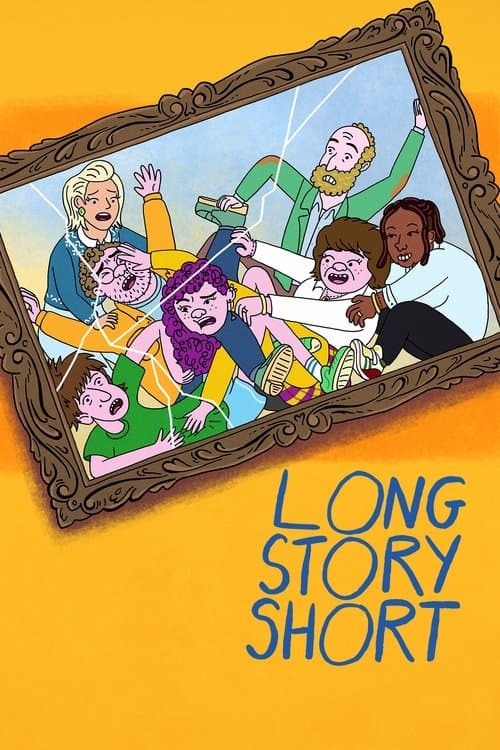
Long Story Short
Does this age rating seem accurate to you?
Detailed parental analysis
Long Story Short is a warm and melancholic family dramedy driven by New York Jewish humour and genuine emotional sensitivity. The series follows an American Jewish family gathering for a bar mitzvah, navigating generational tensions, recent bereavements and deep disagreements about identity and faith. The intended audience is clearly adult, with possible openness to teenagers from a certain age onwards.
Social Themes
The death of matriarch Naomi from Covid-19 in 2020 forms the emotional pivot of the series. The funeral conducted via video conference embodies a reality many families experienced, and the treatment is both realistic and painful. The Holocaust is evoked several times as a backdrop for identity and memory, without dialogue delving into the details of historical events. These two subjects, the collective grief linked to the pandemic and the memory of the Holocaust, give the narrative a thematic density that far exceeds the register of family comedy.
Underlying Values
The series places family solidarity, forgiveness and tolerance at the heart of its purpose. The characters are deliberately flawed: they hurt one another, make mistakes, then seek to repair the damage. Jewish faith and religious practice are not presented as a monolithic block but as a terrain of negotiation between generations, between believers and sceptics, between tradition and modernity. This nuanced treatment of religion is one of the narrative's structural strengths and offers material for genuine discussion.
Parental and Family Portrayals
The maternal figure, absent through death, structures the entire family dynamic. Her absence reveals how much she was the glue holding the group together, and each character responds differently to this void. Parent-child and in-law relationships are treated with an honesty that avoids both idealisation and caricature. The series shows adults who struggle to communicate but who make sincere efforts, making it a useful mirror for families watching together.
Sex and Nudity
Sexual references are present but never explicit. The question of medically assisted reproduction for a female couple gives rise to several exchanges about sperm and fertility, treated in a comic register but repeated. One character naively asks whether helping the couple conceive involves sexual intercourse. These elements are contextualised and not gratuitous, but their frequency makes them worth flagging for parents of younger children.
Substances
Alcohol is consumed at family gatherings in a normalised way and without narrative warning. One character smokes a joint, again without this being presented as problematic. These elements are anecdotal in the economy of the narrative but present.
Language
The language is moderately crude, with a few mild expletives and familiar turns of phrase. Nothing aggressive or systematic, but the register is clearly that of adults speaking amongst themselves without self-censorship.
Violence
Violence is limited to a comic scuffle between family members at the bar mitzvah. It is played for laughs and without any dramatic consequence. This is not a cause for concern.
Strengths
The series succeeds in holding comedy and grief together without one overwhelming the other, which is a difficult writing exercise. The grounding in American Jewish culture is precise and vivid, far from surface folklore: the tensions between religious practice, cultural identity and contemporary life are rendered with an authenticity that gives the narrative real substance. The treatment of grief linked to the pandemic rings true, particularly for viewers who experienced distant funerals. The series also offers an honest portrayal of a female couple confronted with the desire for a child, integrated into the narrative without making it a manifesto.
Age recommendation and discussion points
The series is not recommended before age 13 due to emotional density, repeated references to fertility and the treatment of grief linked to Covid-19. From age 14 onwards, it can be watched with an adult and offers excellent starting points for discussing what it means to belong to a family and a culture, how one grieves a loved one, and how faith or religious identity can be experienced differently within the same family.
Synopsis
From the creator of "BoJack Horseman" comes this animated comedy about a family over time, following siblings from childhood to adulthood and back again.
Where to watch
Availability checked on Apr 03, 2026
About this title
- Format
- TV series
- Year
- 2025
- Runtime
- 26m
- Countries
- United States of America
- Original language
- EN
- Directed by
- Raphael Bob-Waksberg
- Main cast
- Lisa Edelstein, Paul Reiser, Ben Feldman, Abbi Jacobson, Max Greenfield, Angelique Cabral, Nicole Byer
- Studios
- The Tornante Company, ShadowMachine, Vegan Blintzes
Content barometer
- Violence1/5Mild
- Fear2/5A few scenes
- Sexuality2/5Mild
- Language2/5Moderate
- Narrative complexity1/5Accessible
- Adult themes2/5Present
Values conveyed
- Acceptance of difference
- Forgiveness
- family bonds
- memory and legacy
- acceptance of the passage of time
- resilience