
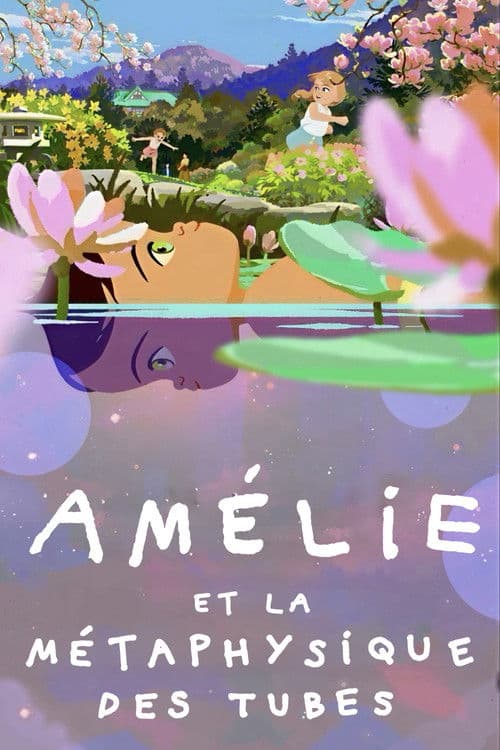
Little Amélie or the Character of Rain
Amélie et la métaphysique des tubes
Does this age rating seem accurate to you?
Detailed parental analysis
Amélie and the Metaphysics of Tubes is a contemplative and intimate film, tinged with a gentle and luminous melancholy, adapted from Amélie Nothomb's autobiographical novel. The story follows a young girl growing up in Japan and discovering the world through the lens of her earliest emotional relationships, particularly with her Japanese nanny. The film is primarily aimed at children from a certain age and their parents, but its thematic depth also makes it valuable for adolescents drawn to philosophical fiction.
Underlying Values
The narrative is structured around the transition from egocentrism to empathy: young Amélie begins by seeing herself as the absolute centre of the world, then gradually learns to recognise the existence and value of the other. This path is not moralising but embodied in concrete and tender relationships. The film values intellectual curiosity and wonder as drivers of a fulfilling life, which makes it a rare account of a child's inner development. Unconditional love is portrayed here as something that is built over time and presence, without needing to be earned.
Parental and Family Portrayals
The primary attachment figure is not the biological mother but Nishio-san, the Japanese nanny, which places a foundational emotional bond outside the traditional family framework at the centre of the narrative. This narrative choice deserves to be discussed with a child: it raises delicately the question of who truly shapes us, and why certain presences matter more than others. Biological parents are neither caricatured nor absent, but the nanny-child relationship is explicitly the emotional core of the film.
Discrimination
The film introduces the character of Kashima-san as an embodiment of xenophobic trauma inherited from the Second World War, opposing her to the warm relationship between Amélie and Nishio-san. This contrast allows the film to represent hatred of the foreigner as a transmitted historical wound, without ever trivialising it. It is a useful entry point for discussing with a child or adolescent the rejection of the other and their origins, without the film being a history lesson.
Social Themes
Cultural uprooting is a discreet but constant thread: growing up in a foreign country, not fully belonging to the surrounding culture, and yet forging one's deepest attachments there. The film treats this subject with subtlety, without melodrama or artificial resolution. For a child who has experienced expatriation or family migration, the resonance can be very strong.
Strengths
The film draws particular strength from its faithfulness to childhood interiority: it restores with precision the distinctive logic of a young girl who makes sense of the world in her own way, never condescending to her nor romanticising her excessively. The relationship between Amélie and Nishio-san is written with a sobriety that makes it all the more moving, and the scenes of separation achieve genuine emotional intensity. The film raises philosophical questions about identity, transmission and loss without ever fixing them into answers, which makes it remarkably open material for family discussion.
Age recommendation and discussion points
The film is suitable from 7 or 8 years old for children accompanied by an adult, and fully accessible from 10 years old independently. After viewing, two angles are worth exploring with a child or adolescent: why does Nishio-san matter so much to Amélie when she is not her mother, and what does that say about the people who truly shape us? And regarding Kashima-san: where does fear or hatred of someone who comes from elsewhere come from, and can we inherit it without choosing to?
Synopsis
The world is a perplexing, peaceful mystery to Amélie until a miraculous encounter with chocolate ignites her wild sense of curiosity. As she develops a deep attachment to her family's housekeeper, Nishio-san, Amélie discovers the wonders of nature as well as the emotional truths hidden beneath the surface of her family's idyllic life as foreigners in post-war Japan.
About this title
- Format
- Feature film
- Year
- 2025
- Runtime
- 1h 17m
- Countries
- France
- Original language
- FR
- Directed by
- Maïlys Vallade, Liane-cho Han
- Main cast
- Loïse Charpentier, Victoria Grobois, Yumi Fujimori, Cathy Cerda, Marc Arnaud, Laëtitia Coryn, Haylee Issembourg, Isaac Schoumsky, François Raison, Emmylou Homs
- Studios
- Maybe Movies, 2 Minutes, France 3 Cinéma, Puffin Pictures, 22D Music, Ikki Films
Content barometer
- Violence1/5Mild
- Fear1/5Mild
- Sexuality0/5None
- Language0/5None
- Narrative complexity2/5Moderate
- Adult themes0/5None
Watch-outs
- Grief
- Death / grief
- Ethnic or racial stereotypes
Values conveyed
- Friendship
- Acceptance of difference
- Compassion
- Loyalty
- intergenerational friendship
- awakening to nature
- family bond
- curiosity
- life lessons
- grief and resilience
- otherness and culture