Funny Little Bunnies
Funny Little Bunnies
Your feedback improves this guide
Your feedback highlights guides that need a second look and keeps the rating trustworthy.
Does this age rating seem accurate to you?
Sign in to vote
What this film brings
Content barometer
Violence
0/5
None
Fear
0/5
None
Sexuality
0/5
None
Language
0/5
None
Narrative complexity
0/5
Simple
Adult themes
0/5
None
Expert review
This animated short takes place in a highly stylized Easter world, where anthropomorphic rabbits prepare treats, baskets, and decorated eggs in a light, magical atmosphere. Sensitive content is almost nonexistent, there is no real violence, no lasting threat, no rude language, and no adult material, only a few old fashioned visual gags and constant busy movement that might briefly surprise very young viewers. The intensity stays extremely low throughout, with the story relying more on music, motion, and whimsical craft activity than on conflict or fear. For parents, the main point to consider is the fast visual rhythm and the 1930s animation style, which can feel unusual or slightly overstimulating to children who are used to modern cartoons. Overall, this is a very accessible short for young children, especially with a parent present if the child is new to classic animation.
Synopsis
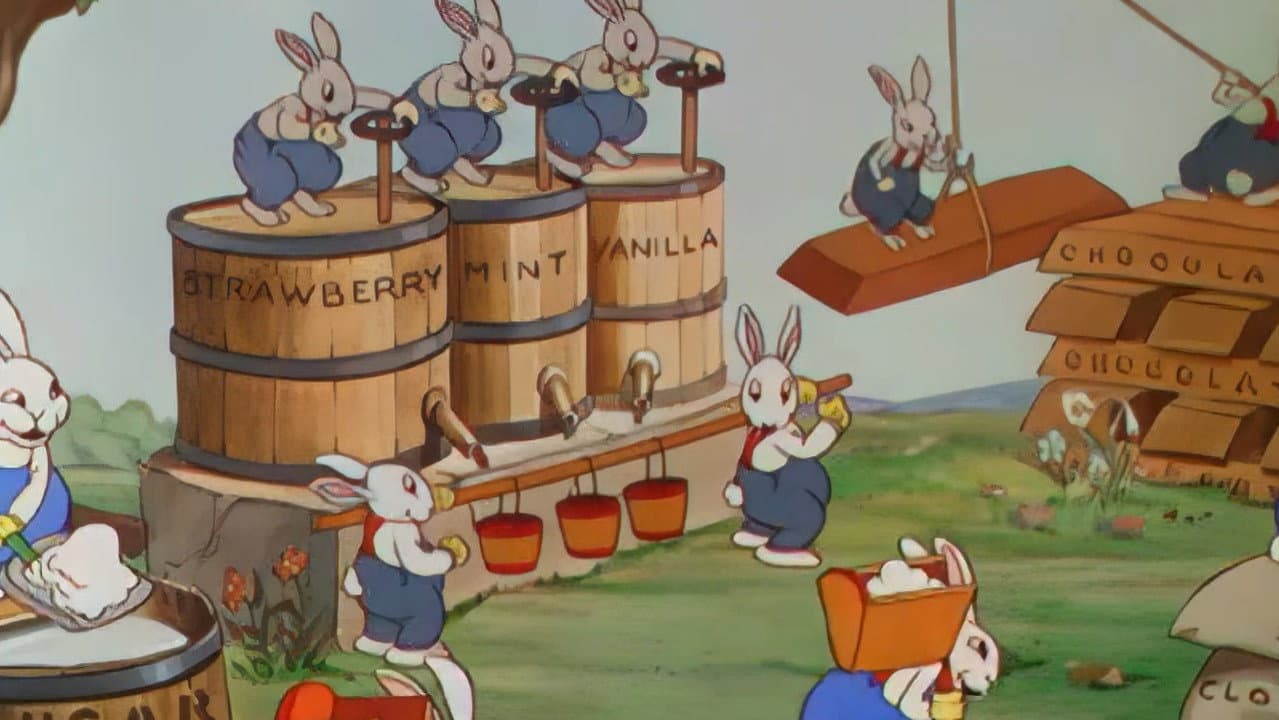
We see bunny rabbits preparing for Easter, by making chocolate eggs and rabbits, decorating eggs, and weaving and filling baskets.
Difficult scenes
Several sequences show very busy workshop activity, with many rabbits doing different Easter tasks at once around eggs, chocolate, and baskets. This is not frightening, but the dense visual motion may tire or distract a very young child who is sensitive to fast moving images. The enchanted setting and the anthropomorphic characters belong to a strongly whimsical style, with mechanical movements and an older visual design that may feel a little unusual to some children. The most likely reaction is not fear, but surprise or mild unease if the child is not used to classic animated shorts.
Where to watch
No verified platform for the US market yet. We keep this section updated as availability changes.
Availability checked on Apr 01, 2026
About this title
- Format
- Short film
- Year
- 1934
- Runtime
- 7m
- Countries
- United States of America
- Original language
- EN
- Studios
- Walt Disney Productions
Content barometer
Violence
0/5
None
Fear
0/5
None
Sexuality
0/5
None
Language
0/5
None
Narrative complexity
0/5
Simple
Adult themes
0/5
None
Expert review
This animated short takes place in a highly stylized Easter world, where anthropomorphic rabbits prepare treats, baskets, and decorated eggs in a light, magical atmosphere. Sensitive content is almost nonexistent, there is no real violence, no lasting threat, no rude language, and no adult material, only a few old fashioned visual gags and constant busy movement that might briefly surprise very young viewers. The intensity stays extremely low throughout, with the story relying more on music, motion, and whimsical craft activity than on conflict or fear. For parents, the main point to consider is the fast visual rhythm and the 1930s animation style, which can feel unusual or slightly overstimulating to children who are used to modern cartoons. Overall, this is a very accessible short for young children, especially with a parent present if the child is new to classic animation.
Synopsis
We see bunny rabbits preparing for Easter, by making chocolate eggs and rabbits, decorating eggs, and weaving and filling baskets.
Difficult scenes
Several sequences show very busy workshop activity, with many rabbits doing different Easter tasks at once around eggs, chocolate, and baskets. This is not frightening, but the dense visual motion may tire or distract a very young child who is sensitive to fast moving images. The enchanted setting and the anthropomorphic characters belong to a strongly whimsical style, with mechanical movements and an older visual design that may feel a little unusual to some children. The most likely reaction is not fear, but surprise or mild unease if the child is not used to classic animated shorts.