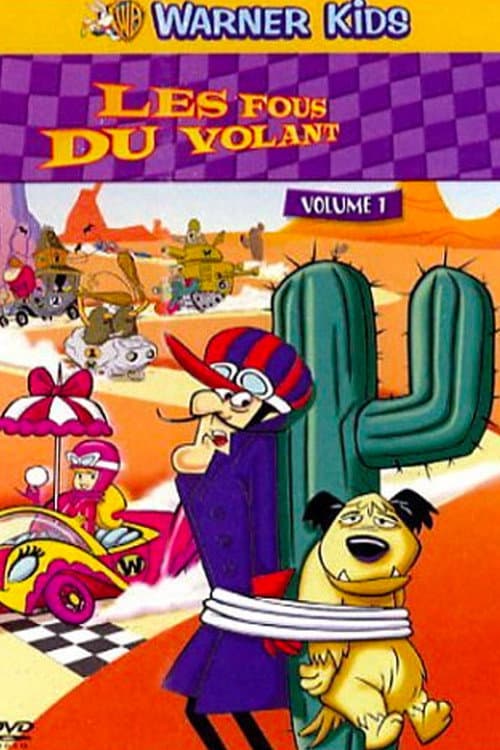
Les Fous du volant Vol.1
Does this age rating seem accurate to you?
Detailed parental analysis
Wacky Races is a zany and colourful animated comedy, directly adapted from the 1960s television series, with a festive atmosphere and exuberant cartoon humour. The plot follows a chaotic car race in which colourful crews compete through tricks and sabotage to cross the finish line first. The film is aimed primarily at young children and families, but parents would do well to know a few angles to address after viewing.
Violence
Cheating is the film's normal operating principle: almost all competitors sabotage, trap or deceive their opponents, and some dishonest ones actually win races. The narrative offers no unified moral on the subject: if the recurring arch-villains, Satanas and Diabolo, always end up falling prey to their own schemes, other cheaters get away without consequence. Competition is valorised as pure spectacle, regardless of any fair play. This is the most useful point to discuss with a child, since the film does not spontaneously offer him the tools to distinguish amusing trickery from genuinely problematic behaviour.
Underlying Values
Penelope is the only woman in the race and her treatment is characteristic of the 1960s: she is portrayed as solely concerned with her appearance, her hair, her lipstick and her hairspray, even in the most perilous situations. This gender stereotype is not questioned by the narrative, it is used as a recurring comic device. The character of Al Carbone, armed bandit with stolen money, is a comic-book gangster caricature, without depth or particular ethnic problematic. The female stereotype is the only one worth flagging and discussing with a girl, or with a child regardless of gender.
Discrimination
Penelope is the only woman in the race and her treatment is characteristic of the 1960s: she is portrayed as solely concerned with her appearance, her hair, her lipstick and her hairspray, even in the most perilous situations. This gender stereotype is not questioned by the narrative, it is used as a recurring comic device. The character of Al Carbone, armed bandit with stolen money, is a comic-book gangster caricature, without depth or particular ethnic problematic. The female stereotype is the only one worth flagging and discussing with a girl, or with a child regardless of gender.
Strengths
The film has the merit of its straightforwardness: it fully embraces the cartoon comedy register inherited from the great tradition of 1960s American animation, with a brisk pace and a gallery of memorable characters, each endowed with strong visual identity and its own logic. It is a solid object of cultural transmission for parents who grew up with the original series, and a gateway to period humour for the younger ones. The mechanics of the races offer a repetitive but effective structure that holds children's attention, and slapstick humour, despite its limitations, remains an exercise in image literacy accessible to a young audience.
Age recommendation and discussion points
The film is suitable from 5 or 6 years old with parental accompaniment, with a conversation to be had on two points: cheating, omnipresent without being clearly condemned, and the portrayal of Penelope, the only woman in the film, reduced to her concern for appearance. These two angles allow for a simple but concrete discussion about what we expect of characters in a story and how films from another era portrayed women differently from today.
About this title
- Format
- Feature film
- Year
- 2004
- Original language
- FR
Content barometer
- Violence2/5Moderate
- Fear1/5Mild
- Sexuality0/5None
- Language0/5None
- Narrative complexity0/5Simple
- Adult themes0/5None
Watch-outs
- Gender stereotypes
- Violence
Values conveyed
- Loyalty
- perseverance
- humor
- adventure
- fair play