Donald's Dilemma
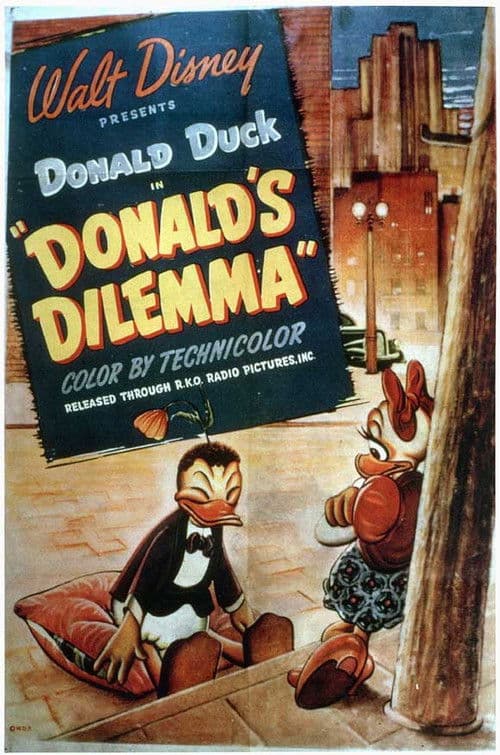
Donald's Dilemma
Your feedback improves this guide
Your feedback highlights guides that need a second look and keeps the rating trustworthy.
Does this age rating seem accurate to you?
Sign in to vote
Watch-outs
What this film brings
Content barometer
Violence
1/5
Mild
Fear
1/5
Mild
Sexuality
0/5
None
Language
0/5
None
Narrative complexity
0/5
Simple
Adult themes
0/5
None
Expert review
This classic Donald and Daisy cartoon has a mostly comedic and melodramatic tone, with highly stylized animation and almost no realism, so it remains broadly approachable for young viewers. The main sensitive elements are a head injury played for slapstick comedy, an emotional separation that leaves Daisy deeply distressed, and one more delicate scene in which her suicidal thoughts are represented visually with a gun and several other dangerous items placed in front of her. These images are brief and not realistic in presentation, yet the despair theme may still unsettle very young children because it is unusually strong for a short cartoon. Overall intensity is low to mild, with no sexual content, no profanity, and no substance use. For children around ages 4 to 6, watching together is wise so adults can calmly explain that the dangerous objects are not for play and that Daisy's extreme sadness is exaggerated in the style of older cartoons.
Synopsis
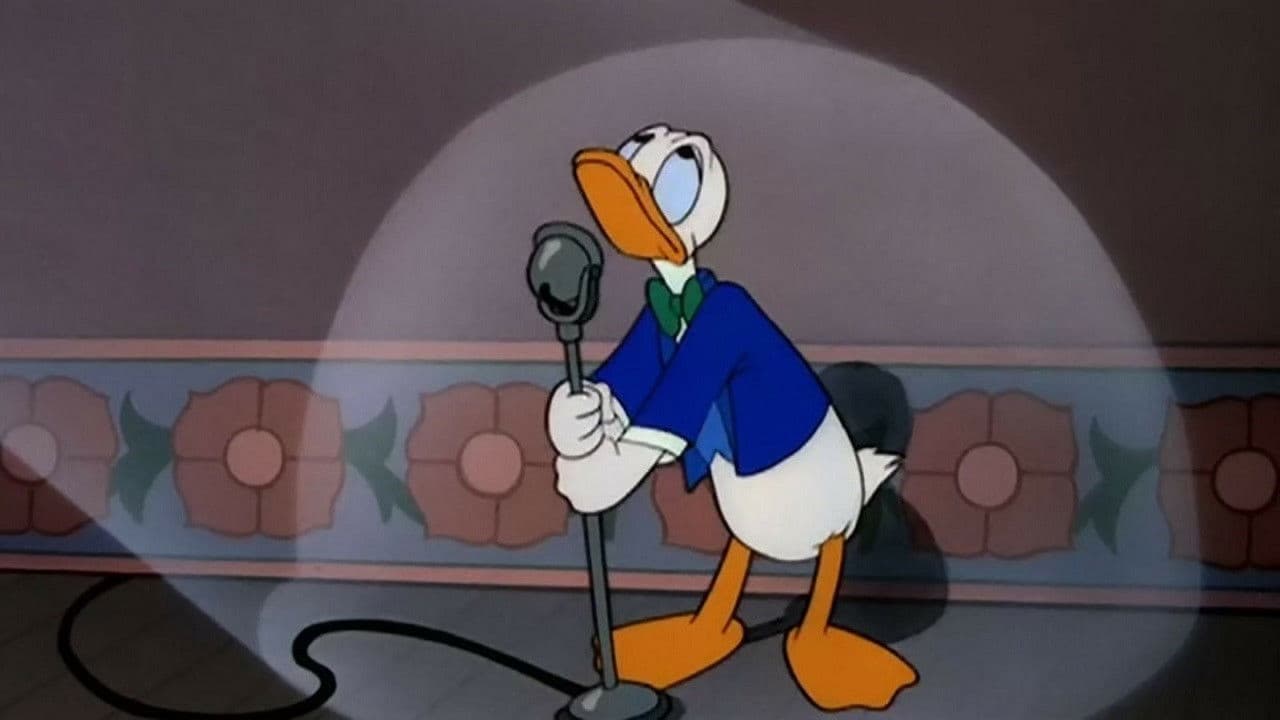
Donald and Daisy are walking when he is hit by a flowerpot. He's convinced he's a famous singer, and he croons divinely, but does not recognize Daisy. He in fact does become famous. Daisy is devastated by her inability to get over him and sees a psychiatrist. He tells her she has to choose between the world having Donald, or her getting him back. She picks herself, and drops another flowerpot, which restores him.
Difficult scenes
Early in the story, a flowerpot falls onto Donald's head. The scene is played in a slapstick cartoon style with no realistic injury, yet it is still the clearest physical impact in the short and could startle very young children who react strongly to sudden accidents. The main point parents may want to know about involves Daisy describing her distress to the psychologist. She is shown pointing a gun at her head, with other dangerous methods displayed on a table, including a noose, a grenade, a bomb, a knife, and poison, which is brief and stylized but still introduces suicidal imagery very directly. Part of the cartoon centers on Daisy's heartbreak after Donald changes and no longer recognizes her. She says she cannot eat or sleep, which gives the short an unusually sad emotional thread that some younger viewers may not fully understand, even though the overall presentation remains comic and exaggerated.
Where to watch
No verified platform for the US market yet. We keep this section updated as availability changes.
Availability checked on Apr 01, 2026
About this title
- Format
- Short film
- Year
- 1947
- Runtime
- 7m
- Countries
- United States of America
- Original language
- EN
- Directed by
- Jack King
- Main cast
- Clarence Nash, Gloria Blondell, George Magrill, Richard Conte, Ken Darby
- Studios
- Walt Disney Productions
Content barometer
Violence
1/5
Mild
Fear
1/5
Mild
Sexuality
0/5
None
Language
0/5
None
Narrative complexity
0/5
Simple
Adult themes
0/5
None
Expert review
This classic Donald and Daisy cartoon has a mostly comedic and melodramatic tone, with highly stylized animation and almost no realism, so it remains broadly approachable for young viewers. The main sensitive elements are a head injury played for slapstick comedy, an emotional separation that leaves Daisy deeply distressed, and one more delicate scene in which her suicidal thoughts are represented visually with a gun and several other dangerous items placed in front of her. These images are brief and not realistic in presentation, yet the despair theme may still unsettle very young children because it is unusually strong for a short cartoon. Overall intensity is low to mild, with no sexual content, no profanity, and no substance use. For children around ages 4 to 6, watching together is wise so adults can calmly explain that the dangerous objects are not for play and that Daisy's extreme sadness is exaggerated in the style of older cartoons.
Synopsis
Donald and Daisy are walking when he is hit by a flowerpot. He's convinced he's a famous singer, and he croons divinely, but does not recognize Daisy. He in fact does become famous. Daisy is devastated by her inability to get over him and sees a psychiatrist. He tells her she has to choose between the world having Donald, or her getting him back. She picks herself, and drops another flowerpot, which restores him.
Difficult scenes
Early in the story, a flowerpot falls onto Donald's head. The scene is played in a slapstick cartoon style with no realistic injury, yet it is still the clearest physical impact in the short and could startle very young children who react strongly to sudden accidents. The main point parents may want to know about involves Daisy describing her distress to the psychologist. She is shown pointing a gun at her head, with other dangerous methods displayed on a table, including a noose, a grenade, a bomb, a knife, and poison, which is brief and stylized but still introduces suicidal imagery very directly. Part of the cartoon centers on Daisy's heartbreak after Donald changes and no longer recognizes her. She says she cannot eat or sleep, which gives the short an unusually sad emotional thread that some younger viewers may not fully understand, even though the overall presentation remains comic and exaggerated.